
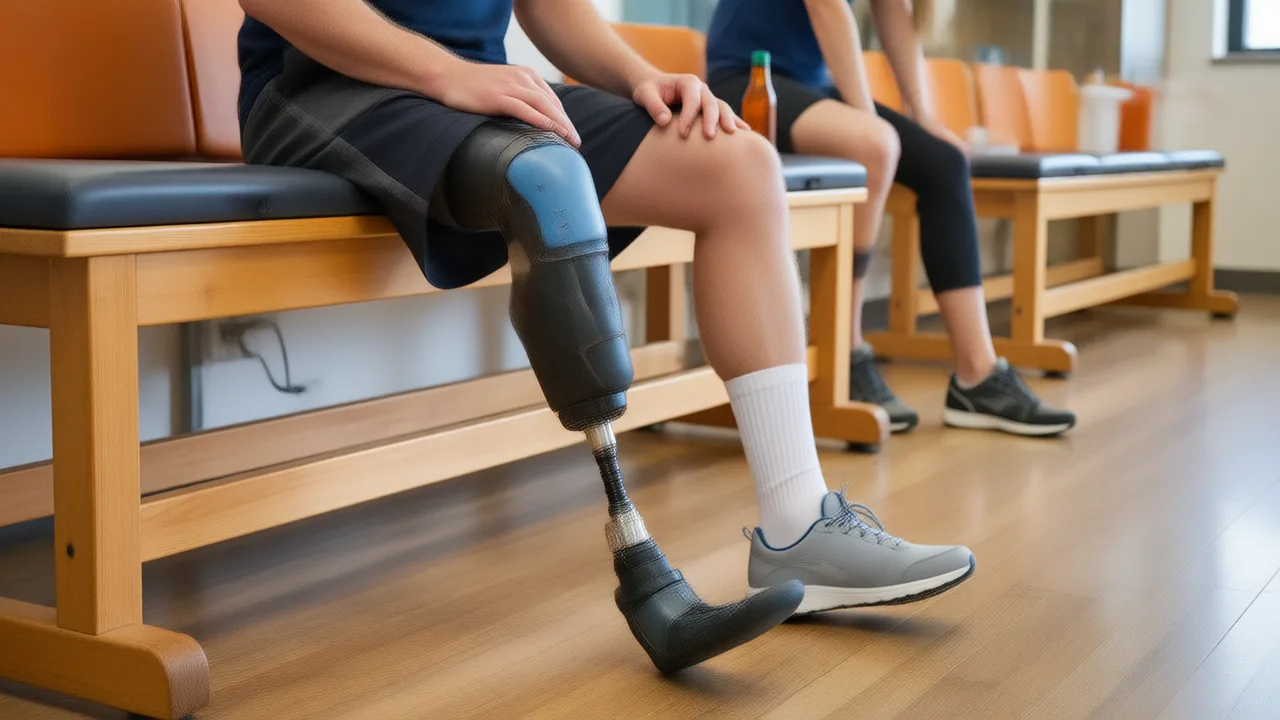
Short answer: A suction socket prosthesis stays on by keeping air out. Your limb, or a sealing liner or sleeve, fits the socket closely; a one-way expulsion valve lets air escape as you step in; and the slight negative pressure left inside holds the leg on without a pin or strap. It works best with a close fit and a stable limb volume, and sweat and shrinking are its usual problems.
This guide is for people whose prosthetist has suggested suction suspension, and for people already wearing a suction prosthetic leg who want to understand why it behaves the way it does. It covers how suction works, the common setups, what the valve does, who it suits, and how to handle sweat and volume changes.
Suspension is one piece of a bigger picture. For how a socket should feel overall, and what to do when it doesn’t, start with our guide to getting a good socket fit.
How suction suspension holds the leg on
Think of a suction cup on a window. Push it on and the air squeezes out; try to pull it off and the air can’t get back in fast enough, so it holds. A suction socket uses the same idea.
- You put on the socket and push down. Air trapped between your limb and the socket escapes through a valve.
- The valve closes, so air can’t flow back in.
- When you lift the leg to take a step, the prosthesis tries to drop away from your limb. With no air to fill the gap, the negative pressure inside holds it on.
The whole system depends on a seal. If air gets in anywhere, around the top of the socket, through a torn liner or a leaky valve, the hold weakens. That’s why suction rewards precision and punishes small leaks.
Suction is one of several ways to hold a prosthetic leg on, alongside pin-locking liners, sleeves, straps and vacuum pumps. None of them is the right answer for everyone: a systematic review of below-knee suspension systems found no clinical evidence that any one system should be the standard for all below-knee amputees.
Three common suction setups
“Suction” covers a few different designs. Your prosthetist will choose based on your limb, skin and goals.
| Setup | How the seal is made | Worth knowing |
|---|---|---|
| Sealing liner | A liner with one or more sealing rings that press against the socket wall | Ottobock describes its sealing liners as using a sealing ring to create an air-tight vacuum connection against the socket |
| Liner plus suction sleeve | A cushion liner inside, and a sleeve rolled over the top of the socket and onto the thigh | Ottobock notes cushion liners are often paired with a suction sleeve; the sleeve must stay intact to hold the seal |
| Skin-fit suction | The skin itself seals against the socket, with no liner | A traditional approach, used mostly at above-knee level; it asks a lot of the skin and of limb stability |
Anything worn over a sleeve or across the socket’s top edge can affect the seal. That includes clothing and decorative covers: a Loud Limb cover, for example, goes on the outside of a below-knee prosthesis, over everything else, and never under a suspension sleeve.

The expulsion valve: a one-way door
The valve is the small part doing a big job. It lets air out as you put weight on the leg and stops it coming back in. Some valves let air out automatically with each step; others have a button you press to release the seal when you take the leg off.
Valves collect lint, sweat and skin oils, so a sticky or leaky valve is worth ruling out when suction gets weak. Our guide to the expulsion valve on a prosthesis covers the types and how to keep one clean.
Suction is often confused with elevated vacuum. A suction socket relies on the air you push out when you step in. A vacuum system adds a pump, mechanical or electric, that keeps drawing air out as you move. The difference matters for fit and volume, and our guide to vacuum suspension (coming soon) explains it.
Who a suction socket fits well
Suction tends to work best when a few things line up. Your prosthetist is the one to judge them, but it helps to know what they’re looking at:
- A stable limb. Suction needs a close fit, so it suits a limb that has mostly finished shrinking after surgery better than one still changing week to week.
- Enough length and a good shape. More limb in the socket gives more surface to seal and hold. A very short limb brings its own challenges, which we cover in prostheses for a short residual limb.
- Healthy, intact skin where the liner, sleeve or socket seals.
- Hand strength to put it on. The same systematic review notes that putting on and taking off soft liners is hard for some users, especially those with upper-limb weakness. Tell your prosthetist if your hands or grip are a problem.
Suction isn’t only for legs. Some arm prostheses use it too; see our guide to the below-elbow prosthesis (coming soon) for how suspension works there.
Sweat, heat and a suction prosthetic leg
A sealed socket is warm, and sweat has nowhere to go. A literature review on heat inside prostheses found that more than 53% of people with amputation in the reviewed studies had heat or sweating discomfort inside their prosthesis. The suspension review names sweat control as a major concern with suspension liners.
For suction, sweat is doubly annoying: it’s uncomfortable, and a layer of moisture can let the limb slide and break the seal. What helps:
- Start each day with a clean, completely dry limb and a clean liner, following your liner’s own care instructions.
- On hot or active days, plan a break: take the leg off, dry the limb and liner, and put it back on.
- Ask your prosthetist about liner materials and whether a different setup would suit your climate or job.
- Ask your doctor before using any antiperspirant or product on the limb, and ask your prosthetist whether it’s compatible with your liner.
Volume changes: the main enemy of suction
Your limb doesn’t stay the same size all day. WillowWood’s liner instructions say it is completely normal for limb volume to change during the day, and that when the limb shrinks, the socket can slip and the limb can move inside it. For suction, a shrinking limb means a looser fit and a weaker seal.
The warning sign is pistoning: the leg moving up and down on your limb as you walk. The VA/DoD residual limb management tool lists insufficient suspension and a socket that’s too loose among its causes. Other clues include a squeak or hiss of air, or the leg feeling heavier than usual.
How you manage volume depends on your exact setup. With some suction designs, adding a sock in the wrong place can break the seal, so ask your prosthetist exactly where, and whether, socks go in your system. Our guide to socks versus liners explains what each layer does, and what to do when a prosthesis keeps losing suction walks through the troubleshooting.
When to call your prosthetist or doctor
Call your prosthetist if the leg keeps losing suction even when your limb and liner are dry, the valve sticks or hisses, a liner or sleeve tears, you notice pistoning, or the socket feels loose or tight in a way that doesn’t settle. Suction problems are usually fit problems, and fixing fit is the prosthetist’s job.
Stop wearing the leg and call your doctor if you see a blister, an open sore, a dark or blood-filled spot, redness that spreads or doesn’t fade, warmth or drainage, or you have a fever, new severe pain or numbness. A seal that pulls on damaged skin makes it worse with every step.
A daily routine for a good seal
- Wash and fully dry your limb; clean your liner the way its maker says.
- Roll the liner on rather than pulling it up. The VA/DoD tool warns that pulling liners and sleeves up can cause shear on the skin.
- Check the valve is clean and the sleeve or seal has no nicks.
- Step in firmly and listen for the air to leave.
- Check your skin when the leg comes off at night, and note anything new for your next visit.
Sources
- Clinical Biomechanics — Transtibial prosthesis suspension systems: systematic review of literature
- Ottobock — All about Ottobock liners for prosthetic leg users
- Journal of Rehabilitation Research and Development — Prevalence of heat and perspiration discomfort inside prostheses: literature review
- WillowWood — Patient Instructions: Alpha Liners
- VA/DoD Lower Limb Amputation CPG clinical support tool — Residual Limb Management
From the Loud Limb shop: funny amputee shirts & hoodies and prosthetic leg covers in loud prints. Our covers go on the outside of a below-knee prosthesis; measure yours first with the size guide.
Published by Loud Limb. This guide is general information drawn from the sources listed above, not medical advice. Loud Limb sells printed prosthetic leg covers and clothing and is not a clinic: ask your doctor, surgeon or prosthetist about your own care.
Leave a Reply