
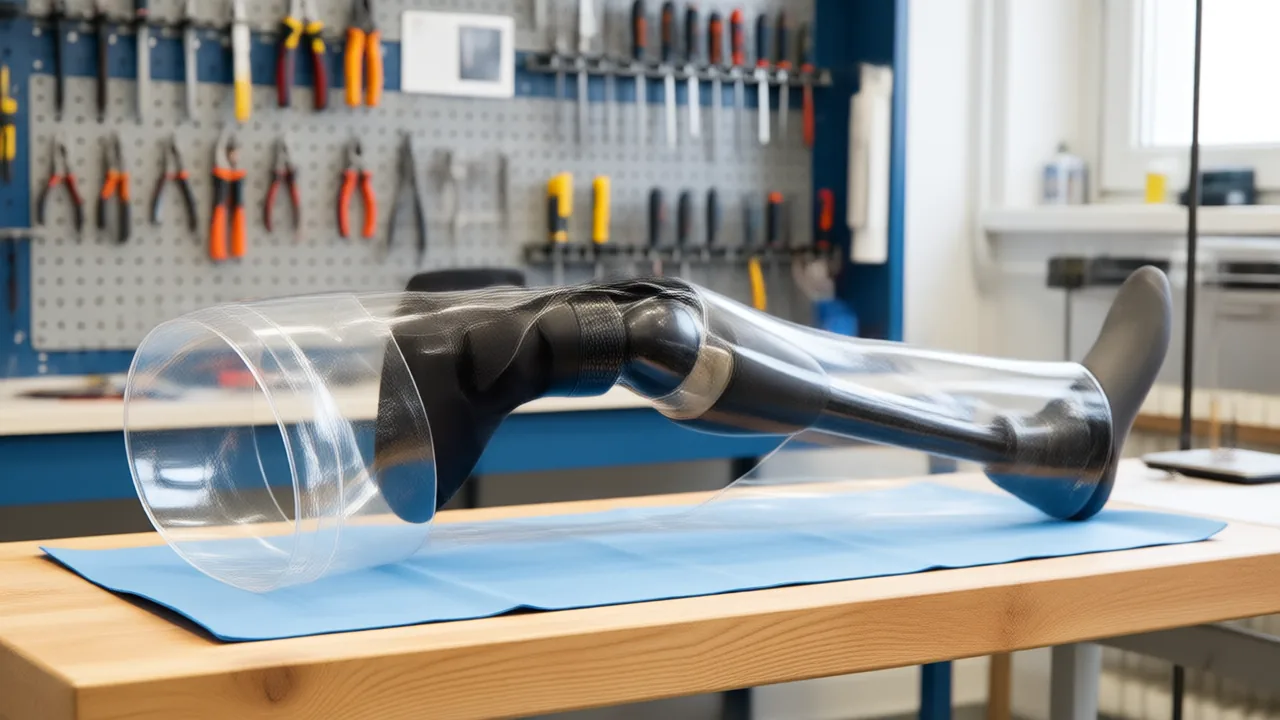
Short answer: A flexible inner socket is a two-part prosthetic socket: a thin, bendable plastic shell that holds your residual limb, set inside a rigid outer frame that carries your weight and connects to the rest of the leg. The flexible walls can give a little when your muscles tighten and when you sit, which many people find more comfortable. The trade-off is more parts to check and maintain.
This is for anyone whose prosthetist has mentioned a “flexible socket” or a “frame socket,” or who is wondering why their new socket has windows cut into the outside. You’ll see the design most often in above-knee sockets, though it’s used below the knee too. For the bigger picture on how any socket should feel, start with our guide to getting a good socket fit.
What a flexible inner socket is, and what the frame does
The socket connects the prosthesis to your residual limb, usually with a liner or sock in between, as Cleveland Clinic explains. It’s also the one part built only for you: a review of lower-limb prosthetic rehabilitation published in 2019 in the Indian Journal of Plastic Surgery calls the socket the customized part of the prosthesis and crucial to how the whole leg performs.
A traditional socket is one rigid shell. A flexible inner socket splits that job in two:
- The inner socket is a thin shell of flexible plastic, shaped from the cast or scan of your limb. It’s the surface your liner or sock touches.
- The outer frame is rigid and carries the load down to the knee or pylon. It usually has open windows, so some areas of the inner are held firmly and others are free to flex.
You may also hear it called a flexible socket prosthesis, a frame socket, or by an older name, the ISNY socket. The frame does the holding up; the inner does the hugging.
Why a prosthetist might suggest a flexible socket prosthesis
Your residual limb isn’t a solid block. Muscles bulge when they contract and soft tissue shifts when you sit down. A rigid shell can’t change shape with any of that. A flexible inner can, a little, wherever the frame leaves it free. The reasons prosthetists commonly give:
- Room for working muscles. Where the frame is cut away, the inner wall can give as your thigh or calf muscles tighten during a step.
- A softer edge. A flexible rim can be more forgiving than a hard trim line, which matters most at the groin or the back of the knee.
- Room to adjust. In many designs the inner can be reshaped in spots, or remade, without replacing the frame. Ask whether yours can.
Treat that list as the reasoning behind the design, not a promise. How much it helps varies from person to person, and the only test that counts is how the socket feels on your limb at the end of a normal day.
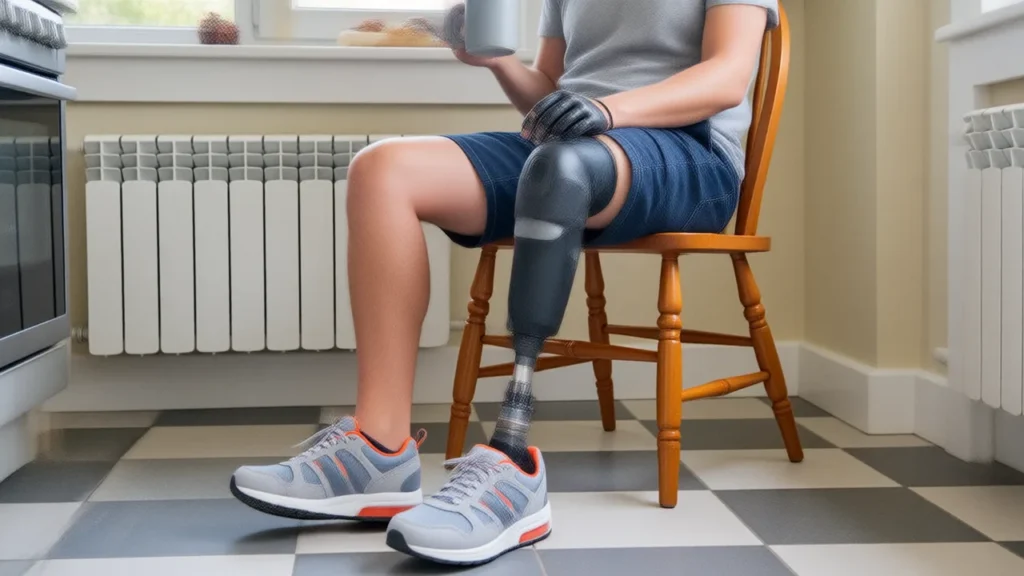
Sitting in a flexible inner socket
Sitting is where many people notice the difference, especially above the knee. A thigh socket has to reach high enough to keep you stable when you stand, so its upper edge sits close to the sitting bone and the groin. When you sit, that edge can press into the chair and into you. A flexible brim can bend with the seat instead of digging in.
How high that edge goes depends on the socket’s shape more than its material. An ischial containment design (coming soon) wraps around the sitting bone for stability, so a flexible brim does a lot of the comfort work there. A subischial socket (coming soon) keeps the trim line below the sitting bone altogether. Your prosthetist weighs stability against sitting comfort when choosing between them.
Below the knee, the pressure point when sitting is usually the back wall of the socket, and its height matters more than its flexibility.
The trade-offs of a two-part socket
- More parts to wear out. A thin flexible shell can crack, split at the edge, or work loose from the frame. In many designs the inner can be replaced on its own, but it’s one more thing to inspect.
- It still traps heat. A flexible inner is still a closed plastic shell around your skin. In a 2014 literature review, more than 53% of people with amputation in the reviewed studies had heat or sweating discomfort inside their prosthesis. No socket design makes that disappear.
- Cleaning takes a little more care. Ask your prosthetist whether the inner comes out of the frame and which cleaners the plastic tolerates.
- It isn’t for every limb. Your prosthetist may have good reasons to recommend a one-piece socket instead.
Flexible inner socket vs. a one-piece rigid socket
| Flexible inner in a rigid frame | One-piece rigid socket | |
|---|---|---|
| What your liner touches | Thin flexible plastic | The hard socket wall |
| Where it gives | At the frame’s windows and the brim | Nowhere; the liner and any padding cushion |
| Typical adjustments | Reshape or replace the inner | Pad, reshape or remake the socket |
| Often chosen for | Comfort around working muscles and when sitting | Simplicity and fewer parts |
With a one-piece socket, small pressure fixes usually come from padding. Our guide to socket padding (coming soon) covers what it can and can’t solve.
Fit still comes down to volume and suspension
A flexible inner changes how the socket feels, not the basic rules of fit. Your limb changes shape and size during the day, and a 2014 study of below-knee prosthesis users describes how those changes affect socket fit, with socks added or removed to manage them. Our guide to socks versus liners explains how the layers work together. Two fit problems look the same in any socket:
- Too loose. Your limb moves up and down inside the socket with each step, called pistoning. The VA/DoD residual limb management guide lists insufficient suspension, a loose socket or a too-compliant locking liner as causes.
- Too tight. Pressure, throbbing or numbness, often worse late in the day. See our guide to a socket that feels too tight.
Don’t fix either one by trimming, heating or padding the inner yourself. Thin plastic deforms easily and is hard to put back.
When to call your prosthetist or doctor
Call your prosthetist, the person who built the socket, if:
- you see a crack, a split edge, or a gap opening between the inner and the frame;
- the brim digs in when you sit, or you’ve started avoiding sitting in the leg;
- you need noticeably more or fewer sock plies than usual to feel snug;
- you feel new clicking, squeaking or movement inside the socket.
Stop wearing the leg and call your doctor the same day if you have an open sore or blister, redness that spreads or doesn’t fade after the leg is off, fever, new severe pain, or numbness. Those are skin or circulation problems first and socket problems second. Once they’re treated, your prosthetist can fix whatever caused them.
Questions to bring to your next fitting
- Is this socket one piece, or a flexible inner in a frame, and why did you choose it?
- Which areas of the inner are meant to flex?
- Can the inner be adjusted or replaced on its own if the limb changes?
- How should it be cleaned, and what signs of wear should I watch for?
And if you want the outside to look as good as the inside feels, a printed cover for a below-knee leg goes over everything, frame included, and never inside the socket. Our guide to measuring a prosthetic leg shows how to size one.
Sources
- Cleveland Clinic — Prosthetic Leg: What It Is, Who Needs It & How It’s Used
- Indian Journal of Plastic Surgery (2019) via PubMed Central — Prosthetic Rehabilitation in the Lower Limb
- Journal of Rehabilitation Research and Development (2014) via PubMed — Prevalence of heat and perspiration discomfort inside prostheses: literature review
- Prosthetics and Orthotics International (2014) via PubMed — Self-reported prosthetic sock use among persons with transtibial amputation
- VA/DoD Lower Limb Amputation CPG clinical support tool (2025) — Residual Limb Management in Lower Limb Amputation
From the Loud Limb shop: funny amputee shirts & hoodies.
Published by Loud Limb. This guide is general information drawn from the sources listed above, not medical advice. Loud Limb sells printed prosthetic leg covers and clothing and is not a clinic: ask your doctor, surgeon or prosthetist about your own care.