
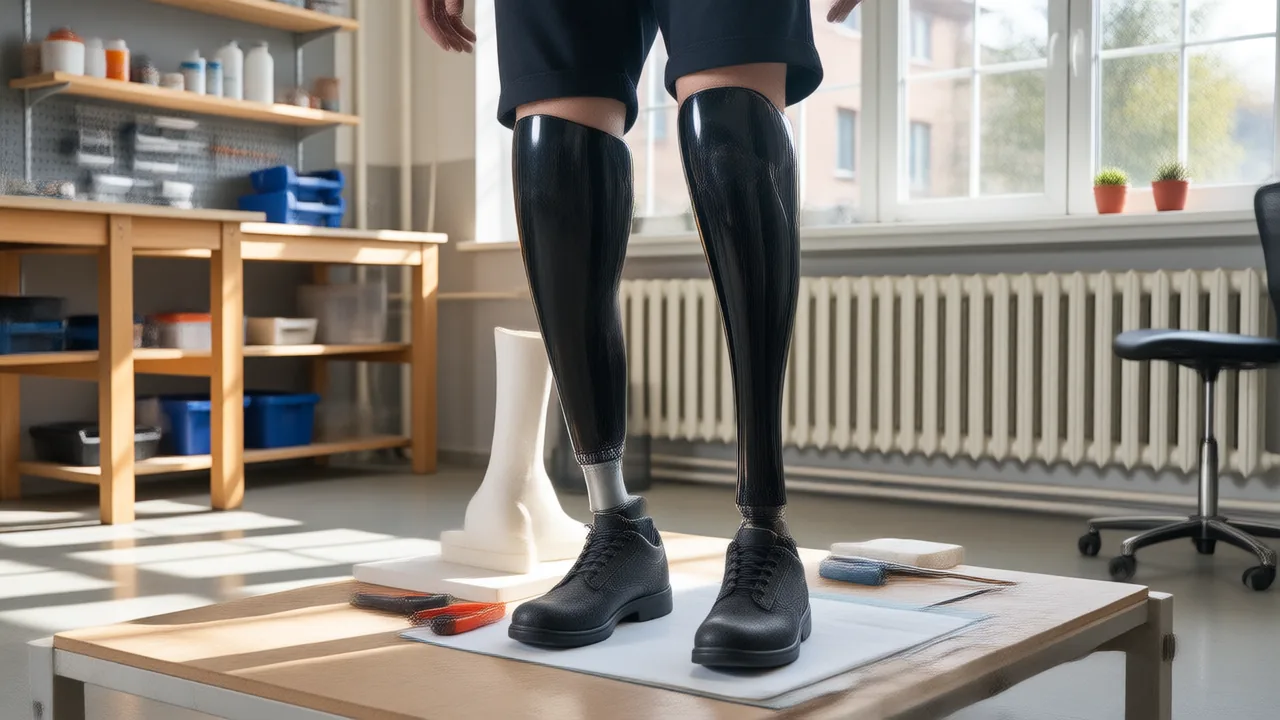
Short answer: The main prosthetic socket types are, for below-knee legs, patellar tendon bearing (PTB) and total surface bearing (TSB); for above-knee legs, quadrilateral, ischial containment and subischial; plus adjustable sockets at either level. They differ in where they put your weight, how high they reach, and how they cope with a limb that changes size. Your prosthetist picks one to fit your limb.
This guide is for anyone who has heard a socket name at the prosthetist’s office and nodded politely. It explains each design in plain words, who it tends to suit, and what to ask. If your socket already hurts or slips, start with our guide to prosthetic socket fit, which covers troubleshooting.
What a socket does, and why the shape matters
The socket is the part of the leg your residual limb sits in. It carries your body weight, transfers every movement of your limb to the rest of the leg, and has to do it without damaging skin that was never meant to be stood on. A review of lower limb prosthetic rehabilitation, published in 2019, describes the socket as the customized part of the prosthesis and crucial to how well it performs. The knee, pylon and foot come off a shelf; the socket is made for you.
Every socket design is an answer to the same question: which parts of this limb can take pressure, and which need to be spared? Some areas, like broad muscle or the tendon below the kneecap, tolerate load well. Others, like the cut end of a bone or a spot where a nerve sits close to the surface, do not. The names below are really different strategies for sharing out that load.
Two things are easy to mix up with socket type. The liner is the soft layer between skin and socket; our guide to the prosthetic gel liner (coming soon) covers materials and care. Suspension is whatever holds the leg on: a pin, suction, a vacuum pump, a sleeve or a strap. A socket shape can often be paired with more than one suspension method.
Below-knee socket types: PTB and TSB
Patellar tendon bearing (PTB)
The PTB socket is the older of the two main designs. It concentrates weight on the areas of a below-knee limb that handle pressure best, especially the patellar tendon just below the kneecap, and the socket is shaped to ease off over sensitive spots such as the end of the shinbone. It is often worn with socks or a soft insert rather than a gel liner, and held on with a strap, a sleeve, or wings that grip above the knee bones.
Tends to suit: long-time users who have done well in one for years, people who cannot tolerate a gel liner, and situations where a simple, easy-to-don leg matters most.
Total surface bearing (TSB)
A TSB socket aims to spread pressure over the whole surface of the limb instead of a few zones. It is almost always used with a gel liner, which fills the gaps and cushions the skin, and it pairs with pin-lock, suction or vacuum suspension. A 2014 systematic review of below-knee suspension found that most amputees in the studies it reviewed favored a TSB socket with a pin and lock, but also that no suspension system has the evidence to be called the standard for everyone. Our TSB socket guide (coming soon) goes deeper on how it is cast and fitted.
Tends to suit: many new below-knee amputees today, and people whose skin does better with even pressure than with concentrated load.
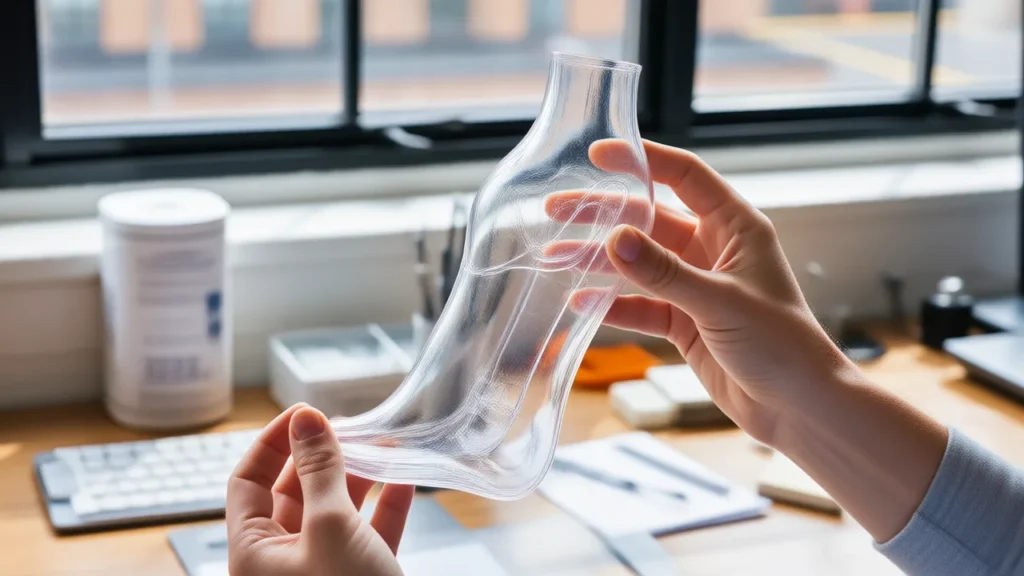
Above-knee socket types: quadrilateral, ischial containment and subischial
Above-knee sockets have a harder job. They carry your weight near the pelvis, keep the thigh bone in a useful position, and have to steer a prosthetic knee. Where the top of the socket sits relative to your ischial tuberosity (the sit bone) is the main difference between the designs.
Quadrilateral
Seen from above, the rim is roughly four-sided, and the sit bone rests on a shelf at the back, a bit like sitting on the edge of a chair. It is an older design, narrow from front to back. Some long-time users still prefer it, but many prosthetists now reach for ischial containment first because it tends to steady the leg side to side. Our quadrilateral socket guide (coming soon) covers its history and who still wears one.
Ischial containment (IC)
Instead of perching the sit bone on a shelf, an IC socket wraps around it and holds it inside the socket. That grip helps keep the thigh bone angled in naturally and makes the leg more stable when you stand on it. It is a common choice for above-knee sockets today.
Tends to suit: people who need side-to-side stability, including many with shorter residual limbs.
Subischial
A subischial socket stops below the sit bone, so you can sit and move your hip more freely. To hold on without that bony anchor, it depends on a close-fitting liner, snug compression of the thigh and usually vacuum or suction suspension. It is not right for every limb or every level of strength, and it takes a prosthetist experienced with the design.
Whatever the shape, the socket is how you control the knee. Our overview of prosthetic knee types (coming soon) explains what the knee adds on top.
Adjustable sockets for a limb that changes size
Residual limbs change volume through the day. In a 2014 study of people with below-knee amputations, sock ply rose over the day on average from 4.8 to 5.5, as limbs shrank and people added socks to keep the socket snug. For some people the swings are much bigger, and adding socks stops being enough.
Adjustable sockets tackle this with panels, straps or cables tightened by a dial, so you can change the fit while wearing the leg. Some are built for a new amputee’s early months, when the limb is shrinking fast; others are definitive legs for people whose volume swings every day. The trade-offs are more moving parts and a learning curve for how tight is right. Our guide to the adjustable prosthetic socket covers the designs and who does well with them.
Prosthetic socket types at a glance
| Socket type | Level | How it carries weight | Often suits |
|---|---|---|---|
| PTB | Below knee | Pressure-tolerant zones, especially below the kneecap | Long-time PTB users; people who do not tolerate gel liners |
| TSB | Below knee | Spread over the whole limb, with a gel liner | Many new below-knee users |
| Quadrilateral | Above knee | Sit bone on a shelf at the back rim | Some long-time users who prefer it |
| Ischial containment | Above knee | Wraps and holds the sit bone inside | People who need side-to-side stability |
| Subischial | Above knee | Stops below the sit bone; relies on snug fit and vacuum | Suitable limbs where sitting comfort and hip freedom matter |
| Adjustable | Either | Any of the above, with dial or strap adjustment | Limbs that change size a lot |
Treat the last column as a starting point for a conversation, not a prescription.
How your prosthetist chooses a socket
There is no best socket, only the best one for a particular limb. Your prosthetist will weigh:
- the length and shape of your limb, and how much soft tissue covers the bone
- scars, skin grafts, sensitive spots and past skin problems
- how much your volume changes during the day
- your hand strength and dexterity for putting the leg on
- your activity level, and what you want to do on the leg
- what you have worn before, and what you liked or hated about it
Most people try at least one clear test socket before the final one is made, so the prosthetist can see where the skin blanches and where it gaps. Speak up during those sessions. That is the easiest point to change anything.
For a small group of people, no socket works. The FDA’s summary for the OPRA bone-anchored implant describes it for above-knee amputation from trauma or cancer in people who have problems with, or cannot use, a socket prosthesis, including recurrent skin infections or ulcers, pain, a short residual limb and volume fluctuation. It is surgery, with its own risks, and a conversation for your surgeon and rehab doctor.
When to call your prosthetist or doctor
Call your prosthetist if the leg starts pumping up and down on your limb as you walk. The VA/DoD’s residual limb management guide lists insufficient suspension, a socket that is too loose, and a locking liner that is too soft among the causes of that pistoning. Call too if you need far more socks than usual, the rim digs in, or you get new clicks or rubbing. These are fixable, and usually faster than you expect.
Stop wearing the leg and call your doctor if you find an open sore, a blister, redness that does not fade, warmth, drainage, fever, new severe pain or numbness. Skin damage inside a socket gets worse with every step, and your doctor needs to see it before your prosthetist changes the fit.
Questions to bring to your next fitting
- What socket design is this, and why that one for this limb?
- What suspension are we pairing with it, and what are the alternatives?
- Where should I expect pressure, and where should there be none?
- How many sock plies should I start the day with, and when is it too many?
- Would an adjustable socket make sense if my volume keeps changing?
Our explainer on socks versus liners helps with question four. And if you want the outside of a below-knee leg to say something louder, our printed prosthetic covers go on over everything; the socket underneath stays exactly as your prosthetist built it.
Sources
- Indian Journal of Plastic Surgery (2019) — Prosthetic Rehabilitation in the Lower Limb
- Clinical Biomechanics (2014) — Transtibial prosthesis suspension systems: systematic review of literature
- Prosthetics and Orthotics International (2014) — Self-reported prosthetic sock use among persons with transtibial amputation
- U.S. FDA — OPRA (Osseoanchored Prostheses for the Rehabilitation of Amputees) Implant System, PMA P190009, approved 2020
- VA/DoD clinical support tool (2025) — Residual Limb Management in Lower Limb Amputation
From the Loud Limb shop: funny amputee shirts & hoodies.
Published by Loud Limb. This guide is general information drawn from the sources listed above, not medical advice. Loud Limb sells printed prosthetic leg covers and clothing and is not a clinic: ask your doctor, surgeon or prosthetist about your own care.