
Short answer: The best sleeping positions after amputation are on your back or on your side, with the residual limb lying straight and no pillow under it. If your care team agrees, add a few short sessions a day lying on your stomach. The point is to keep your hip and knee from tightening in a bent position, because a joint that won’t straighten makes walking with a prosthesis harder.
This is for anyone in the first months after a leg amputation, and for whoever shares the bed: the positions that protect your joints, what to do with pillows, phantom sensations after lights-out, and a plan for the night bathroom trip. It sits inside our bigger guide to everyday life with a prosthetic leg.
If anything here differs from what your surgeon or physical therapist told you, their instructions win. They know your limb.
Why your sleep position matters more than it used to
When a joint spends long stretches bent, the muscles and tissues around it can tighten until the joint loses range of motion. That loss is called a contracture, and the Amputee Coalition’s above-knee amputation guide names preventing contractures as a focus of rehab. Night is the longest stretch you spend in one position, so it matters.
Which joint needs watching depends on your level:
- Below-knee amputation: the knee. The Amputee Coalition’s below-knee guide says the most common contracture at this level is a knee that stays bent and can’t fully straighten.
- Above-knee amputation: the hip. The above-knee guide notes that hip contractures are a common problem at this level and can be painful.
Why it matters later: a prosthesis is built and aligned for a limb that can straighten. A knee or hip that stays bent fights the leg on every step.
The best sleeping positions after leg amputation
On your back
The easy default. Lie flat with the residual limb straight on the mattress and pointing forward, not rolled out to the side. A below-knee limb rests with the knee straight; an above-knee limb lies flat and level with your other leg. If your mattress sags in the middle, your hips sag with it, which is worth mentioning to your physical therapist.
On your stomach
This is the one people skip, and it’s the one that stretches. MedlinePlus discharge instructions for leg amputation say to lie on your stomach 3 or 4 times a day for about 20 minutes to stretch the hip muscle. You don’t have to sleep face down all night; one session can be your phone-scrolling time before bed. If lying on your stomach isn’t possible yet because of other injuries, your breathing or your incision, ask your physical therapist for an alternative.
On your side
Side sleeping is fine for most people, with one rule: keep the residual limb straight. The curled-up fetal position bends the hip and knee at once, exactly the combination to avoid. Whether you can lie on the amputated side in the early weeks depends on your incision and dressing, so ask your surgical team before you try it.
The same thinking applies all day, not only in bed. Our guide to positioning your residual limb through the day covers sitting, wheelchairs and the couch.
Pillows: what to prop and what to leave alone
MedlinePlus is blunt about it: do not place a pillow under your residual limb. It feels comfortable, and that’s the trap. Under a below-knee limb it bends the knee; under the thigh it bends the hip. Hours of that, night after night, is how a joint starts to tighten.
Generally fine:
- Under your head, as usual.
- Behind your back when you’re on your side, so you don’t roll forward into a curl.
- Between your legs for side-lying comfort, but ask your physical therapist first, especially with an above-knee amputation, where the angle of the thigh matters.
Skip:
- A rolled towel or cushion under the knee.
- Letting a below-knee limb hang off the edge of the bed, which leaves the knee bent.
- Raising the head of an adjustable bed high for the whole night, which keeps both hips bent.
If your surgeon asked you to raise the limb early on to manage swelling, follow that order and ask how to do it with the joint straight.
Recliners, chairs and the accidental couch nap
Recliners are where good intentions go to nap. Sleeping in one keeps the hip and knee bent for hours. If you’ve been sleeping in a chair because getting into bed is hard, treat that as a problem to solve, not a habit to keep: a physical or occupational therapist can help with bed height, a rail and a safer way in and out. The same goes for long days in a wheelchair; ask your physical therapist how often to change position.
Amputee sleep and phantom sensations at night
With the lights off and nothing else to pay attention to, phantom sensations can be hard to ignore. The Amputee Coalition’s phantom limb pain fact sheet describes it as burning, twisting, itching or pressure, and lists possible triggers including touch, smoking, changes in barometric pressure and exposure to cold.
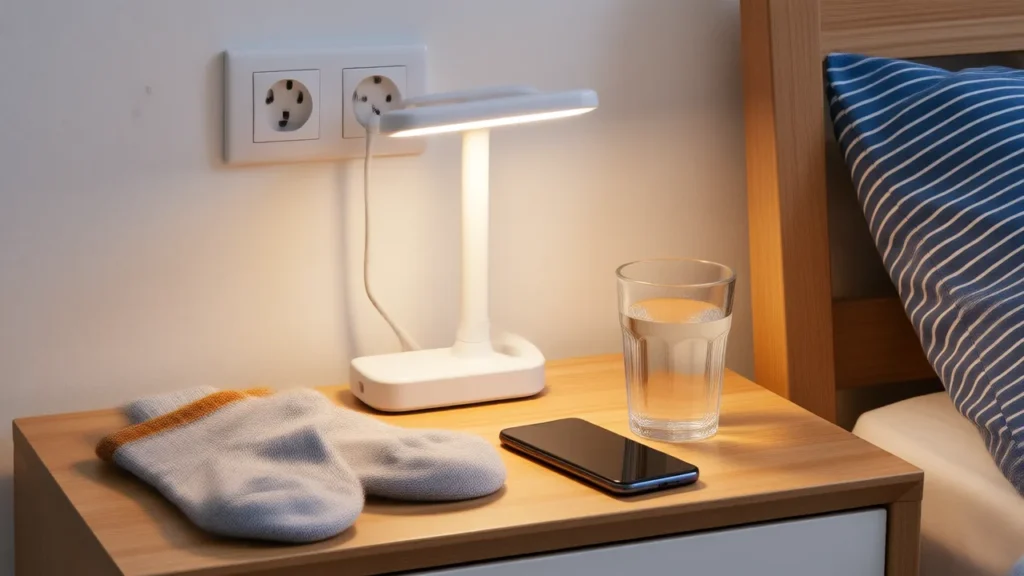
- Stay warm. Cold is on the trigger list, so a chilly bedroom isn’t helping. Warm layers and a pair of socks on your other foot are an easy start (ours are loud, but any warm pair counts).
- Write down the pattern. A long day on the leg, a cold night, a weather change: that list helps your doctor more than “it’s bad at night.”
- Treat pain as a reason for an appointment. The same fact sheet says combining medications from several categories with non-medication treatments seems to work best. If phantom pain is costing you sleep, tell your doctor rather than toughing it out.
For the daytime side of recovery, see our guides to staying healthy after amputation and weight changes after limb loss (coming soon).
A night bathroom plan that doesn’t involve hopping
The prosthesis usually comes off at night, so the bathroom trip happens on one leg, in the dark, half asleep. In a 2001 study of 435 community-living people with lower-limb amputation, 52.4% had fallen in the past year and 49.2% said they were afraid of falling.
Set it up before you need it:
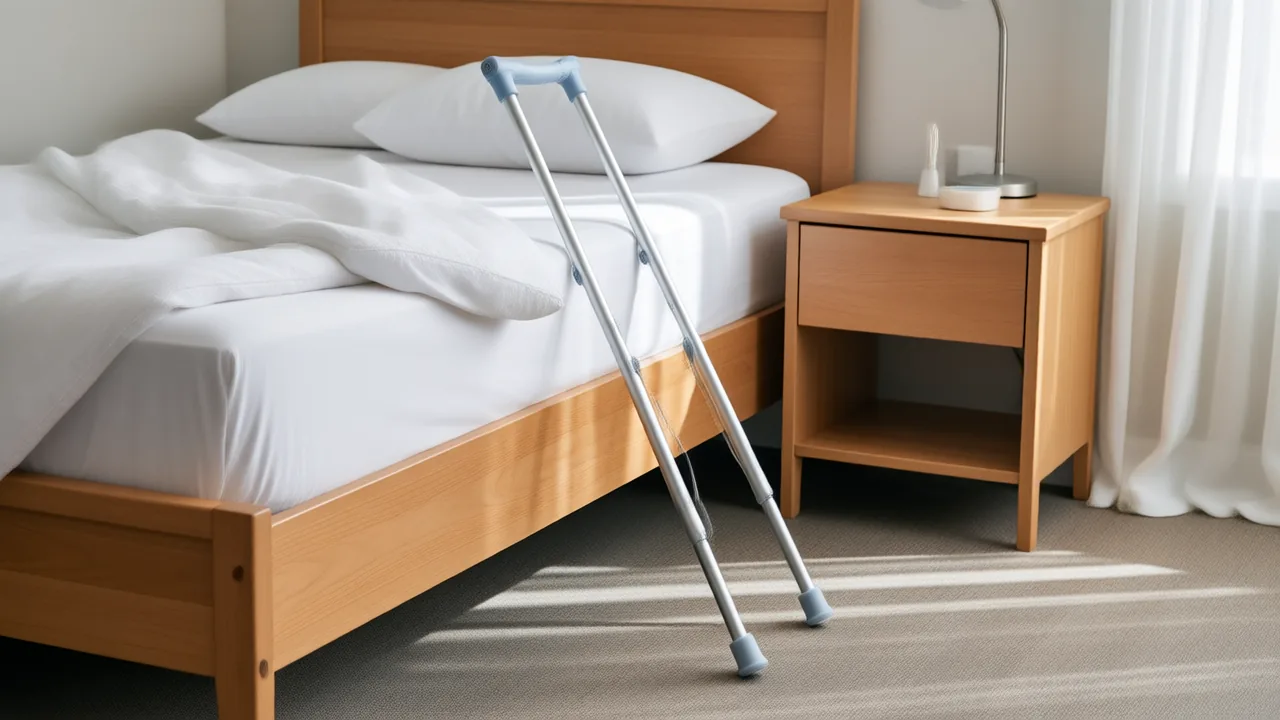
- Park your crutches, walker or wheelchair within reach of the bed, in the same spot every night.
- Light the route and clear the floor: no rugs, cords or shoes.
- Sit on the edge of the bed for a moment before you stand.
- Don’t hop, even for a few feet.
- If the trip is long or you’re still unsteady, a bedside commode or urinal is a perfectly good tool. An occupational therapist can help you choose one.
- Keep your phone within reach, in case you end up on the floor.
If you’ve been told to wear your elastic bandage or shrinker all the time, as the MedlinePlus instructions say for the bandage, that includes nights. Ask your prosthetist before you start putting the prosthesis on for night trips.
When to call your doctor, physical therapist or prosthetist
Stop and call your surgeon or doctor if the residual limb looks redder, has red streaks going up it, feels warmer, swells or has new drainage. MedlinePlus lists all of these as reasons to call. Also call for a fever, new severe pain or new numbness.
Call your physical therapist if you can’t fully straighten your knee or hip, if it’s getting harder to straighten than it was, or if lying flat or on your stomach hurts. Range of motion is easier to protect than to win back, so early is better.
Call your prosthetist if your limb aches at night after a day in the prosthesis, or if red marks from the socket don’t fade by bedtime. That points to fit, and fit is their job.
Sleep that stays broken for weeks is worth raising with your doctor too. Exhaustion makes everything harder, including the plans in our guide to returning to work after amputation (coming soon).
Tonight’s checklist
- Residual limb straight, on the mattress, no pillow under it.
- Head of the bed flat, or only slightly raised.
- A stomach-lying session before sleep, if your team has cleared it.
- Room warm, socks on the other foot if you run cold.
- Crutches or walker parked within reach, night-light on, floor clear.
- Phone by the bed.
Sources
- MedlinePlus (NIH National Library of Medicine) — Leg amputation: discharge
- Amputee Coalition — Beginning Your New Journey: Below-Knee Amputation (2025)
- Amputee Coalition — Beginning Your New Journey: Above-Knee Amputation (2025)
- Amputee Coalition — Living With Phantom Limb Pain
- Archives of Physical Medicine and Rehabilitation (2001) — The prevalence and risk factors of falling and fear of falling among lower extremity amputees
Published by Loud Limb, a shop for printed prosthetic leg covers, socks and clothing.
Leave a Reply