
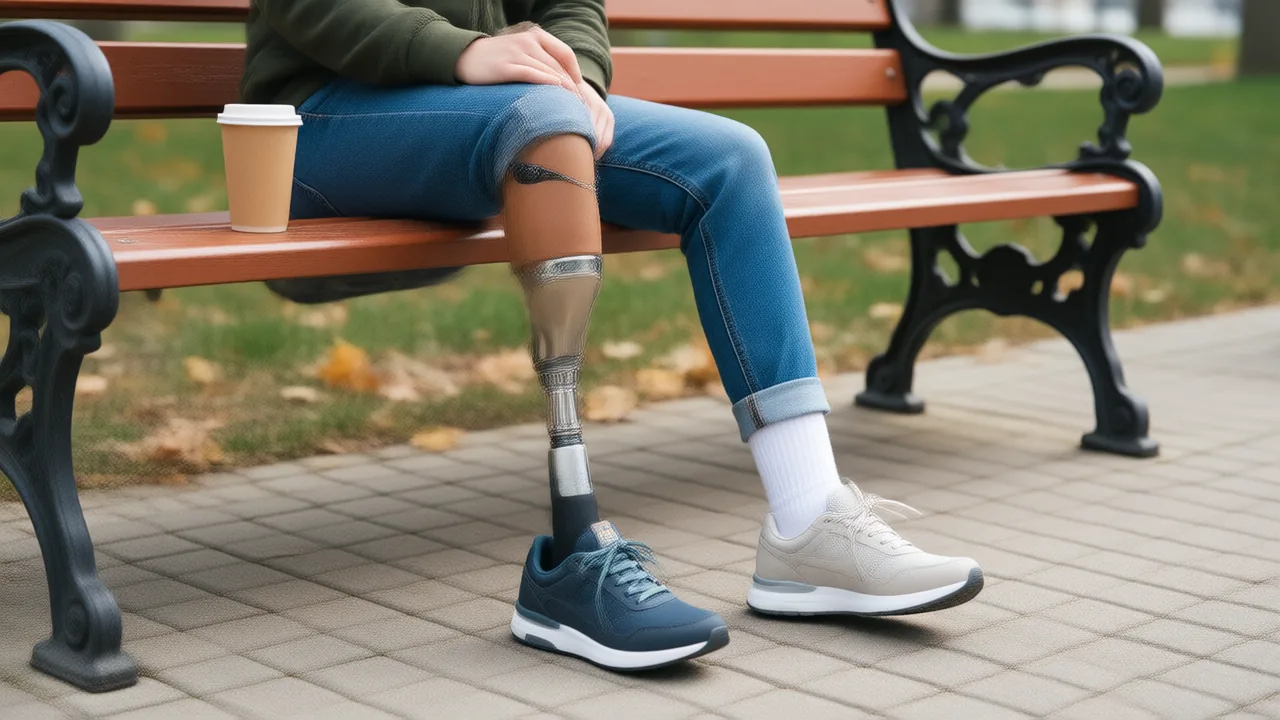
Short answer: A below-knee prosthesis, also called a transtibial or BK prosthesis, replaces the lower leg, ankle and foot for someone whose amputation is between the knee and the ankle. It is built from a custom socket, a liner and socks, a suspension system that holds it on, a pylon, and a prosthetic foot. Because you keep your own knee, you steer it with a joint you’ve used your whole life.
This guide is for new below-knee amputees, people preparing for surgery, and the people helping them. It goes through what a BK prosthetic leg is made of, the main socket and suspension styles, the feet you’re likely to see, how the first leg arrives, and what daily life with one involves.
If you’re still working out which kind of leg applies to you, start with our overview of prosthetic legs by amputation level.
What a transtibial prosthesis is, and who wears one
“Transtibial” means “through the tibia,” the shin bone. A transtibial prosthesis is for anyone whose leg ends somewhere below the knee and above the ankle, whether from surgery, injury or a limb difference present from birth. If you’re still before or just after surgery, our guide to what a below-knee amputation involves (coming soon) covers the operation and recovery.
The big advantage of this level is the knee. You keep a joint that bends, absorbs impact and pushes you forward, controlled by the thigh muscles you’ve always had. The prosthesis has to replace the shin, ankle and foot, and connect to your limb comfortably enough to carry your full weight all day.
Other levels add parts and complexity. An above-knee prosthesis (coming soon) needs a prosthetic knee, a knee disarticulation prosthesis (coming soon) fits a limb that ends at the knee joint itself, and a hip disarticulation prosthesis (coming soon) adds a hip joint too. The arm counterpart to a BK leg is the below-elbow prosthesis (coming soon), which shares the same logic of a socket built around a limb that keeps its main joint.
The parts of a BK prosthetic leg, from skin outward
Cleveland Clinic describes a prosthetic leg as a socket that connects to the residual limb, usually with a changeable liner or sock in between, plus the components below it. On a below-knee leg, the stack looks like this:
| Part | What it does on a BK leg |
|---|---|
| Liner | A soft silicone, gel or similar sleeve rolled onto the skin to cushion it and, in many systems, to help hold the leg on |
| Socks | Worn over the liner (or skin) to fill space as the limb changes size during the day |
| Socket | The custom shell your limb sits in; it takes your weight and steers the leg |
| Suspension | The pin, seal, sleeve, vacuum or strap that keeps the leg attached |
| Pylon | The tube between socket and foot; it sets length and alignment |
| Foot and ankle | From a simple cushioned foot to a carbon-fiber foot with ankle motion |
| Cover (optional) | A shaped, printed or plain cover over the outside, purely for looks |
Liners and socks get mixed up constantly. They do different jobs, and wearing the wrong combination is a fast route to a sore limb. Our guide to stump socks, prosthetic socks and liners untangles them.

Socket styles for a below-knee leg
The socket is the one part made only for you, and it decides most of how the leg feels. Two broad design ideas show up most in below-knee sockets:
- Patellar tendon bearing (PTB). A classic design that puts more load on areas that tolerate pressure well, including the tendon just below the kneecap, and relieves sensitive spots.
- Total surface bearing (TSB). A close-fitting socket that spreads load over the whole limb, usually with a gel or silicone liner. A systematic review of below-knee suspension systems found that a TSB socket with a pin-lock system was favored by most amputees in the studies it reviewed.
Your prosthetist may blend ideas from both, and will usually test the shape with a clear check socket before building the final one. Early sockets tend to be replaced as the limb shrinks after surgery; the more settled socket comes later.
How a below-knee leg stays on: suspension options
Suspension is how the socket stays attached when you lift your leg. Cleveland Clinic lists straps or belts, suction liners, pin-locking liners, electric vacuum pumps and neoprene sleeves. On a BK leg, you’ll most often hear about these:
- Pin lock. A liner with a pin at the bottom clicks into a lock in the socket. It’s simple to put on and easy to tell when you’re locked in.
- Suction or sealing liner. A liner with a seal, plus a one-way valve, holds the leg by keeping air out.
- Sleeve. A flexible sleeve rolled from the socket onto the thigh creates a seal or simply holds the leg on.
- Elevated vacuum. A pump, mechanical or electric, actively removes air to hold the limb snugly.
- Straps or a thigh cuff. Older, simpler options still used for some people and situations.
There’s no single winner. The same review found no clinical evidence that any one suspension system should be the standard for all below-knee amputees, named sweat control as a major concern with suspension liners, and noted that putting on and taking off soft liners is hard for some users, especially those with weakness in their hands or arms. Tell your prosthetist about your hands, your climate and your job; all three matter.
Typical feet on a below-knee prosthesis
Because you control the leg with your own knee, a BK leg can use almost any prosthetic foot. The choice depends on your activity, weight, goals and coverage.
- SACH foot. Cleveland Clinic calls the solid-ankle cushioned-heel foot the simplest type and often the first one used.
- Flexible keel. Bends slightly under your weight and stores and returns some energy as you walk.
- Single-axis and multiaxial. Add ankle motion, either up and down only or in several directions for uneven ground.
- Dynamic-response feet. Carbon-fiber feet that spring back at push-off so walking takes less energy; Cleveland Clinic notes they’re also called energy-storage-and-return (ESAR) feet.
- Microprocessor and activity-specific feet. Computer-controlled ankles, running blades and feet for water or sport.
Your first foot isn’t necessarily your last. Ask your prosthetist what your first foot is, why, and what would need to change for a different one.
Getting your first below-knee leg
Timelines vary a lot, but the Amputee Coalition’s guide to below-knee amputation lays out a typical path:
- You may be fitted with a shrinker sock within the first week to start shaping the limb.
- The first prosthetic fitting comes at about 8 to 12 weeks in its timeline.
- Expect weekly physical therapy visits for several months.
The same guide notes that the most common contracture after a below-knee amputation is a knee that stays bent and can’t fully straighten. Keeping that knee straight matters, because a BK leg is built for a knee that can straighten. Your physical therapist will show you how to position your leg and stretch; follow their plan rather than a generic one.
Daily life with a below-knee prosthesis
Most of living with a BK leg is routine: a morning that takes a few minutes longer, and an evening check. Some things to expect:
- Your limb changes size during the day. In a study of self-reported sock use by below-knee prosthesis users, sock ply increased over the day from about 4.8 to 5.5 on average, and people wore their prostheses about 14 to 15 hours a day. Adding or removing socks as the day goes on is normal; carry spares.
- Clean the liner and socket the way their makers say. Liner care differs by manufacturer, so follow your liner’s own instructions rather than a general rule.
- Check your skin every night, with a mirror for the back of the limb.
- Clothes and shoes. Most everyday clothes work over a BK leg. Your foot is aligned for a particular heel height, so ask your prosthetist before switching to shoes with a very different heel.
- Anything on the outside of the leg, from a cover to a travel bag, starts with its dimensions. Here’s how to measure a prosthetic leg without taking it apart.
When to call your prosthetist or doctor
Call your prosthetist if the socket feels loose or tight in a way socks don’t fix, the leg moves up and down on your limb as you walk, you hear new clicks or squeaks, the leg feels a different length, or your knee, hip or back starts aching after a change. Those are fit and alignment problems, and they’re often quick to adjust.
Stop wearing the leg and call your doctor if you find an open sore, a blister, redness that spreads or stays, warmth, drainage, or you have a fever, new severe pain or numbness. If you have diabetes or circulation problems, report any skin change early; don’t wait for your next routine visit.
Questions to bring to your fitting
- Which socket style and suspension are you planning, and why this one for this limb?
- Is this a preparatory leg or a definitive one?
- Which foot am I starting on, and what would it take to change it?
- How do I clean my liner and socket, and how do I manage socks during the day?
- What should my skin look like after a day of wear, and what’s a warning sign?
- How fast can I be seen if something rubs, breaks or stops fitting?
Sources
- Cleveland Clinic — Prosthetic Leg: What It Is, Who Needs It & How It’s Used
- Clinical Biomechanics — Transtibial prosthesis suspension systems: systematic review of literature
- Cleveland Clinic — Prosthetic Foot: What It Is, Who Needs It & How It’s Used
- Amputee Coalition — Beginning Your New Journey: Below-Knee Amputation
- Prosthetics and Orthotics International — Self-reported prosthetic sock use among persons with transtibial amputation
From the Loud Limb shop: printed crew socks and prosthetic leg covers in loud prints. Our covers go on the outside of a below-knee prosthesis; measure yours first with the size guide.
Published by Loud Limb. This guide is general information drawn from the sources listed above, not medical advice. Loud Limb sells printed prosthetic leg covers and clothing and is not a clinic: ask your doctor, surgeon or prosthetist about your own care.
Leave a Reply