
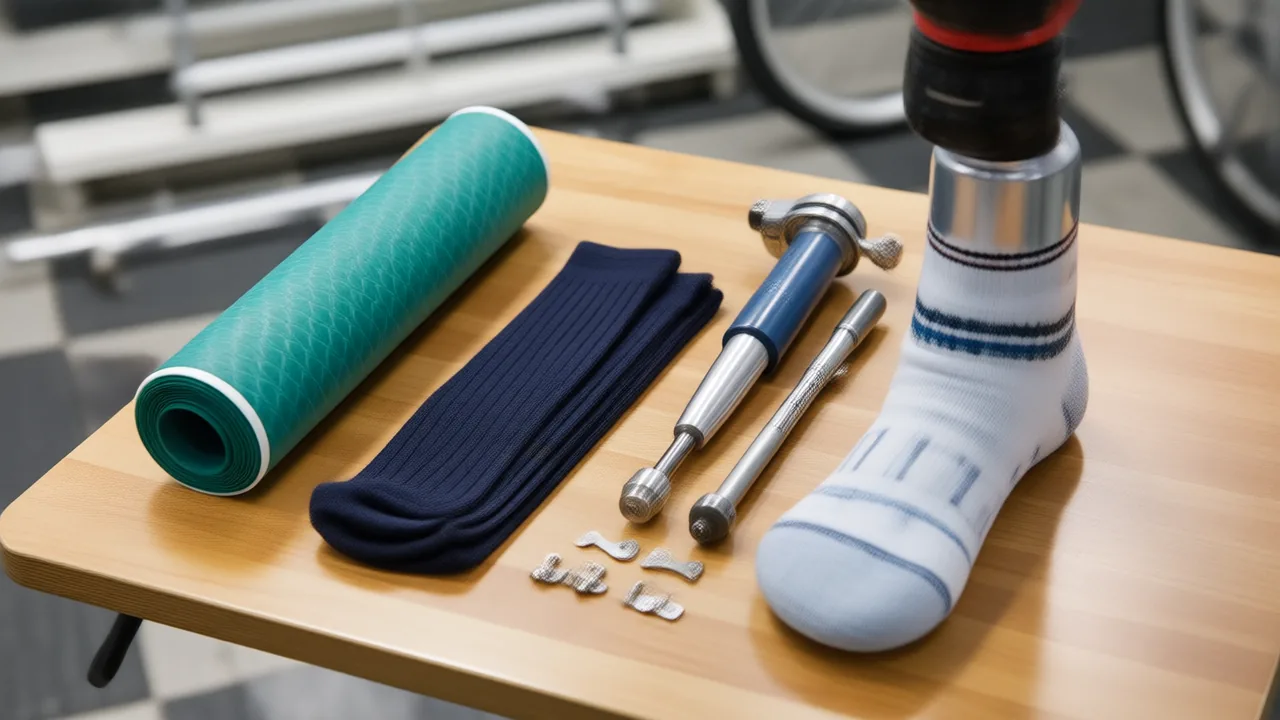
Short answer: The main prosthetic leg parts are the liner and socks against your skin, the custom socket, the suspension that holds the leg on, the pylon and adapters that connect and align everything, a prosthetic knee if the amputation is above the knee, and the foot, foot shell and shoe. The soft, high-contact parts wear out first. Your prosthetist adjusts almost everything else.
This is a glossary for new amputees, family members and anyone who has nodded along at a fitting while the prosthetist said “pyramid” and “pylon.” It names each component, says what it does, flags what tends to wear out, and tells you who is supposed to touch it. For how these parts combine into different kinds of legs, see our overview of prosthetic legs by amputation level.
Prosthetic leg parts at a glance
Read it top to bottom, the way the leg is built, from your skin down to the floor.
| Part | What it does | Wear to watch for | Who adjusts it |
|---|---|---|---|
| Liner | Soft sleeve between skin and socket | Thinning, tears, stretched top, lost grip | You clean it; prosthetist fits and replaces |
| Socks | Fill space as limb volume changes | Thin spots, holes, lost stretch | You, day to day |
| Socket | Custom shell your limb sits in | Cracks, pressure spots as your limb changes | Prosthetist only |
| Suspension | Holds the leg on | Worn pins, torn sleeves, sticky valves | Prosthetist; you replace some sleeves |
| Pylon and adapters | Connect parts, set height and alignment | Loose bolts, clicking | Prosthetist only |
| Knee unit | Bends and holds for above-knee users | Changed resistance, noises, battery | Prosthetist; servicing per maker |
| Foot and foot shell | Absorb impact, push you forward | Split shell, squeaks, worn heel | Prosthetist |
A below-knee leg is the socket-to-foot stack without a knee. Every level higher adds joints. The guide to how a prosthetic leg works explains how those parts move together when you take a step.
The parts that touch your skin: liner and socks
The liner is a soft sleeve you roll onto your residual limb before anything else. Amputee Coalition describes it as a barrier between your skin and the socket. According to Ottobock’s liner guide, liners come in silicone, polyurethane and copolymer, and in a few working styles:
- Cushion liners, often paired with a suction sleeve.
- Locking liners, with a pin at the bottom that clicks into the socket.
- Sealing liners, with a ring that seals against the socket wall to create a vacuum.
Prosthetic socks go over the liner. They come in different thicknesses, measured in plies, and you add or remove them to keep the fit snug as your limb’s volume changes during the day. Our comparison of socks and liners goes deeper on both.
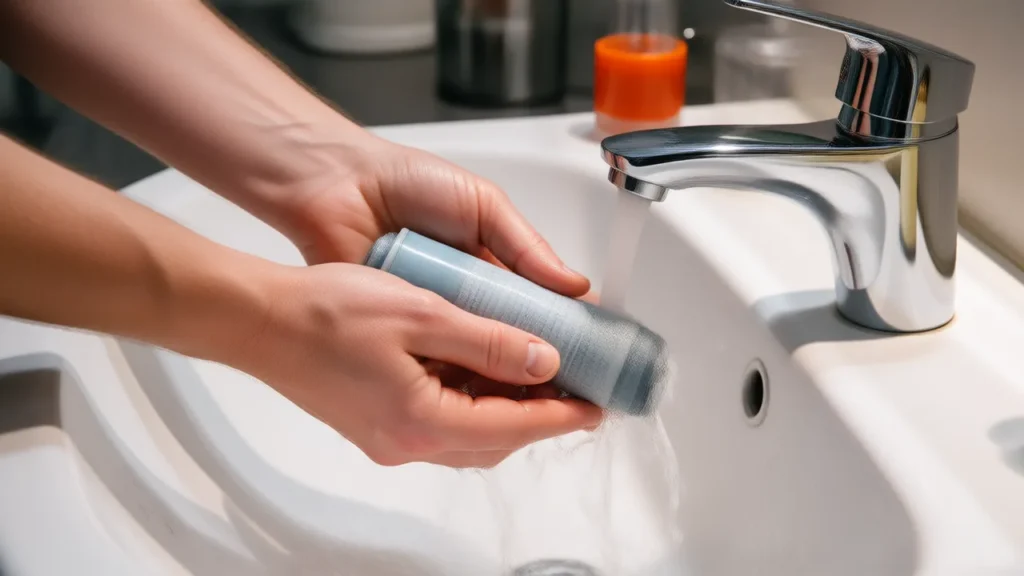
These are the parts that wear out first, because they flex, stretch and get washed every day. Care rules differ by manufacturer, so follow the instructions for your specific liner.
The socket: the one part built only for you
The socket is the rigid shell your limb, in its liner, sits inside. Cleveland Clinic describes it as the part that connects the prosthesis to your residual limb, usually with a changeable liner or sock in between. Everything else on the leg can be ordered from a catalog. The socket is molded or scanned from your limb, and it decides whether the leg feels like yours or like a rental.
Sockets don’t wear out so much as stop fitting. As your limb shrinks, settles, or changes with weight, the socket that fit last spring can feel loose or pinch now. That’s normal, and it’s the prosthetist’s job to fix it, with padding, adjustments or a new socket. Don’t sand, heat or pad it yourself.
Suspension: what keeps the leg on
Suspension is the system that holds the socket to your limb so it doesn’t slip when you lift the leg. Cleveland Clinic lists the main types as straps or belts, suction liners, pin-locking liners, electric vacuum pumps and neoprene sleeves. The parts involved:
- Pin and lock: a pin on the liner’s end clicks into a lock at the bottom of the socket. A release button lets you out.
- Lanyard: a strap from the liner’s end threads through the socket and fastens outside it.
- Valve: a one-way valve lets air out of a suction socket but not back in.
- Suspension sleeve: a stretchy sleeve rolled over the socket’s top and onto your thigh to seal it.
- Vacuum pump: a mechanical or electric pump that pulls air out of the socket.
- Belts and straps: external straps, often used above the knee or as a backup.
Sleeves can tear and lose their seal, pins and locks can wear, and valves can get sticky. Our guide to how prosthetic legs attach compares the systems in detail.
Pylon and adapters: the prosthesis components that set alignment
The pylon is the tube that stands in for your shin, or your shin and thigh if you have a knee unit. It connects the socket above to the foot below, and its length sets your height on that side.
The adapters are the small connectors at each end. Many use a pyramid-shaped fitting held by set screws. Tightening or loosening those screws tilts and shifts the parts relative to each other, which is how your prosthetist sets alignment: the angles that decide whether you walk straight or roll off the side of your foot. Other small hardware, like rotators or shock-absorbing pylons, can sit in the same stack.
Never adjust these screws yourself, even if a friend with a hex key says it’s easy. A few degrees can change your walk, load your joints differently or put pressure on your skin. If you hear clicking or feel play in the leg, that’s a prosthetist visit. For what these tubes and parts are made of, see our guide to carbon fiber prosthetics (coming soon).
Prosthetic knee units
If your amputation is above the knee or through it, the leg needs a knee that bends when you swing the leg forward and holds steady when you put weight on it. You’ll hear these names:
- Single-axis knees hinge like a door. Some can be locked straight for stability.
- Polycentric knees use several linked pivots, which changes how the knee bends and how stable it feels.
- Hydraulic and pneumatic knees use fluid or air to control swing. A clinical practice guideline on prosthetic knee selection says they are indicated for active walkers, improving comfort, speed and symmetry.
- Microprocessor knees use sensors and a battery to adjust resistance step by step. The same guideline says that, compared with non-microprocessor knees, they are indicated to reduce stumbles, falls and the mental effort of walking.
Knees are serviced on the manufacturer’s schedule, and microprocessor knees need charging. A change in how the knee resists or sounds is a reason to call, not something to live with.
Ankle, foot, foot shell and shoe
The Amputee Coalition’s guide to prosthetic feet groups them into SACH, elastic keel, single-axis, multi-axis, dynamic-response and microprocessor feet. The basic SACH and elastic keel feet cushion, but return less energy than dynamic-response feet. Which one you get depends on your amputation level, age, weight, foot size, activity level, goals and job.
Around the foot you’ll find:
- The foot shell, a foot-shaped outer skin that lets the foot wear a shoe. Shells split at the toe and heel over time.
- A thin sock between the foot and the shell, on many feet, to reduce friction and squeaking.
- The shoe, which counts as part of the system. The leg is aligned for a specific heel height, so switching from sneakers to boots with a different heel can change how you walk. Ask before you switch.
What wears out first, and who fixes it
As a rule of thumb, the soft parts that flex and get washed every day go first: socks, liners and sleeves. Foot shells, pins, valves and small hardware tend to come next, then the socket’s fit. Feet and knees are built to last longer but still need checks, and your prosthetist can tell you what to expect from your specific parts. How long the whole leg lasts varies. Amputee Coalition says a prosthesis can last from several months to several years depending on age, activity level and growth. Our guide to how long prosthetic legs last (coming soon) covers replacement in detail.
Water is its own category. Not every foot, knee or shell is made to get wet, so check before you step into the shower in your everyday leg. Our guide to showering with a prosthetic leg covers the options.
Call your prosthetist for cracks, clicking, a loose or wobbly feel, a knee that behaves differently, or a fit that needs many more or fewer socks than usual. Call your doctor the same day, and stop wearing the leg, if you find an open sore, a blister, spreading redness, warmth, fever or new numbness. Those are skin problems first and part problems second.
Before your next prosthetist visit
- Write down the name of each component on your leg. Your prosthetist can tell you, and it helps with replacements.
- Note any sounds, and when they happen: heel strike, push-off, sitting down.
- Bring the shoes you wear most.
- Bring your spare liner and socks so they can be checked for wear.
- Ask which parts you can clean, replace or charge yourself, and which you should never touch.
If you’ve been asked for your leg’s measurements for anything, from pants to covers, our guide to measuring a prosthetic leg shows where to put the tape.
Sources
- Amputee Coalition — Prosthetic FAQs for the New Amputee
- Ottobock (manufacturer product information) — All about Ottobock liners for prosthetic leg users
- Cleveland Clinic — Prosthetic Leg: What It Is, Who Needs It & How It’s Used
- Journal of Prosthetics and Orthotics (Clinical Practice Guideline, 2019) via PubMed — Prosthetic Knee Selection for Individuals with Unilateral Transfemoral Amputation
- Amputee Coalition — Prosthetic Feet
From the Loud Limb shop: printed crew socks and prosthetic leg covers in loud prints. Our covers go on the outside of a below-knee prosthesis; measure yours first with the size guide.
Published by Loud Limb. This guide is general information drawn from the sources listed above, not medical advice. Loud Limb sells printed prosthetic leg covers and clothing and is not a clinic: ask your doctor, surgeon or prosthetist about your own care.