
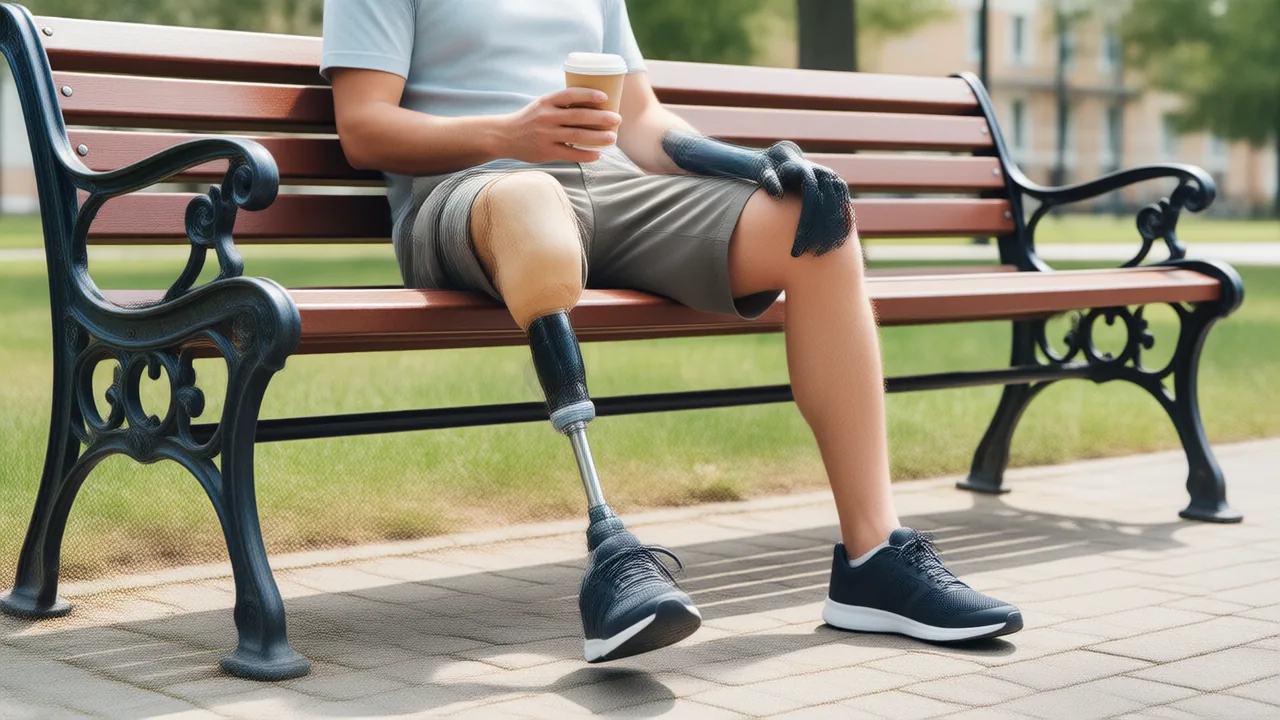
Short answer: Good amputee jokes punch at the situation, not the person: the sock drawer with a permanent surplus, the knee that needs charging, the metal detector that knows you by name. They land best when the amputee tells them, or clearly invites them. Below you’ll find original puns, why humor can help after limb loss, and the signs a joke has crossed the line.
This page is for amputees who want fresh material, and for friends, partners and coworkers who want to laugh along without putting a foot wrong. Every joke here was written for this page, so take whatever you like. And if you want a room full of people who’ll get them without an explanation, an amputee support group is a good crowd to test them on.
One leg jokes for everyday life
The best material is the stuff that happens on an ordinary Tuesday. A few to start with:
- The sock drawer: “Every pair of socks I buy comes with a free spare. I’m running a surplus.”
- Leg day: “Leg day takes me half as long. I use the extra time to gloat.”
- Shoe shopping: “Shoes only come in pairs, so one of them is basically a cover charge.”
- Cold tile at 6 a.m.: “Only half of me has an opinion about the bathroom floor.”
- The toy on the floor in the dark: “Stepping on it is a coin flip now, and the odds are in my favor.”
- Wedding nerves: “Cold feet? Honestly, I can only manage one.”
- The spare leg: “I always have a leg up on the competition. It’s in the closet.”
- Midnight trips to the bathroom: “I’m not hopping mad. I’m just hopping.”
Leg amputee jokes about the hardware
The prosthesis itself is a gift to comedy. It’s expensive, it’s weird, and it has more appointments than you do.
- “Sorry I’m late. The knee needed charging.”
- “The metal detector and I have a standing appointment.”
- “This leg sees the prosthetist more often than I see my friends. Honestly, it has a better social life.”
- “I don’t have a bad side in photos. I have a removable one.”
- “Yes, it comes off. No, you can’t borrow it for your costume.”
- “The leg never gets tired. The rest of me files complaints on its behalf.”
- “Kids ask if I’m a robot. I tell them only from the knee down.”
Amputee puns for the group chat
Short, silly, built to be sent without context:
- “I’m a person of few words and fewer toes.”
- “I put my foot down once. It’s still in the car.”
- “Party at my place. It’s a shin-dig, minus one shin.”
- “My theme song is Footloose. By 5 p.m., the socket agrees.”
- “Need a hand? Sorry, wrong limb. Need a foot? Also complicated.”
- “Above-knee users don’t have problems. They have knee-d-to-know issues.”
Want more of the stuff only the club finds funny? Our list of things only amputees understand is basically a collection of in-jokes with explanations attached.
Why humor helps after limb loss
Humor isn’t therapy, and nobody owes anyone a punchline. But there are good reasons people reach for it. A review of psychosocial adjustment to lower-limb amputation (Horgan and MacLachlan, 2004) linked positive adjustment with more time since amputation, social support, satisfaction with the prosthesis and active coping. It also found that social discomfort and body-image anxiety went along with more activity restriction, depression and anxiety.
That review didn’t measure jokes, so don’t read it as proof that puns heal anything. What a well-timed joke can do is practical. It takes the tension out of a room, gives people permission to ask the question they were quietly staring about, and puts you in charge of the story. When you make the first joke, the conversation happens on your terms.
It doesn’t have to be every day, either. The Amputee Coalition’s guide to emotional recovery describes stages that can occur in any order and last any length of time. A joke that feels great on Tuesday can feel awful on Friday. Both are normal.
Who gets to tell amputee jokes
The person with the limb difference sets the tone. Everyone else follows it.
- If it’s your body, it’s your material. Joke as much or as little as you want, and change your mind whenever.
- If you’re close family or a close friend, laugh when they joke. Making your own is fine once they’ve clearly opened the door, and only while they’re still laughing.
- If you’re a coworker, acquaintance or stranger, don’t open with a joke about someone’s body. Let them bring it up, if and when they want to.
- If it’s a kid, let them lead. A child born with a limb difference didn’t lose anything, so jokes built on “losing” a leg may not make sense to them at all.
Humor also has a place in pride and in dating. Our guides to amputee pride (coming soon) and dating as an amputee (coming soon) cover how people use it to set the tone early.
When amputee jokes cross the line
A joke has probably gone wrong if:
- It’s aimed at the person, not the situation. Mocking how someone walks isn’t a pun; it’s just mocking.
- It’s about how they lost the limb, especially if that involved trauma, combat, illness or anything recent.
- It’s the tenth time. A joke repeated on someone becomes a nickname they didn’t choose.
- It’s used to dodge a real conversation, like skipping past someone’s pain or a hard appointment.
- It treats the prosthesis as a prop: knocking on it, hiding it, grabbing it without asking.
- The person it’s about isn’t laughing.
If you told the joke and it landed badly, apologize once, plainly, and move on. Don’t explain why it was funny. If you’re on the receiving end, you don’t owe anyone a laugh. “That one’s mine to make” is a complete sentence.
When the jokes are covering something heavier
Humor can be a way through, and sometimes a way around. The same review found depression and anxiety are relatively high for up to two years after amputation before declining toward general population levels. If you, or someone you love, are joking constantly but not sleeping, not eating, pulling away from people or losing interest in things you used to enjoy, tell your doctor and ask about a mental health counselor.
If you’re thinking about harming yourself, reach out now. The 988 Suicide & Crisis Lifeline is free, confidential and available 24/7 by call, text or chat. Veterans can dial 988 and press 1, or text 838255, through the Veterans Crisis Line, without being enrolled in VA benefits or care.
Where to take the jokes next
- Find your audience. In a 2024 US survey of people with major lower limb amputation, two out of three had received some form of peer support, and peer groups were seen as helpful for both information and emotional support.
- See how others tell it. Our roundup of famous amputees (coming soon) covers people who have lived with limb loss very publicly, on their own terms.
- Wear the punchline. Loud Limb’s original slogan tees and hoodies say it so you don’t have to, and our gift guide for amputees has ideas for the funniest person in your life.
Sources
- Disability and Rehabilitation (Horgan & MacLachlan, 2004) via PubMed — Psychosocial adjustment to lower-limb amputation: a review
- Amputee Coalition — Emotional Recovery
- Archives of Physical Medicine and Rehabilitation (2024) via PubMed — Utilization and Perception of Peer-Support After Lower Limb Loss in the United States
- 988 Suicide & Crisis Lifeline — If you need emotional support, reach out to the national mental health hotline: 988
- U.S. Department of Veterans Affairs — Veterans Crisis Line
Published by Loud Limb, a shop for printed prosthetic leg covers, socks and clothing.