
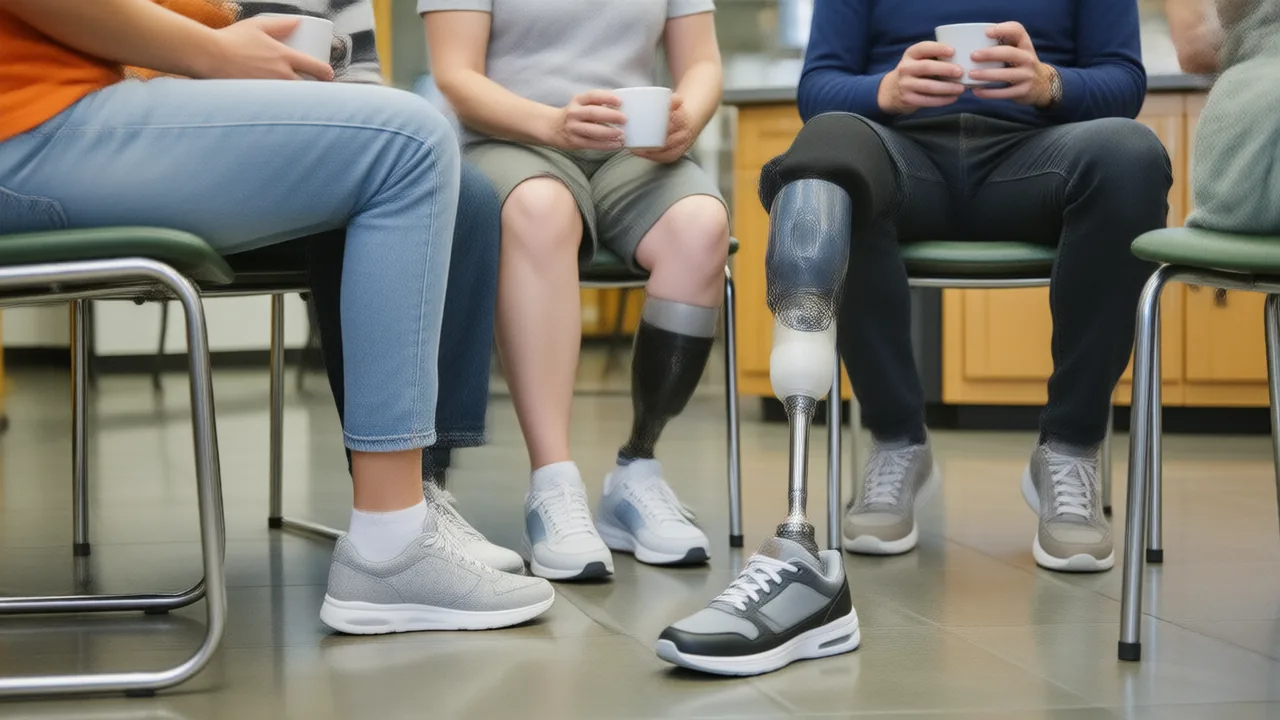
Short answer: Amputee support groups connect you with other people who live with limb loss or limb difference, in person, one on one or online. They trade practical know-how and emotional support that clinicians cannot always give. To find one, ask your rehab team or prosthetist, check national limb loss organizations, and, if you are a veteran, ask your VA care team about peer programs.
This guide is for new amputees, people years into life with limb loss who want company, parents of kids with limb difference, and partners and caregivers who need people of their own. It covers what support groups actually do, how to find one near you or online, what to do when a group is not enough, and the wider community of humor, awareness and role models that sits around them.
You do not need to be struggling to join one. Plenty of people go for the practical tips, the jokes nobody else gets, or to be the person a newer amputee can ask.
What amputee support groups actually do
A good group does two jobs at once. It is an information exchange, where someone who has had the same socket problem, the same insurance denial or the same awkward family dinner tells you what worked. And it is a place where you do not have to explain yourself, because everyone in the room already knows. A 2024 US study of peer support after lower limb loss found that peer-support groups are seen as helpful for both information and emotional support.
Support comes in a few different shapes:
- In-person groups, usually monthly, often hosted by a hospital, rehab center or prosthetics clinic.
- One-on-one peer visitors, trained volunteers with limb loss who meet new amputees, sometimes before surgery or in the hospital.
- Online communities, from forums to social media groups to video meetups, available at 2 a.m. when the phantom pain is loud and the house is asleep.
- Activity groups, like adaptive sports teams, walking clubs and hiking groups, where the support happens between drills.
- Groups for the people around you, such as parents of kids with limb difference and partners or caregivers.
Why peer support for amputees matters
Clinicians know a lot about amputation. Other amputees know what it is like on a Tuesday. That difference is the whole point of peer support.
It is also common. In the same national survey of people with major lower limb amputation, two out of three respondents had received some form of peer support after their amputation, and those who had received it showed a trend toward greater mobility. A trend is not proof that peer support caused the difference, but it is an encouraging signal.
Older research points the same way. A review of psychosocial adjustment to lower-limb amputation found that positive adjustment is associated with more time since amputation, more social support, greater satisfaction with the prosthesis and active coping. A support group is not the only source of social support, but it is one of the easiest to add.
What peer support can do, in practice:
- Show you what the next year can look like, from people a year or ten ahead of you.
- Give you questions to take to your prosthetist, doctor or insurer.
- Normalize the stuff nobody warns you about, from phantom sensations to how strangers react.
- Give you a role once you are further along: being the person who helps.
Talking to a peer visitor
If you are facing a planned amputation or are newly home from the hospital, a one-on-one conversation with a trained peer visitor can be easier than walking into a room of strangers. Ask your surgeon’s office, rehab unit or prosthetist whether they can arrange one, and ask for someone with a similar amputation level if possible. Useful questions to bring: what the first months were really like, what they wish they had known before their first fitting, how they handled work and family, and what they would ask their own care team if they could start again. A peer visitor shares experience, not medical advice, so take anything clinical back to your own team.
How to find an amputee support group near me
Start local, then widen the search. The best leads usually come from people already involved in your care:
- Your prosthetist’s office. Clinics often host groups or know which ones are active nearby, and the waiting room is full of potential peers.
- Your rehab hospital or physical therapist. Inpatient rehab units and outpatient amputee clinics often run groups or peer visitor programs.
- National limb loss nonprofits. They keep directories of support groups and can often connect you with a trained peer visitor.
- The VA, if you are a veteran. Ask your amputation care team about veteran mentorship and peer connection programs.
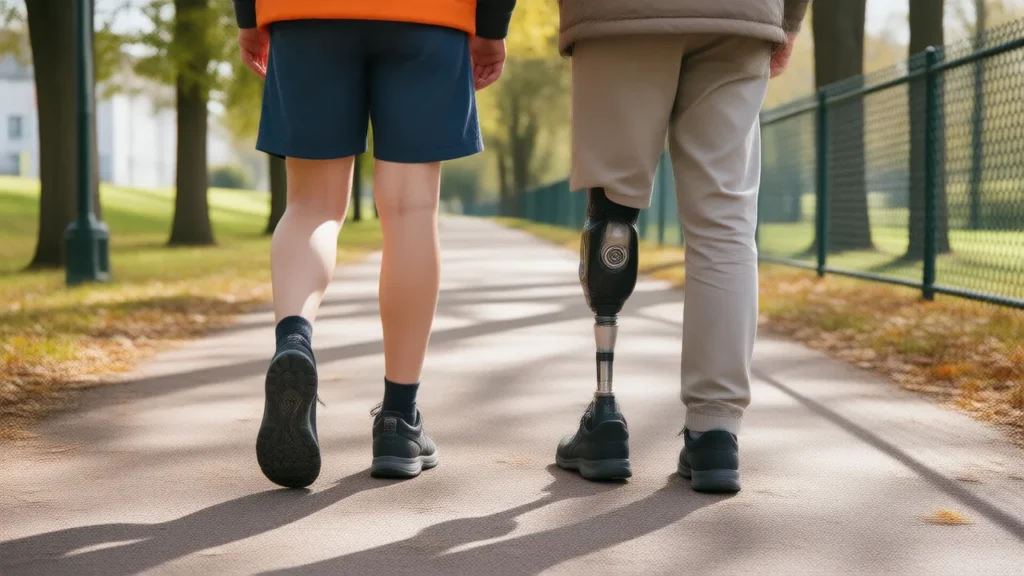
- Adaptive sports programs. Many people find their people on a team rather than in a circle of chairs.
- Children’s hospitals and limb difference camps, for families of kids with limb difference.
When you find a group, it is fair to ask a few questions before you go: how often it meets, who runs it, whether the venue is accessible, whether caregivers are welcome, and whether most members are new or long-time amputees. If the first group is not a fit, try another. Groups have personalities, just like people.
Online amputee support: communities, pros and cautions
Online groups are the easiest way in, especially if you live somewhere rural, do not drive yet, or want to lurk for a while before saying anything. They are also good for very specific questions, like a particular knee, a rare amputation level, or life as a bilateral amputee, where a local group may not have anyone with the same experience.
A few cautions keep online support helpful:
- Treat medical advice as a question, not an answer. Something that worked for one person’s skin or socket can be wrong for yours. Take it to your prosthetist or doctor before you try it.
- Be careful with product recommendations. Some posts are sales pitches wearing a peer’s clothes.
- Protect your privacy. Think before sharing photos, your location, your insurer or your medical details in a public group.
- Notice how you feel after scrolling. Some groups lift you up. Some are an endless feed of worst cases. You are allowed to leave.
Groups for specific needs, including caregivers
General groups work for many people, but a more specific group can be a better fit, depending on where you are:
- New amputees, for the first months of healing, shrinkers, first fittings and learning to walk again.
- Groups by cause, such as diabetes and vascular disease, trauma, or cancer, where the medical story and the fears are often shared.
- Groups by age, including young adults, whose questions about school, work and dating look different from those of retirees.
- Veterans, who may want peers with military experience.
- Parents of kids with limb difference.
- Caregivers and partners, who carry a lot and rarely get asked how they are doing.
If you are the one doing the caring, our guide to caring for an amputee (coming soon) covers the practical side and how to look after yourself while you do it.
When a support group is not enough
A support group is not therapy, and it is not meant to be. Mood problems after amputation are common and treatable. A 2024 systematic review and meta-analysis found a pooled prevalence of depression after limb amputation of about 34%. The adjustment review mentioned above found depression and anxiety are relatively high for up to two years after amputation, then decline toward general population levels.
Talk to your doctor, or ask for a referral to a psychologist or counselor, if low mood, worry, poor sleep or loss of interest in things you used to enjoy does not lift, or starts getting in the way of daily life. Our guides to depression after amputation (coming soon), coping with amputation (coming soon) and body image after amputation go deeper on what helps and how to get it.
If you are thinking about hurting yourself or you are in crisis, do not wait for the next meeting. The 988 Suicide & Crisis Lifeline is available 24/7 by call, text or chat, and conversations are free and confidential. Veterans can reach the Veterans Crisis Line by dialing 988 and pressing 1, or by texting 838255, and do not have to be enrolled in VA benefits or health care to connect. If you are in immediate danger, call 911.
Community beyond the meeting room
Support does not only happen in groups. A lot of it happens in how the limb loss community talks, laughs and shows up in public.
- Humor. Plenty of amputees cope by joking about it first, and loudest. Our collection of amputee jokes is built for laughing with amputees, never at them. Loud Limb’s slogan tees are the wearable version.
- Awareness. Limb Loss and Limb Difference Awareness Month (coming soon) is a good time to find events, walks and meetups near you, or to start a conversation at work.
- Role models. Seeing people with limb loss in sport, music, politics and business matters. Our list of famous amputees (coming soon) is a good place to start.
- Relationships. Questions about dating and intimacy come up in almost every group, usually quietly. Our guide to amputee dating (coming soon) answers them out loud.
And if you want to show up for someone in your life with limb loss, our gifts for amputees guide has ideas that land better than a sympathy card.
Starting your own group if there isn’t one nearby
If the nearest group is two hours away, you may be the person to start one. It does not need to be formal:
- Ask your prosthetist or rehab clinic whether they would host, or let you put a flyer in the waiting room.
- Pick a regular time and an accessible place, with parking close by, seating, and a restroom you can actually use.
- Keep the first meetings simple: introductions, one topic, coffee.
- Set two ground rules early: what is said in the group stays there, and medical questions go to clinicians, not the group.
- Invite a guest now and then, like a prosthetist, a physical therapist or a benefits specialist, to answer questions.
Your first meeting: what to expect
Most groups start with introductions, where you can say as much or as little as you like. You can listen for the whole first meeting and nobody will mind. Bring a question if you have one, like a fit problem, an insurance hassle or how people explain their leg to kids, because a specific question is the fastest way into a conversation.
A few habits make groups work for everyone. Keep what others share inside the group. Speak from your own experience rather than telling people what they should do. And leave room for the quiet person in the corner, who may be at their very first meeting, just like you once were.
Give a group two or three meetings before you decide. The first one is almost always the most awkward, for everyone. If after that it still leaves you feeling worse rather than better, that is useful information too: try a different group, a different format, or a one-on-one peer instead.
Sources
- Archives of Physical Medicine and Rehabilitation (2024) via PubMed — Utilization and Perception of Peer-Support After Lower Limb Loss in the United States
- Disability and Rehabilitation (Horgan & MacLachlan, 2004) via PubMed — Psychosocial adjustment to lower-limb amputation: a review
- Journal of Psychosomatic Research (2024) via PubMed — The prevalence of depression in people following limb amputation
- 988 Suicide & Crisis Lifeline
- U.S. Department of Veterans Affairs — Veterans Crisis Line
Published by Loud Limb, a shop for printed prosthetic leg covers, socks and clothing.