
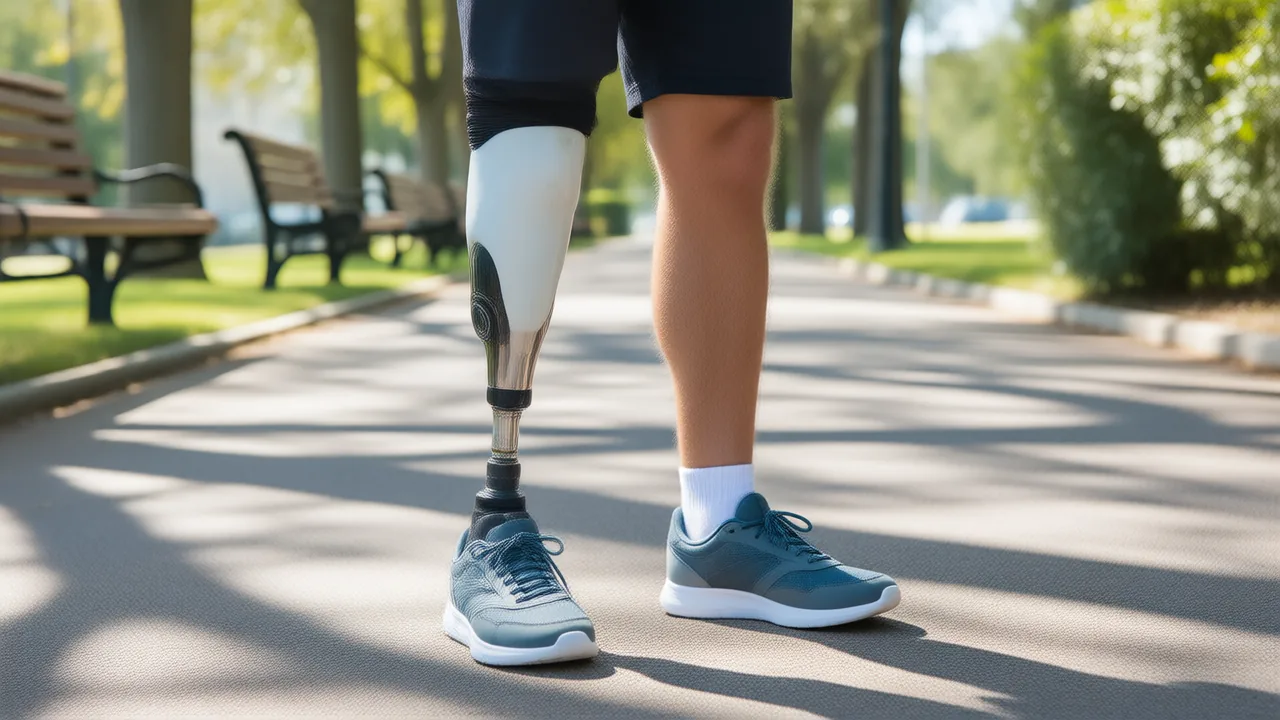
Short answer: A prosthetic leg works as a chain. The socket takes your body weight and turns every movement of your residual limb into movement of the leg. A prosthetic knee, if you have one, bends freely as the leg swings and resists bending while you stand on it. The foot rolls you forward and often flexes like a spring. Your own muscles supply the power; the leg directs it.
So how does a prosthetic leg work, mechanically? This page covers where your weight goes, how the leg moves through a step, how a knee knows when to bend, and where energy return fits in. It is not a parts catalog. For what the different legs look like, start with our guide to types of prosthetic legs, and for a name-by-name tour, see the parts of a prosthetic leg.
Your body is the motor
Most prosthetic legs have no motor at all. There is nothing inside that pushes. The power for every step comes from you: your hip muscles, your thigh, and, if your amputation is below the knee, your own knee. The prosthesis is a clever set of levers, dampers and springs that takes that effort and shapes it into walking.
That changes how you think about the leg. It does not walk for you, so it can only be as good as the connection between you and it and the training behind that connection. A small number of powered knees and ankles do add a motor, but they still take their cues from how you move.
How the socket carries your weight
Follow your weight down the leg. It passes from your body into your residual limb, from your limb into the socket, down the pylon (the tube), through the foot and into the ground. The ground pushes back up the same path. Every step, the socket is where that force meets your skin.
That is why the socket matters more than any other part. A review of lower limb prosthetic rehabilitation in the Indian Journal of Plastic Surgery calls the socket the customized part of the prosthesis and crucial to its performance. It is shaped to put load on the parts of your limb that can take it, and to spare the parts that cannot.
The socket is also your steering wheel. When you swing your thigh forward, the socket moves with it and the rest of the leg follows. When you press back with your hip, the socket passes that force down to the foot. The snugger the fit, the more directly your movement reaches the ground. A loose socket loses some of that movement in a wobble. The liner and socks between your skin and the socket fine-tune the fit through the day; our guide to socks versus liners explains which does what.
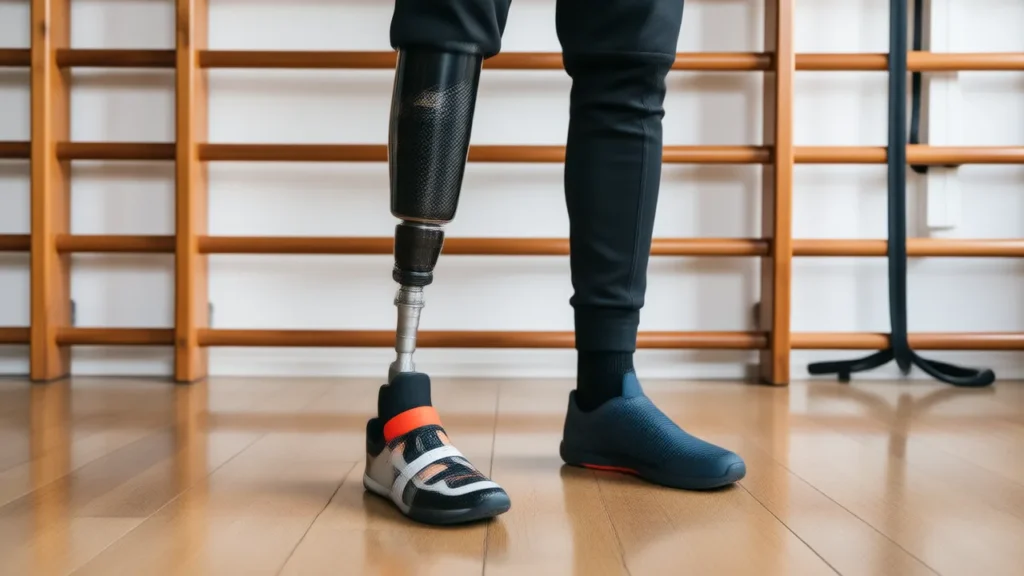
How does a prosthetic leg move? One step, start to finish
Walking is a repeating cycle. Here is what a prosthetic leg does in each part of it.
- Heel strike. The heel of the foot touches down first and compresses a little, softening the landing.
- Loading. Your weight comes onto the leg. A below-knee user’s own knee bends slightly to absorb it. An above-knee leg has to stay stable here, which is the knee’s hardest job.
- Midstance. Your body passes over the foot. The foot rolls forward, and a flexible foot bends and loads up like a spring.
- Push-off. Your weight moves onto the toe. A spring-like foot releases some of the energy it stored.
- Swing. The leg leaves the ground and swings forward. An above-knee leg’s knee bends so the foot clears the floor, then straightens in time for the next heel strike.
With a below-knee leg, your own knee and hip handle the bending and the swing, and the prosthesis mainly replaces the shin, ankle and foot. With an above-knee leg, the prosthetic knee has to get both stance and swing right, every single step, which is why above-knee rehab takes longer. Our above-knee prosthesis guide (coming soon) covers what that training looks like.
How does a prosthetic leg know when to bend?
It does not read your mind. It reads the forces you put through it. Different knees do that in different ways.
Mechanical knees
- Alignment. The prosthetist sets the knee’s pivot slightly behind the line your body weight travels down. When you stand on the leg, your weight pushes the knee straight rather than folding it.
- Weight-activated brakes. Some knees have a friction brake that engages when you put weight on the leg and releases when you take it off.
- Manual locks. The simplest knees lock straight for walking and unlock with a lever when you want to sit.
- Fluid control. Hydraulic or pneumatic cylinders resist bending by pushing oil or air through small openings, so the leg swings at a speed that matches your pace.
A 2019 clinical practice guideline on knee selection says knees with hydraulic or pneumatic swing resistance are indicated for active walkers, improving comfort, speed and symmetry.
Microprocessor knees
A microprocessor knee adds sensors, a small computer and a battery. It keeps measuring things like the knee angle and the load on the leg, and adjusts its hydraulic resistance on the fly: firm when you are standing on it, freer when you swing it. The first fully microprocessor-controlled knee, the C-Leg, arrived in 1999, according to the Indian Journal of Plastic Surgery review. The same knee-selection guideline says that, compared with non-microprocessor knees, microprocessor knees are indicated to reduce stumbles, falls and the mental effort of walking.
Either way, you are still in charge. Pressing back with your hip keeps a knee straight, and rolling your weight over the toe at the end of a step is the cue many knees use to let go for swing. Learning that timing is much of what physical therapy teaches.
The foot: rollover and energy return
The foot’s job is to land softly, roll you forward smoothly and give you something to push off from. The Amputee Coalition sorts prosthetic feet into SACH, elastic keel, single-axis, multi-axis, dynamic-response and microprocessor feet. The two most basic types, SACH and elastic keel, cushion well but return less energy than dynamic-response feet.
Energy return is the spring idea. Cleveland Clinic explains that a flexible keel stores and transfers energy by bending slightly under your weight, and that dynamic-response feet use materials like carbon fiber that spring back at push-off, so walking takes less energy. You may also hear these called energy-storage-and-return (ESAR) feet. Our guide to carbon fiber prosthetics (coming soon) explains why that material is so common.
One honest limit: a passive foot can only give back part of the energy you put into it. It cannot add power the way a calf muscle does. That is the gap powered ankles try to close with a motor.
Why walking on a prosthesis takes more effort
Because the leg supplies no push of its own, the rest of your body works harder. A 2021 systematic review and meta-analysis found that people with lower-limb amputation use significantly more energy to walk than people without one. The smallest increase, about 12%, was in below-knee amputation not caused by vascular disease. The largest, about 102%, was in above-knee amputation caused by vascular disease.
Those are averages across studies, not a prediction for you. They explain why good fit, the right components and training all matter: each one cuts down the effort lost between your body and the ground.
What keeps the system working
- Alignment. The angles between socket, pylon and foot decide how the leg rolls. Small changes make a big difference, and switching to shoes with a very different heel height can throw it off. Ask your prosthetist before you do.
- Fit. Your limb changes size through the day and over months. Socks handle small changes; bigger ones need your prosthetist.
- Wear. Foot shells, bumpers, fluid units and batteries wear out. Our guide to how long prosthetic legs last (coming soon) covers what gets replaced and when.
- Clean contact surfaces. Sweat and grime inside the socket and liner affect both skin and fit. See how to clean a prosthetic leg (coming soon) for the routine.
When to call your prosthetist or doctor
Call your prosthetist if the knee buckles or feels unpredictable, the foot slaps down or rolls oddly, the leg feels a different length, you hear new clicks or squeaks, or the leg moves up and down on your limb as you walk. These are mechanical or alignment problems, and they are the prosthetist’s to fix.
Stop wearing the leg and call your doctor if you notice an open sore, a blister, redness that spreads or stays, warmth, drainage, fever, new severe pain or numbness. Do not adjust your way around a skin problem.
Questions that make your own leg make sense
- What controls my knee in stance, and what makes it release for swing?
- What kind of foot do I have, and how much spring should I expect from it?
- Which heel heights is the leg aligned for?
- What will wear out first, and what does that feel like?
Ask them at your next visit. A prosthetist who can answer all four in plain words is giving you the manual your leg did not come with.
Sources
- Indian Journal of Plastic Surgery (2019) — Prosthetic Rehabilitation in the Lower Limb
- Journal of Prosthetics and Orthotics (2019) — Prosthetic Knee Selection for Individuals with Unilateral Transfemoral Amputation: A Clinical Practice Guideline
- Amputee Coalition — Prosthetic Feet
- Cleveland Clinic — Prosthetic Foot: What It Is, Who Needs It & How It’s Used
- Prosthetics and Orthotics International (2021) — General estimates of the energy cost of walking in people with different levels and causes of lower-limb amputation
From the Loud Limb shop: printed crew socks and prosthetic leg covers in loud prints. Our covers go on the outside of a below-knee prosthesis; measure yours first with the size guide.
Published by Loud Limb. This guide is general information drawn from the sources listed above, not medical advice. Loud Limb sells printed prosthetic leg covers and clothing and is not a clinic: ask your doctor, surgeon or prosthetist about your own care.