

Short answer: The main types of prosthetic arms are passive arms, which restore shape and help hold or stabilize things; body-powered arms, which use a harness and cable driven by your shoulders; myoelectric arms, which use batteries and motors controlled by muscle signals; hybrids that combine the two; and activity-specific arms built for one job, like a sport or a tool.
This guide is for anyone with arm or hand loss, or a limb difference, who is trying to understand the options: new amputees, parents of kids born with an arm difference, and people who have used one kind of arm for years and are curious about another. It explains each type of upper limb prosthesis, how amputation level changes the choice, and what to ask your team.
One point before the details. Arm loss is much less common than leg loss, so fewer clinicians specialize in it. A 2024 study of US limb loss prevalence found that about 91% of people with limb loss had a lower-extremity amputation and only 9.2% an upper-extremity one. When you choose a prosthetist, ask how many arm patients they see.
Types of prosthetic arms at a glance
Most arms fall into one of five groups. Many people end up with more than one, because an arm that is great at one job can be clumsy at another.
| Type | How it works | Strengths | Trade-offs |
|---|---|---|---|
| Passive | No motors or cables; the hand or fingers are positioned by hand | Light, simple, natural-looking options available | No active grip |
| Body-powered | A harness and cable turn shoulder and upper-body movement into opening and closing the hand or hook | Durable, no charging, you feel the pull through the harness | The harness can be uncomfortable; some movements are tiring |
| Myoelectric | Sensors in the socket read muscle signals from your residual limb and drive a battery-powered hand, wrist or elbow | No harness for many users, strong grip, some hands offer several grip patterns | Heavier, needs charging and more upkeep, and not every one is made for water or dirt |
| Hybrid | Mixes body-powered and powered parts, often for higher amputation levels | Can combine the strengths of both | More complex to fit and learn |
| Activity-specific | A device built for one task, like cycling, lifting, playing an instrument or using tools | Does its one job very well | Usually no good for anything else |
Different arms can also share parts. The piece at the end, called the terminal device, can be a hook, a hand or a specialized tool, and some arms let you swap between them.
Upper limb prosthesis levels: from fingers to shoulder
Where the limb difference or amputation is shapes everything else, because every joint the body is missing is a joint the prosthesis has to supply or work around.
- Fingers and partial hand: missing one or more fingers or part of the palm. Options range from single-finger devices to partial hand prostheses that work with the wrist and remaining fingers.
- Wrist disarticulation: through the wrist joint.
- Below elbow (transradial): through the forearm. You keep your own elbow, which makes controlling most arm types easier.
- Elbow disarticulation and above elbow (transhumeral): the arm also needs an elbow, which adds weight and makes control more complex.
- Shoulder level: through or above the shoulder joint, where the prosthesis has to provide shoulder, elbow, wrist and hand.
The below-elbow level is where many people start their research. Our guide to the below elbow prosthesis (coming soon) covers sockets, suspension and the types of arm that suit that level.
Passive prosthetic arms: more than cosmetic
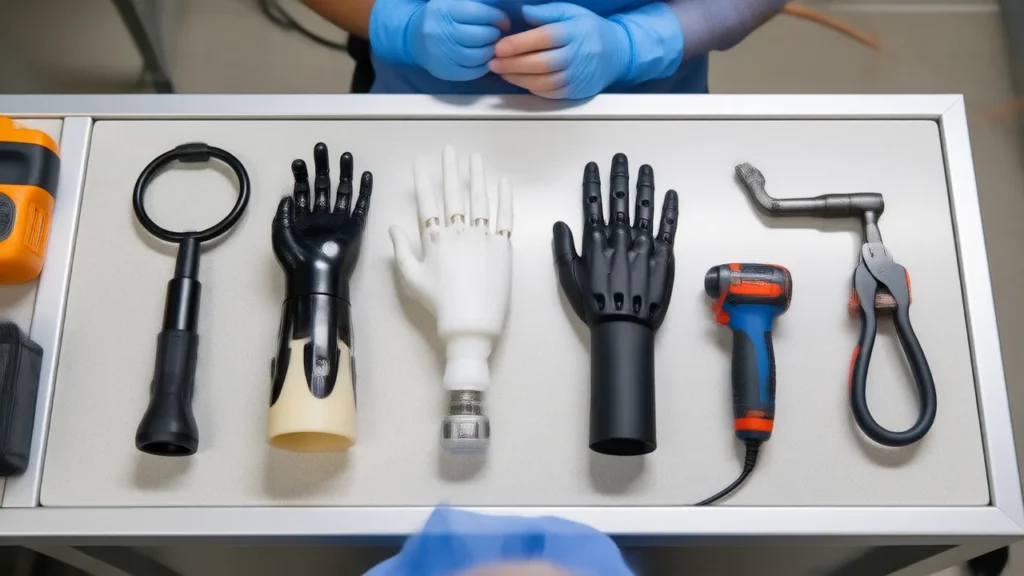
Passive arms are often called cosmetic arms, which undersells them. People have wanted artificial limbs to look right for a very long time. A history of early prosthetics in the ANZ Journal of Surgery notes that prostheses were developed for function, cosmetic appearance and a psycho-spiritual sense of wholeness, and that the surgeon Ambroise Paré invented both upper-limb and lower-limb prostheses.
A modern passive arm can be a lifelike silicone hand matched to your skin tone, or a simple lightweight device. It does not grip on its own, but it can steady paper while you write, hold a bag in the crook of the fingers, balance a plate, or push and support. The fingers of some passive hands can be bent into position by your other hand. Because it is light and asks almost nothing of you, a passive arm can be the easiest one to wear all day.
Body-powered prosthetic arms
A body-powered arm uses a harness across your shoulders and a cable running down to the terminal device. When you move your shoulder or upper arm in a trained way, the cable pulls and the hook or hand opens or closes. It is simple mechanics, and that is its appeal: no batteries, no charging, and parts that tolerate dirt, water and hard work better than electronics usually do.
Because you control the cable with your own body, you can feel how far it is pulling, which gives you a sense of how open the hook is without looking. The trade-offs are the harness, which some people find uncomfortable or restrictive, and the effort some movements take, especially at higher amputation levels.
Body-powered arms are often paired with a split hook. Hooks look industrial, but they can make fine work easier, because you can see exactly what you are picking up. Our guides to the body-powered prosthetic arm (coming soon) and the prosthetic hook (coming soon) explain how they work and who tends to choose them.
Myoelectric and bionic arms
A myoelectric arm reads the small electrical signals your muscles make when they contract. Sensors inside the socket pick up those signals from your residual limb, and a battery-powered motor turns them into movement: open, close, rotate the wrist, or switch grips. There is usually no harness, which can be more comfortable, and the grip can be strong.
The trade-offs are weight, charging, cost, and the care that any electronic device needs. Many are not designed for water or heavy dirt, so check the manufacturer’s guidance before you get yours wet. Learning to control one well takes practice, usually with an occupational therapist. Our guide to the myoelectric prosthetic arm covers control, training and daily life.
“Bionic arm” is not a separate medical category. It is the popular name for the most advanced powered arms and hands, often with individually moving fingers and multiple grip patterns controlled by muscle signals or an app. Our guide to the bionic arm (coming soon) separates what these devices really do from the headlines, and our guide to the prosthetic hand (coming soon) compares passive, body-powered and powered hands side by side.
Hybrid and activity-specific arms
A hybrid arm mixes systems. A common example at the above-elbow level is a body-powered elbow combined with a myoelectric hand, which can spread the work between your body and a battery. Hybrids are more complex to fit and learn, and they are very individual, so they are a conversation to have with an experienced upper-limb team.
Activity-specific arms are built for one job and do it very well. There are terminal devices for cycling handlebars, weightlifting bars, golf clubs, kayak paddles, musical instruments, cameras, kitchen tools and workshop tools. If one activity matters a lot to you, whether that is your job, your sport or your guitar, tell your prosthetist. It may be worth a dedicated device, and it is certainly worth asking about.
At work, the right device is only part of the picture. The Job Accommodation Network’s guidance on amputation notes that not everyone with an amputation needs job accommodations, and many need only a few. JAN offers free, confidential consultation at (800) 526-7234 if you want help thinking through changes at work.
Partial hand and finger prostheses
Missing one or more fingers, or part of the hand, brings its own set of choices. Some people use nothing at all and adapt around it. Others use a passive finger or partial hand that restores shape and helps with pinching or holding. There are also mechanical fingers powered by the movement of the remaining knuckles or wrist, and powered partial hands for some levels.
Because the rest of the hand still works, the goal is usually to add function without getting in the way of what you can already do. Our guides to the partial hand prosthesis (coming soon) and prosthetic fingers (coming soon) go through the options level by level.
Choosing an arm, training, and when to call your team
Choosing is a team decision, usually with a rehab doctor, a prosthetist and an occupational therapist. The questions that matter most are what you want to do, what your residual limb can control, how much weight and upkeep you will accept, and what your insurance will cover. Training matters as much as the device. Most people need structured practice with an occupational therapist to get real use out of any active arm.
Some people decide not to wear an arm at all, or wear one only for certain tasks, and that is a legitimate choice. It is especially common in children. Nationwide Children’s Hospital’s article on limb loss and milestones notes that children with upper-limb differences often prefer not to use a prosthesis until they are much older, since no prosthesis gives them skin sensation, and that it is never too late to revisit the idea.
Call your prosthetist if the socket rubs, slips or pinches, if a harness leaves marks that do not fade, or if the arm stops responding the way it should. Stop wearing it and call your doctor if you notice a blister or open skin, redness that spreads, warmth or swelling, or a fever. Pain deserves its own conversation: phantom pain, according to Cleveland Clinic, is more common after upper-extremity amputations, and your doctor can talk you through treatment options.
Questions to bring to your first appointment
- How many people with my level of arm loss do you fit each year?
- Which types of arm would suit my level, and why?
- Can I try a body-powered and a powered option before deciding?
- How much does each weigh, and what upkeep does it need?
- What training comes with it, and who provides it?
- Is an activity-specific device worth considering for the things I care about most?
- What will my insurance cover, and what documentation do you need from me?
Sources
- Archives of Rehabilitation Research and Clinical Translation (2024) via PubMed — Estimating Recent US Limb Loss Prevalence and Updating Future Projections
- ANZ Journal of Surgery (2007) via PubMed — Paré and prosthetics: the early history of artificial limbs
- Job Accommodation Network (JAN), U.S. Department of Labor — Amputation
- Nationwide Children’s Hospital — Limb Loss: Adapting to the Challenges and Reaching Milestones
- Cleveland Clinic — Phantom Limb Pain
From the Loud Limb shop: trucker hats and funny amputee shirts & hoodies.
Published by Loud Limb. This guide is general information drawn from the sources listed above, not medical advice. Loud Limb sells printed prosthetic leg covers and clothing and is not a clinic: ask your doctor, surgeon or prosthetist about your own care.
Leave a Reply