
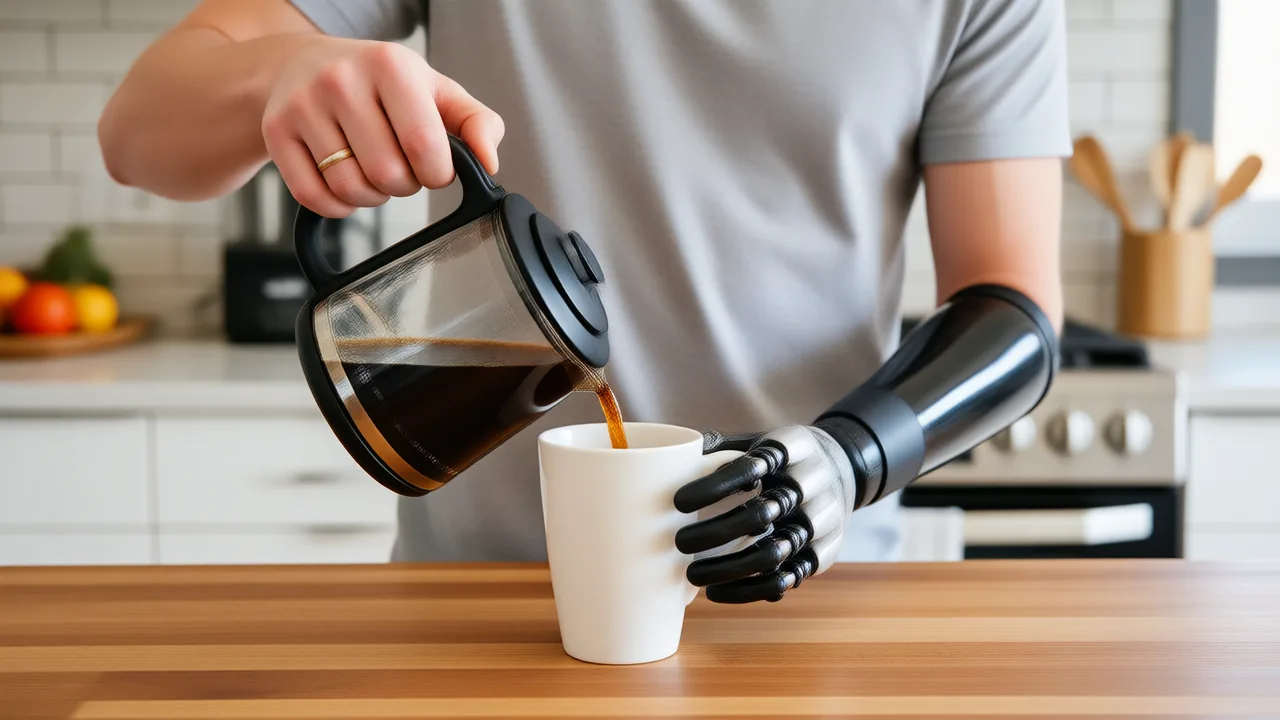
Short answer: A myoelectric prosthetic arm is a battery-powered arm or hand controlled by your own muscles. Sensors inside the socket rest on the skin over muscles in your residual limb. When you tighten one of those muscles, the sensors pick up its tiny electrical signal and tell a motor to open or close the hand, turn the wrist or bend the elbow. No harness, no cables.
This guide is for people with arm loss or a limb difference weighing their options, and for the family members reading along. It covers how the signals actually work, what training looks like, the daily reality of charging and care, and who a myoelectric prosthesis tends to suit. Upper-limb loss is the smaller group: a 2024 US prevalence study found that only 9.2% of people with limb loss had an upper-extremity amputation, which is one reason good plain-language information is hard to find.
For the full lineup of arm prostheses, from passive to hybrid, start with our overview of the main types of prosthetic arms (coming soon).
How a myoelectric prosthetic arm works
Every time a muscle contracts, it produces a small electrical signal. That stays true after an amputation: the muscles in your forearm or upper arm still fire when you think about moving the hand that used to be there. A myoelectric arm listens to those signals.
- The sensors. Electrodes built into the socket sit against your skin over one or more muscles. The socket has to fit closely so they keep contact.
- The controller. A small circuit reads the signals and decides what they mean, such as “open” or “close.”
- The motors. Battery-powered motors move the hand, and in some arms the wrist or elbow too.
The word “myoelectric” just means muscle-electric. It describes the control method, not a brand or a level of technology. A simple myoelectric hand might open and close; an advanced one can move individual fingers. Both count.
Controlling a myoelectric prosthesis: from two muscles to many grips
How you control the arm depends on how many usable muscle signals you have and what the hand can do.
Two-site control
The classic setup uses two muscles. On a below-elbow limb, one muscle group might open the hand and the opposite group close it. Many systems are proportional: a stronger contraction moves the hand faster or grips harder, so you can hold a paper cup without crushing it.
Switching modes
With only two signals, you need a way to tell the arm “now turn the wrist instead.” Common options are a quick contraction of both muscles together, a pulse pattern, a button, or an app. Multi-articulating hands use the same tricks to switch between grip patterns, such as a pinch for small objects or a power grip for a handle.
Pattern recognition and extra control sites
Some systems use several electrodes and software that learns the pattern of muscle activity you make for each movement, so you do not have to think in “open” and “close.” For some people, especially at higher amputation levels, surgeons can reroute nerves to new muscle targets to create extra control sites. That is a surgical decision for you, your surgeon and your rehab team, not a setting on the arm.
Myoelectric arm vs. body-powered arm
The other main option is a body-powered arm, which uses a harness and cable so that shoulder and upper-back movement opens and closes a hook or hand. Neither is better across the board. They are good at different things.
| Myoelectric | Body-powered | |
|---|---|---|
| Controlled by | Muscle signals in the residual limb | Shoulder and body movement through a cable |
| Harness | Usually none | Yes, across the shoulders |
| Feedback | Mostly visual; you watch the hand | You feel cable tension, which tells you grip position |
| Power | Rechargeable battery | You |
| Durability | Electronics dislike water, dust and hard impacts | Generally more tolerant of rough, wet or dirty work |
| Weight | Motors and battery add weight | Usually lighter |
Plenty of people own both, or use a hybrid that combines a body-powered elbow with a myoelectric hand. Our guide to the body-powered prosthetic arm (coming soon) covers the cable side in detail, and our explainer on what “bionic arm” really means (coming soon) sorts marketing terms from real features.
Who a myoelectric arm suits
A myoelectric arm tends to make sense when you have at least one reliable muscle signal, skin that tolerates a close-fitting socket, and daily tasks that benefit from a powered grip without a harness: office work, fine handling, two-handed tasks at home. It is used at many levels, from partial hand to above the elbow. For missing fingers or part of the hand, the options are different enough to have their own guide on prosthetic fingers and partial-hand devices (coming soon).
It may be a harder fit if your work is wet, dusty or heavy, if charging every day is unrealistic, or if you rely on feeling what your hand is doing. Set expectations honestly on that last point: Nationwide Children’s Hospital notes that no prosthesis gives skin sensation. You will not feel texture or temperature through the hand.
The same source explains that children with upper-limb differences often prefer not to use a prosthesis until they are much older, and that it is never too late to revisit one. Kids are fitted around their development, not an adult’s checklist; our guide to prosthetic arms for kids (coming soon) covers timing and choices.
Training: learning to use a myoelectric arm
Nobody puts on a myoelectric arm and deals cards on day one. Training is usually led by an occupational therapist who works with upper-limb prosthesis users, alongside your prosthetist.
- Finding the signals. Before the arm is finished, your prosthetist and therapist test where your strongest, most separate muscle signals are, often with a screen that shows each contraction as you make it.
- Isolating and grading. You practice firing one muscle without the other, then firing it softly or strongly on purpose. This is the foundation of a gentle grip.
- Control practice. Opening, closing, holding, releasing, switching modes, at different arm positions, including overhead and down low.
- Real tasks. Cutting food, carrying a bag, zipping a jacket, typing, the jobs you actually do. The goal is using the arm without thinking about it.
Expect it to feel tiring at first. Concentrating on muscle signals is real mental work, and your therapist will set the pace of wear time and practice for you.
Charging, care and daily life
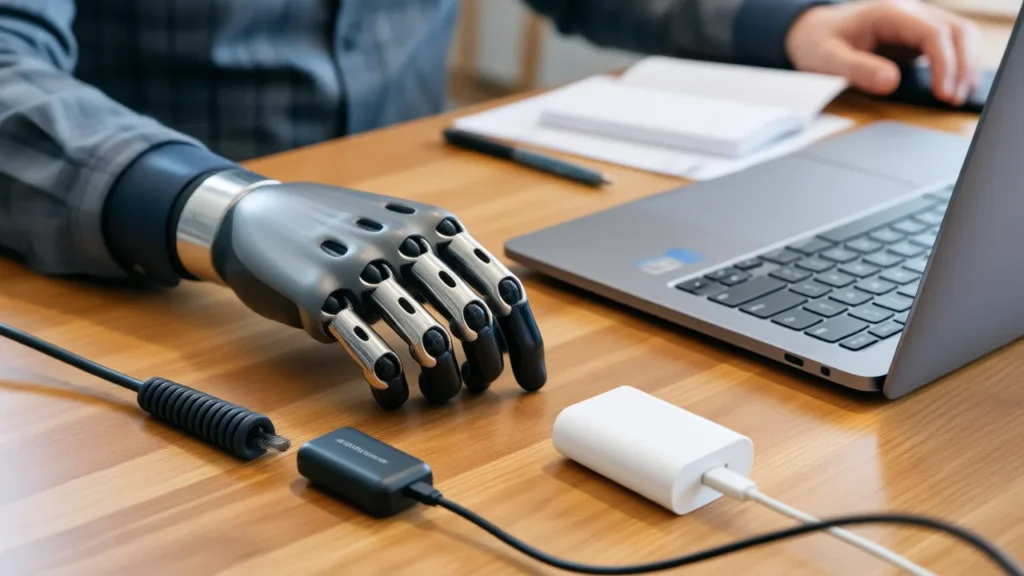
- Charge it like a phone. Build charging into a nightly routine, and ask your prosthetist how long a charge lasts with your hand and your level of use. A spare battery, if your system takes one, is worth asking about.
- Keep the skin and socket clean and dry. Sweat and lotion can interfere with the signal, and skin problems under the electrodes can stop you wearing the arm at all.
- Know the limits. Follow the maker’s instructions on water, dust, weight limits and gloves. Many hands wear a replaceable glove or cover; ask what yours needs.
- Plan for repairs. Electronics break. Ask your prosthetist what happens when the arm needs service, how long that usually takes, and whether a backup device makes sense for you.
Getting a myoelectric arm: prescription and coverage
A myoelectric arm starts with a prescription and documentation from your doctor, then an evaluation, design and fitting by a prosthetist. Coverage depends on your plan and your documented needs.
- Medicare: Medicare.gov says Part B covers prosthetic devices when a doctor or other provider orders them. Once you have paid the yearly Part B amount that comes out of your own pocket first, you pay 20% of the Medicare-approved amount, and the supplier must participate in Medicare.
- Veterans: the VA Amputation System of Care works with VA prosthetic services so Veterans get customized prosthetic limbs, and it teaches prosthetic use and maintenance.
- Work-related need: the Amputee Coalition’s funding guide notes that state vocational rehabilitation agencies usually require you to show how the device helps you get or keep a job. Its Resource Center, at 888-267-5669, option 1, can help with funding questions.
Private plans vary widely. Get your prosthetist to check your benefits before fabrication starts, and ask for any denial in writing so you can appeal it.
When to call your prosthetist, therapist or doctor
Call your prosthetist if the hand opens or closes on its own, stops responding, responds only in certain arm positions, or the socket feels loose or tight. Many signal problems are really fit problems. Call your occupational therapist if control still feels unreliable after practice, or you have stopped using the arm for everyday tasks. Stop wearing it and call your doctor for an open sore, a rash or blisters under the electrodes, redness that spreads, warmth, drainage, fever, new severe pain or numbness. Pain in your shoulders, neck or other arm from overuse deserves a mention to your doctor or therapist too.
Questions to ask before you choose
- How many reliable muscle signals do I have, and where are they?
- What will this hand do that a body-powered device would not, for my actual tasks?
- How long does a charge last, and what is the backup when it is in for repair?
- What are its limits on water, dust and weight?
- Who trains me, how often, and for how long?
- What will my plan cover, and what is my share?
Sources
- Archives of Rehabilitation Research and Clinical Translation (2024) — Estimating Recent US Limb Loss Prevalence and Updating Future Projections
- Nationwide Children’s Hospital — Limb Loss: Adapting to the Challenges and Reaching Milestones
- Medicare.gov — Prosthetic Coverage
- U.S. Department of Veterans Affairs — Amputation System of Care (ASoC)
- Amputee Coalition — Financial Assistance for Prosthetic Services
From the Loud Limb shop: trucker hats and funny amputee shirts & hoodies.
Published by Loud Limb. This guide is general information drawn from the sources listed above, not medical advice. Loud Limb sells printed prosthetic leg covers and clothing and is not a clinic: ask your doctor, surgeon or prosthetist about your own care.