
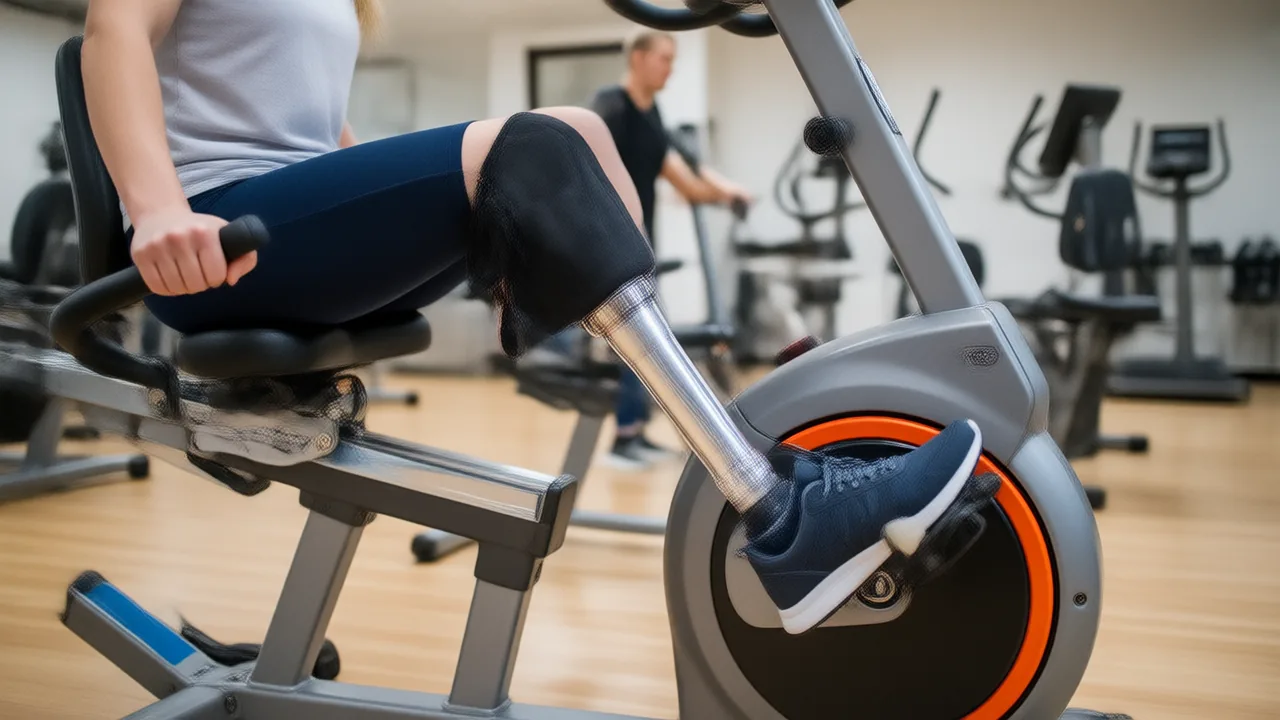
Short answer: The best cardio exercises for amputees are the ones you can do often and safely: a stationary or recumbent bike, a rowing machine, swimming, an arm bike (arm ergometer), seated cardio and plain walking on your prosthesis. Mix options with and without the leg, build toward the CDC’s weekly activity target if you are able, and get your doctor’s go-ahead first.
This guide is for leg amputees who want their heart and lungs working harder, whether you are months out of rehab or years in and bored of the same routine. It covers how much to aim for, which machines work with and without a prosthesis, how to use intervals, and how to protect the joints you are counting on. For team sports, clubs and competition, head to our hub on adaptive sports for amputees.
How much cardio, and how to start
The CDC’s guidance for adults with disabilities says those who are able should get at least 150 minutes a week of moderate aerobic activity, for example 30 minutes on 5 days, plus muscle-strengthening work for all major muscle groups at least 2 days a week. Just as important, it says some physical activity is better than none, and to talk with a health care professional or physical activity specialist about the right types and amounts for you.
Take that last part seriously. If your amputation was related to diabetes or circulation problems, your heart and blood vessels deserve a check too. Ask your doctor before you start or step up cardio, especially if you have heart disease, diabetes or poor circulation, and ask your physical therapist which options suit your amputation level and balance.
Moderate means you are breathing harder but can still talk in short sentences. That is the zone to build most of your time in.
Cardio exercises for amputees wearing a prosthesis
- Walking. Do not underrate it. A 2021 systematic review and meta-analysis found people with lower-limb amputation use significantly more energy to walk than people without one, from about 12% more in non-vascular below-knee amputation to about 102% more in vascular above-knee amputation. A brisk walk is real cardio.
- Stationary or recumbent bike. Low impact and easy to control. A recumbent bike with a backrest is steadier to get on and off. Ask your prosthetist whether your knee and socket tolerate the bend of cycling, and whether a pedal strap would help your foot stay put.
- Elliptical. Smooth, no impact, but it demands balance. Use the handles and start slowly.
- Rowing machine. Works legs, back and arms together. If you row with the prosthesis on, strap the prosthetic foot in securely and let your prosthetist know if the socket rim digs in at the top of the stroke.
Sweat is the catch. A 2014 literature review found more than 53% of people with amputation in the reviewed studies had heat or sweating discomfort inside their prosthesis. Bring a towel, take breaks to dry the liner and your skin, and follow your liner maker’s own cleaning instructions after a workout.
Cardio without the prosthesis
Some days the leg stays off: a sore spot, a socket in for adjustment, or simply a day you want a break. Your cardio does not have to stop.
- Arm bike (arm ergometer). You crank pedals with your hands while seated. It raises your heart rate without loading your residual limb; ask whether your rehab gym or local gym has one.
- Seated cardio. Fast punching, arm circles and seated marching with your sound leg can get you breathing hard. Our guide to chair exercises for amputees has full routines.
- One-leg cycling. Some people ride a stationary bike with the sound leg only. Ask your therapist first; it is tiring and can strain the hip and knee on that side.
- Crutch walking. Serious cardio, but hard on shoulders, wrists and hands. See our guide to crutches for amputees (coming soon) for technique.
Swimming and water workouts
Water takes weight off your joints and lets you move without a socket. The Amputee Coalition’s First Step guide says to get medical clearance from your doctor before getting into the water, that most people remove their prosthesis before swimming, and that a warm pool can relieve aches and pains, improve balance and allow exercise without the burden of a prosthesis.
- Lap swimming, water walking with a pool noodle or kickboard, and deep-water running with a flotation belt all count.
- Plan how you will get from the locker room to the water safely: crutches, a pool wheelchair or a lift.
- Wait until any incision has fully healed and your doctor says the skin is ready.
- If you want to swim with a leg, tell your prosthetist; activity-specific options exist.
Fins can even out your kick; our guide to swimming fins for amputees (coming soon) covers the options.
Intervals: more out of a shorter session
Intervals alternate harder efforts with easy recovery. They are a good fit when long sessions are uncomfortable in a socket, or when the arm bike gets boring. A simple way to start:
- Warm up easy until you feel loose.
- Pick up the pace until talking gets hard, and hold it briefly.
- Slow right down until your breathing settles.
- Repeat a few times, then cool down easy.
Build the number and length of hard efforts gradually, over weeks. Ask your doctor first if you have a heart condition, and your physical therapist if you are unsure how hard is too hard.
Protect your sound leg and your back
After an amputation, the rest of your body picks up the slack. The Amputee Coalition’s guide to avoiding secondary pain reports that in a survey of people with limb loss, nearly 50% reported pain in the non-amputated limb and 62% reported low back pain. It notes that back extension strengthening and balance exercises help decrease stress on the low back and hips.
- Choose low-impact cardio most days: bike, rower, pool, arm bike.
- Rotate machines through the week so no joint takes every session.
- Pair cardio with strength work. Resistance bands are an easy way in, and yoga adapted for amputees (coming soon) helps with balance and flexibility.
When to stop and call your doctor or prosthetist
Stop and get medical help right away for chest pain or pressure, fainting or near-fainting, sudden severe shortness of breath or a racing, irregular heartbeat. Stop exercising and call your doctor if you find an open sore, blister, spreading redness, warmth, drainage or new numbness on your residual limb or sound foot, or pain in your sound leg or back that does not settle. Call your prosthetist if the socket rubs, pinches or loosens during workouts, or the liner slips when you sweat.
A simple starter week
- Day 1: recumbent bike, easy to moderate.
- Day 2: strength with bands, plus a short walk.
- Day 3: pool or arm bike, leg off.
- Day 4: rest or gentle stretching.
- Day 5: rower or bike with a few short intervals.
- Weekend: a walk somewhere you actually like.
Pack a towel, water, a spare liner if your prosthetist recommends one, and fresh socks for your sound foot. If you like your gym socks loud, we make printed crew socks for exactly that job.
Sources
- CDC — Chronic Conditions & Disabilities Activity: Physical Activity Basics
- Prosthetics and Orthotics International (2021) — General estimates of the energy cost of walking in people with different levels and causes of lower-limb amputation
- Journal of Rehabilitation Research and Development (2014) — Prevalence of heat and perspiration discomfort inside prostheses: literature review
- Amputee Coalition — First Step: A Guide for Adapting to Limb Loss (2025)
- Amputee Coalition — Avoiding Secondary Pain
From the Loud Limb shop: prosthetic leg covers in loud prints and printed athletic shorts. Our covers go on the outside of a below-knee prosthesis; measure yours first with the size guide.
Published by Loud Limb, a shop for printed prosthetic leg covers, socks and clothing.