
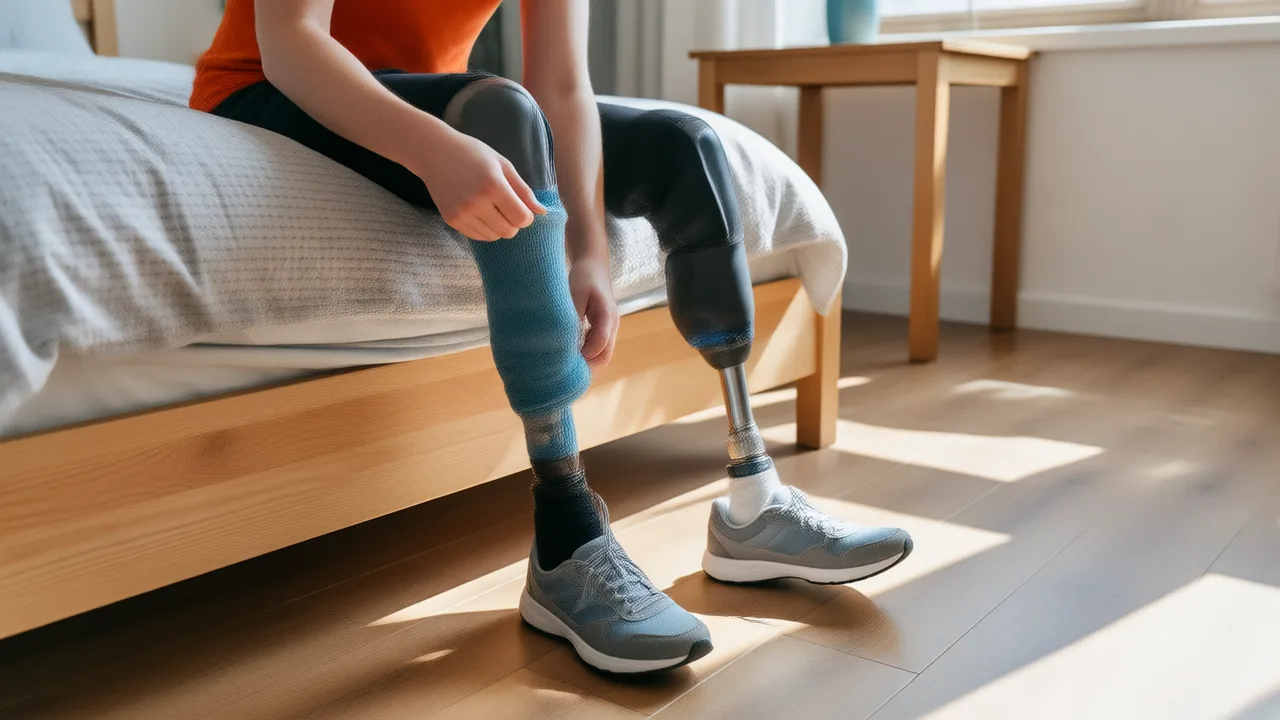
Short answer: Good prosthetic socket fit feels snug and even, like a firm handshake around the whole limb. Pressure sits on the areas built to take it, bony spots are relieved, the leg does not slide up and down as you walk, and nothing hurts. After you take it off, your skin should show only mild redness that fades soon. Fit changes through the day, which is what socks are for.
This guide is for anyone wearing a leg who has thought “is it supposed to feel like this?” It covers what a well-fitting socket feels like, which parts of the limb can take pressure and which cannot, why the fit drifts during the day, how liners, socks and suspension affect comfort, the fixes you can make yourself, and the signs that mean it is time to call your prosthetist.
The socket is the only part of a prosthesis made just for you, and it is where comfort is won or lost. A great foot or knee cannot make up for a socket that hurts.
What good prosthetic socket fit feels like
There is no single sensation that means “perfect,” but a socket that fits well tends to pass all of these checks:
- Snug, not squeezing. You feel contact all the way around, with firm pressure where it belongs and no spot that throbs or goes numb.
- No pistoning. The limb does not noticeably slide up and down inside the socket as you step, and the leg does not feel like it is trying to fall off when you lift it.
- No bottoming out. You do not feel the end of your limb hitting the bottom of the socket, which usually means the limb has shrunk and needs more sock or a fit check.
- Stable when you stand. The leg feels solid under you, not wobbly or rotating.
- Clean skin afterward. When the leg comes off, any redness is mild, sits where the socket is meant to load, and fades soon after. No blisters, no open spots, no dark or purple marks.
- Wearable all day. You can wear it for your normal day without counting the minutes until it comes off.
A brand-new socket is different. Your skin and tissue need time to adjust, and your prosthetist will usually build up your wearing time and fine-tune the fit over several visits. Mild tiredness in new places is expected at first. Pain is not.
Pressure-tolerant and pressure-sensitive areas
A socket is not a tube that squeezes everything equally. It is shaped to put more load on tissue that can handle it and less on areas that cannot, which is why two sockets for the same limb can feel completely different. The VA/DoD guide to residual limb management lists learning your pressure points, along with skin checks, hygiene, sock ply and wear schedule, as core parts of patient education.
For a typical below-knee limb, the areas usually look like this. Your own limb may differ, especially if you have scar tissue, skin grafts or a sensitive spot, so ask your prosthetist to show you where your socket is designed to load and where it relieves.
| Usually designed to take more pressure | Usually relieved or given more room |
|---|---|
| The tendon just below the kneecap | The end of the shin bone |
| The fleshy inner flare of the shin bone | The sharp front edge of the shin |
| The calf muscles at the back | The bony knob on the outer side, just below the knee |
| The soft tissue along the sides of the shin | The hamstring tendons behind the knee, so you can bend it |
Above-knee sockets follow the same principle with different anatomy. They spread load across the thigh muscles and the area around the sit bone, and they are shaped to keep pressure off sensitive tissue in the groin. If an above-knee socket pinches at the top edge when you sit or walk, that is a fit issue to report, not a toughness test.
Why your prosthetic fit changes during the day
Your residual limb is not a fixed shape. Its volume normally shifts through the day, and over weeks and months with activity, heat and weight changes, and the socket does not change with it. A 2014 survey of people with below-knee amputations found that daily changes in limb shape and size affect socket fit, and that people manage it by adding or removing socks. On average, sock ply rose over the day from 4.8 to 5.5, a sign that limbs tended to shrink as the day went on. The same participants wore their prostheses about 14 to 15 hours a day, which is a lot of hours for a small mismatch to add up.
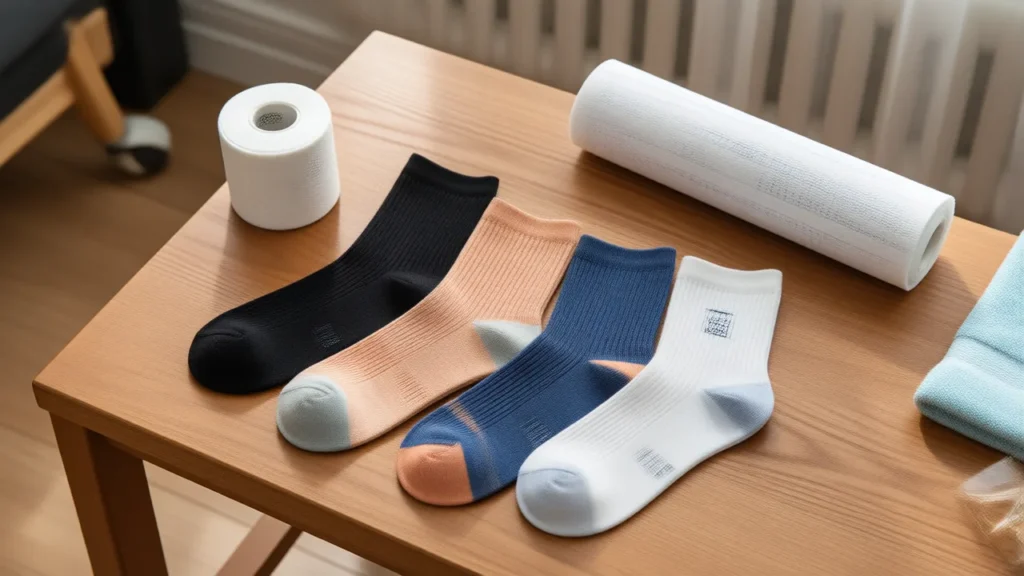
Socks are the everyday adjustment tool. They come in plies (thicknesses), and adding a ply takes up space when the limb shrinks. Two things make this trickier than it sounds:
- Ply is not a precise measurement. Socks from different makers and materials are not the same thickness at the same ply number.
- Socks get thinner as you wear them. A 2016 study found prosthetic socks averaged 75% of their original thickness after a month of normal use. If your fit feels loose and you have been wearing the same socks for weeks, the socks may have changed, not you.
Keep a few spare plies with you, note how many you are wearing at different times of day, and tell your prosthetist when the numbers creep. If you are regularly needing a lot more socks than when the socket was made, the socket may need adjusting or replacing. For the difference between socks, stump socks and liners, see our guide to socks and liners.
Liners: the layer that decides how the socket feels
Most people today wear a liner, a soft sleeve of silicone, gel or similar material rolled onto the skin. It cushions the limb, grips it and spreads pressure. A liner that is the wrong size, the wrong thickness or worn out can make a good socket feel bad.
How you put the liner on matters as much as which one you have. The VA/DoD guide warns that liners and sleeves can cause shear on the skin if they are pulled up instead of rolled up. Turn the liner inside out, place it flat against the end of the limb with no air pocket, and roll it up without stretching or twisting.
Liners differ in material, thickness, profile and whether they have a pin or a seal. Our guide to prosthetic liner types (coming soon) explains what each material is good at and why your prosthetist might switch you from one to another. Always follow your own liner’s care instructions, because they differ by manufacturer.
Suspension: how the leg stays on affects how it feels
Suspension is whatever holds the prosthesis on, and a surprising amount of “bad fit” is really a suspension problem. The VA/DoD guide notes that pistoning can come from insufficient suspension, a loose socket or a locking liner that is too stretchy. A systematic review of below-knee suspension systems found that no single system has the clinical evidence to be the standard for everyone, and that sweat control is a major concern with the liners they all rely on.
The main options, each with its own guide:
- Suction. Air is pushed out as you step in and a one-way valve keeps it out, so the socket holds by seal. See how a suction socket works (coming soon).
- Elevated vacuum. A pump, mechanical or electric, actively draws air out between liner and socket. See vacuum suspension explained (coming soon).
- Pin lock. A pin on the end of the liner clicks into a lock at the bottom of the socket. Simple to use; some people feel a pulling sensation at the end of the limb. See the pin lock prosthesis guide (coming soon).
- Suspension sleeve. A sleeve rolled over the top of the socket and onto the thigh creates the seal. See choosing and wearing a suspension sleeve (coming soon).
If the leg feels loose only at certain times, like late afternoon or after a hot day, suspension and volume are probably working against each other. That is worth describing to your prosthetist in exactly those words.
Socket designs built around fit
Sockets themselves come in several designs, and some exist specifically to solve fit problems. Our overview of prosthetic socket types covers the main shapes and what each one is good at. Two designs come up often in fit conversations:
- Adjustable sockets let you or your prosthetist change the fit, for example with a dial and cables or panels that tighten. They are often considered for limbs whose volume changes a lot. Read more in the adjustable socket guide.
- Flexible inner sockets pair a thin, flexible inner shell with a rigid outer frame, which can make sitting and certain movements more comfortable. See how a flexible inner socket works.
Whether any of these suits you depends on your limb, your activity and what your prosthetist and insurer agree on. They are worth asking about if you are fighting the same fit problem month after month.
How to make a prosthetic leg more comfortable: what you can check yourself
Before you book an appointment, run through the fixes that are yours to make. None of these involve changing the leg itself.
- Adjust your socks. Add a ply if the leg feels loose or you are bottoming out; remove one if it feels tight or you cannot get fully in. Replace socks that have worn thin.
- Put the liner on properly. Rolled, not pulled, with no wrinkles or trapped air at the end.
- Keep everything clean and dry. Sweat and residue on the liner or socket change how it grips. Clean your liner the way its maker says to, and dry your limb fully before putting it on.
- Manage heat. A literature review found more than 53% of people with amputation in the studies had heat or sweating discomfort inside their prosthesis. Taking the leg off for a few minutes to dry the limb and liner when you can, and carrying a small towel, can make a long day easier.
- Check your shoes. The leg is aligned for a certain heel height. Switching to a much higher or flatter shoe can make the socket feel wrong even if nothing inside it has changed.
- Look at what is outside the socket, not inside. Anything worn on the outside of the leg, like pants or a printed leg cover, belongs over everything and never inside the socket or under a suspension sleeve. If you ever need the leg’s outside dimensions, here is how to measure a prosthetic leg.
If you have run through the list and it still does not feel right, stop there. Do not add padding, tape or foam inside the socket on your own. It changes where the pressure goes, often onto a spot that cannot take it.
Fit problems and when to call your prosthetist
Your prosthetist expects these calls. Adjusting fit is a normal part of the job, and small problems are easier to fix before they turn into skin problems.
| What you notice | What it often means | Who to call |
|---|---|---|
| Leg slides up and down as you walk | Volume loss, worn socks or a suspension issue | Prosthetist |
| Pressure or pain at the end of the limb | Limb has shrunk and is bottoming out | Prosthetist |
| Needing far more socks than when the socket was made | The socket may need adjusting or replacing | Prosthetist |
| Redness in a new spot, or redness that does not fade | A pressure point in the wrong place | Prosthetist, and your doctor if the skin breaks |
| Hard to get in, or tight at the top | Limb has swollen or gained volume | Prosthetist |
| Clicking, squeaking or a loose feeling in the leg itself | Hardware or alignment | Prosthetist |
Stop wearing the leg and call your doctor if you find an open sore, a blister, a wound, redness that spreads or feels warm, drainage, a fever, new severe pain or numbness. Those are skin or circulation problems first and fit problems second. Let your doctor check the skin, then work with your prosthetist on what caused it. If you have diabetes or circulation problems, call sooner rather than later, because small skin problems can become serious quickly.
A quick daily fit check
Build this into the end of the day, when the leg comes off:
- Look at every side of the limb, using a mirror or your phone camera for the back.
- Note any redness: where it is, and whether it fades.
- Write down how many plies you ended the day in.
- Check the liner for tears or thin spots, and the socks for wear.
- Clean the liner and the inside of the socket as their instructions say.
After a week or two, those notes turn a vague “it just doesn’t feel right” into something your prosthetist can actually fix. Bring them to your next visit.
Sources
- VA/DoD Lower Limb Amputation CPG clinical support tool (2025) — Residual Limb Management in Lower Limb Amputation
- Prosthetics and Orthotics International (2014) — Self-reported prosthetic sock use among persons with transtibial amputation
- Prosthetics and Orthotics International (2016) — Amputee socks: Sock thickness changes with normal use
- Clinical Biomechanics (2014) — Transtibial prosthesis suspension systems: systematic review of literature
- Journal of Rehabilitation Research and Development (2014) — Prevalence of heat and perspiration discomfort inside prostheses
From the Loud Limb shop: funny amputee shirts & hoodies.
Published by Loud Limb. This guide is general information drawn from the sources listed above, not medical advice. Loud Limb sells printed prosthetic leg covers and clothing and is not a clinic: ask your doctor, surgeon or prosthetist about your own care.