
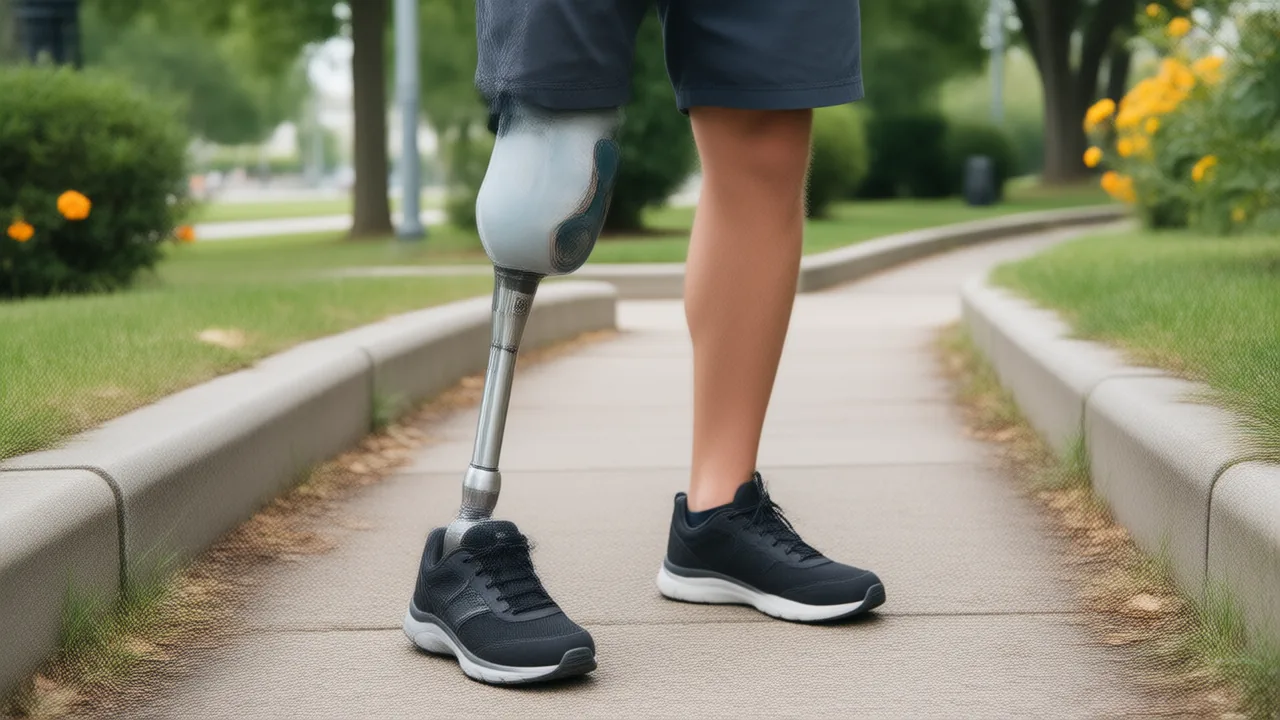
Short answer: The main prosthetic foot types are SACH (solid ankle cushion heel), flexible or elastic keel, single-axis, multiaxial, dynamic-response (energy-storing), hydraulic ankle, microprocessor and powered feet. Simpler feet cushion and stay stable. Dynamic-response feet flex and spring back so walking takes less effort. Hydraulic and microprocessor ankles adjust to slopes, and powered feet add a battery-driven push-off. Your activity level, rated as a K-level, largely shapes which one you get. If you still have part of your foot, partial foot prostheses are a separate family.
This guide is for anyone about to be fitted for a first foot, anyone whose prosthetist just said “we’re thinking about switching your foot,” and anyone who has stared at a foot catalog and wondered why there are so many. It covers how each type works, who it tends to be chosen for, which feet Medicare covers at each K-level, the options after a partial foot amputation, and where the knee fits in if you have one.
A quick reality check before the tour: the “best” foot does not exist in the abstract. The Amputee Coalition lists what goes into the choice: amputation level, age, weight, foot size, activity level, goals and job needs. A foot that is perfect for a trail runner can feel twitchy and tiring for someone who mostly needs to get safely from the car to the kitchen.
Key facts
- The Amputee Coalition sorts prosthetic feet by function into SACH, elastic (flexible) keel, single-axis, multi-axis, dynamic-response and microprocessor feet. (Source: Amputee Coalition, checked )
- Most prosthetic feet last 3 to 5 years, depending on how much they are used. (Source: Cleveland Clinic, checked )
- Medicare’s policy covers a SACH (L5970) or single-axis foot (L5974) from functional Level 1, and a flexible-keel (L5972) or multiaxial foot (L5978) from Level 2. (Source: CMS – Medicare LCD L33787, checked )
- With Medicare Part B, a person pays 20% of the Medicare-approved amount for a medically necessary artificial leg, after the Part B deductible. (Source: Medicare.gov, checked )
Types of prosthetic feet at a glance
The Amputee Coalition sorts prosthetic feet into functional categories: SACH, elastic keel, single-axis, multi-axis, dynamic-response and microprocessor. Hydraulic ankles are often discussed as their own group because they add an adjustable ankle to a flexible foot, and Hanger Clinic also lists powered feet and partial foot and toe devices as groups of their own. Here is the short version of each.
| Foot type | How it works | What it trades off |
|---|---|---|
| SACH | A rigid core with a soft, compressible heel; no moving ankle | Simple, stable and low-maintenance; returns little energy |
| Flexible (elastic) keel | A keel that bends a little under your weight and gives some of it back | Smoother roll-over than SACH; still a basic foot |
| Single-axis | A hinge at the ankle lets the foot point down and up | Gets flat on the ground quickly; moves in one direction only |
| Multiaxial | The ankle can move in several directions, including side to side | Adapts to uneven ground; can feel less firm on flat floors |
| Dynamic-response | A springy keel, often carbon fiber, that stores energy and releases it at push-off | Less effort for active walkers; can feel too stiff at low speeds |
| Hydraulic ankle | An oil-filled ankle unit lets the foot settle to the angle of the ground | Smoother on slopes and when standing; heavier and more to maintain |
| Microprocessor | Sensors, a battery and a controller adjust the ankle as you move | Most adaptable; needs charging and the most upkeep |
| Powered | A battery-driven ankle adds push-off at the end of each step | Some users report less fatigue; heavy, charged daily, and Medicare does not cover the power assist |
| Partial foot | An insert, brace, silicone device or carbon footplate fills in the missing part of the foot | For people who keep part of their foot; helps stability and shoe fit |
Most real feet mix features. A foot can have a dynamic-response keel and a multiaxial ankle, or a flexible keel with a hydraulic unit bolted on top. The categories describe the main idea, not every model.
What a prosthetic foot is made of, and how it attaches
Under the shoe, most prosthetic feet share a few parts. Knowing their names makes a fitting appointment much easier to follow.
- Keel: the core that runs along the sole. In the most basic feet, the Amputee Coalition explains, neoprene or urethane foam is molded over an inner keel and shaped to look like a human foot. A rigid keel feels steady; a flexible or carbon-fiber keel bends and gives some energy back.
- Heel: the part that takes the first hit of each step. On a SACH foot it is a soft rubber wedge that compresses under load to imitate the ankle bending.
- Ankle: Cleveland Clinic notes that a prosthetic leg needs an ankle joint, but that it is usually part of the foot. Depending on the foot, it can be a fixed connection, a mechanical hinge, a hydraulic unit or a computer-controlled one.
- Foot shell or cover: the foot-shaped outer layer that lets the foot wear a shoe. Össur, for example, supplies its Pro-Flex XC with an anatomical foot cover.
- Connector: the fitting on top of the foot that joins it to the rest of the leg. On the Pro-Flex XC, Össur lists it as an integrated pyramid.
Above the foot, Cleveland Clinic describes the rest of the leg as a socket custom-made to fit your limb, a suspension system that holds the leg on (straps or belts, suction liners, pin-locking liners, electric vacuum pumps or sleeves), and a “skeleton” that is often a metal pipe, or pylon, connecting the socket to the joints and the foot. Our guides to how prosthetic legs attach, the prosthetic pylon (coming soon) and the prosthetic foot shell (coming soon) go into each part.
SACH and flexible keel feet: simple, stable and often first
Cleveland Clinic calls the SACH foot the simplest prosthetic foot and says it is often the first one a person uses. It has no ankle joint. Instead, a cushioned heel compresses when your heel hits the ground, which imitates the ankle bending, and a solid forefoot lets you roll over the toe.
That simplicity is the point. There is nothing to adjust, nothing to charge and very little to break. For someone learning to stand and walk again, a foot that behaves the same way every time is a feature, not a limitation. The downside is that it does not give much back: the Amputee Coalition notes that SACH and elastic keel feet cushion but return less energy than dynamic-response feet.
A flexible keel foot is one step up. The same Cleveland Clinic page explains that a flexible keel stores and transfers energy by bending slightly under your weight, which makes the roll from heel to toe feel less like stepping off a block. For the full rundown, including who these feet usually suit and how they feel in different shoes, see our guide to the SACH foot.
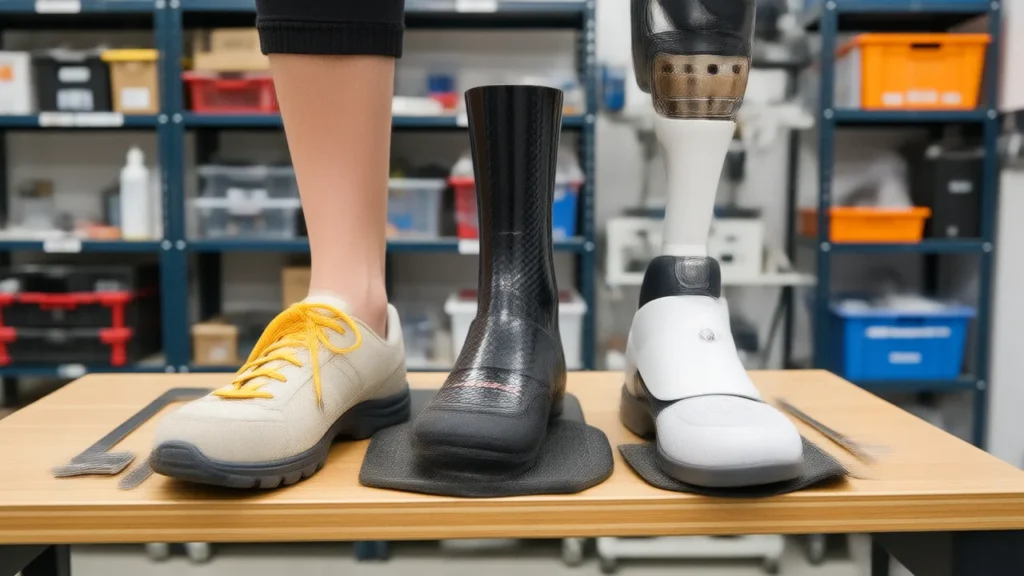
Single-axis and multiaxial feet: an ankle that moves
The next two types add movement at the ankle, which changes how the foot meets the ground.
Single-axis
A single-axis foot has a hinge that lets the front of the foot drop toward the floor after the heel lands, then come back up. Rubber bumpers control how far it moves each way. Because it gets the whole foot flat on the ground quickly, prosthetists sometimes choose it when stability is the priority, including for some above-knee users who need the knee to feel steady early in each step. The trade-off is that it only moves in one direction. Our guide to the single-axis prosthetic foot (coming soon) covers the bumpers, the maintenance and when it makes sense.
Multiaxial
A multiaxial foot can also tilt side to side and rotate a little, so it can follow the shape of uneven ground: a sloped driveway, a lawn, a gravel path. Some people find it feels less firm underfoot on smooth, flat floors. See the multiaxial prosthetic foot guide for how it compares on different terrain.
Dynamic-response feet: the energy-storing option
If you have seen a prosthetic foot shaped like a curved carbon-fiber blade inside a foot shell, you have seen a dynamic-response foot. Cleveland Clinic explains that these feet use materials like carbon fiber that spring back at push-off, so walking takes less energy, and that they are also called energy-storing-and-return (ESAR) feet.
Here is the idea in plain terms. As you roll forward over the foot, the keel bends like a diving board. As your weight comes off it, the keel straightens and gives you a small push forward. The Amputee Coalition notes that many modern prosthetic feet store and return some of the energy generated during walking; dynamic-response feet are built to do the most of it.
The catch is that the spring has to be matched to you. A keel that is too stiff for your weight and speed feels like walking on a plank, and one that is too soft feels mushy. Prosthetists choose the stiffness category for your body weight and activity, then fine-tune the alignment. Our guide to the dynamic-response prosthetic foot (coming soon) explains stiffness, heel height and why these feet can feel strange for the first few weeks.
At the far end of this family are activity-specific feet. The Amputee Coalition’s First Step guide describes feet designed for activities such as swimming, running and skiing. A running blade, for example, is built for one job and usually is not the foot you want to wear around the house.
Hydraulic, microprocessor and powered feet: ankles that adapt
Hydraulic ankles
A hydraulic ankle has a small cylinder of oil with valves inside. Instead of snapping back to one fixed angle, the ankle lets the foot settle to the angle of the ground under it, then resists movement smoothly as you roll over it. People usually consider one for walking on ramps and hills, for standing for long periods, and for a smoother feel overall. The trade-offs are weight, cost and servicing. The hydraulic prosthetic foot (coming soon) guide covers what the ankle does on slopes and stairs and what upkeep looks like.
Microprocessor feet
A microprocessor foot adds sensors, a controller and a battery. It reads how you are moving and adjusts the ankle, for example setting a different angle for walking downhill than uphill. It is the most adaptable option and the most demanding one: it needs charging, it has electronics to protect from water, and it needs regular servicing. See our guide to the microprocessor foot (coming soon) for who these feet are usually considered for and what to ask before you try one.
Powered feet
A powered foot goes one step further: a battery-driven ankle adds push-off at the end of each step, imitating the push your foot and ankle muscles used to give. Hanger Clinic says these feet are generally comparatively heavy and need daily battery charging, and that appropriate patients have reported less fatigue with them. Cleveland Clinic makes a similar point about some microprocessor models, which use their electric power to help propel the foot. One example is Ottobock’s Empower, which the maker describes as giving powered propulsion at toe-off and designs for active users. Coverage is the big hurdle: Medicare’s policy does not cover the power-assist addition, as the K-level section below explains. Our guide to the bionic leg (coming soon) covers powered knees and ankles in more depth.
Partial foot and toe prostheses
Not everyone who needs a foot prosthesis has lost the whole foot. After a toe or partial foot amputation, the device fills in the part of the foot that is missing. Hanger Clinic says partial foot and toe solutions can improve stability, help shoes fit and restore the foot’s appearance. Cleveland Clinic lists four options:
- Shoe insert: a custom orthotic insert that fills in the missing part of the foot.
- Ankle-foot orthosis (AFO): a foot plate and ankle brace that straps onto your foot and shin, modified to fill in the missing part.
- Silicone partial foot prosthesis: flexible and lifelike, modeled by a prosthetist to look like your natural foot and to fit it precisely. If a realistic look matters to you, this is the option to ask about.
- Toe-length carbon fiber footplate: a flexible carbon fiber insole that runs to where your toes would end and gives a springlike action.
Which one fits depends on how much of the foot is left and what you need it to do, so it is a decision to make with your prosthetist. Our overview of types of prosthetic legs shows where partial foot devices sit among the amputation levels, and our guides to the partial foot prosthesis (coming soon) and the prosthetic toe (coming soon) go into each option.
How K-levels shape the choice
For people on Medicare, the foot you can get covered depends largely on your functional level. The Medicare coverage policy for lower limb prostheses (LCD L33787) says Medicare decides which prosthetic components are medically necessary based on your potential functional abilities, rated from Level 0 to Level 4. These are the “K-levels” you will hear about.
- Level 1: can use a prosthesis for transfers or walking on level surfaces at a fixed pace.
- Level 2: can walk and get over low barriers such as curbs, stairs or uneven surfaces.
- Level 3: can walk at variable speeds.
- Level 4: goes beyond basic walking with high impact, stress or energy, as athletes do.
The CMS guidance for providers adds some details worth knowing. Your level is based on your prosthetist’s and treating practitioner’s reasonable expectations, plus your history and current condition, so it is about what you are expected to be able to do, not only what you can do in week one. A Level 3 walker can independently cover terrain that varies in texture and level, such as grass or gravel. And people with two leg amputations often cannot be strictly bound by the classifications at all.
In general, simpler feet line up with lower levels and energy-storing and microprocessor feet with higher ones (the table below has the exact list), but your prosthetist is the person who knows exactly what your documentation supports. If you walked a lot before your amputation, or have clear goals like returning to a job on your feet, say so, early and specifically. Our guide to Medicare K-levels (coming soon) explains how the level is assessed and what to do if you think yours is wrong. Private insurers set their own rules, so check your plan too.
Which feet Medicare covers at each level
The same Medicare policy spells out which feet go with which level. It says basic lower limb prostheses include a SACH foot, and that other feet are covered based on functional level. Each foot type has a billing code (an “L-code”), and the policy groups them like this:
| Functional level | Feet the policy covers (L-code) |
|---|---|
| Level 1 or above | External keel SACH foot (L5970); single-axis ankle/foot (L5974) |
| Level 2 or above | Flexible-keel foot (L5972); multiaxial ankle/foot (L5978) |
| Level 3 or above | Microprocessor-controlled ankle foot system (L5973); energy-storing foot (L5976); dynamic-response foot with multiaxial ankle (L5979); flex foot system (L5980); flex-walk system or equal (L5981); shank foot system with vertical loading pylon (L5987) |
| Not covered | Power-assist addition with a motor (L5969); user-adjustable heel height (L5990) |
Three details in the policy are worth knowing. First, a Level 3 foot can also be covered for someone at Level 2 who meets the Level 2 criteria for a fluid, pneumatic or microprocessor knee and needs the higher-level foot to use that knee safely. Second, coverage depends on clinical documentation of why you need that foot’s particular feature, kept in your practitioner’s or prosthetist’s files. Third, the policy says there is not enough information to show that the power-assist addition meets Medicare’s “reasonable and necessary” standard, so claims for it are denied.
Here is how that looks for a real foot: Össur lists reimbursement code L5981 for its Pro-Flex XC, which puts it in the Level 3 row above. When your prosthetist suggests a foot, asking for its L-code tells you which row applies.
What Medicare pays for a prosthetic foot
Medicare Part B covers medically necessary artificial legs when a doctor or other health care provider orders them. According to Medicare.gov, after the Part B deductible you pay 20% of the Medicare-approved amount. Medicare only pays for a prosthetic device from a supplier that participates in Medicare, and for certain types of lower-limb prosthetics, including microprocessor knees and some prosthetic feet, Medicare requires prior authorization before it will pay. CMS’s Required Prior Authorization List has applied this nationwide since December 1, 2020. What you actually owe also depends on other insurance you may have. Our guides to the cost of prosthetics and to whether Medicare covers prosthetics (coming soon) walk through the numbers and the paperwork.
Feet and knees work as a team
If your amputation is above the knee or through it, the foot does not work alone. The knee and foot are chosen together, because the way the foot meets the ground affects whether the knee feels stable. A foot that gets flat quickly can make a simpler knee feel steadier; a springy foot may pair better with a knee that handles faster walking.
Knees have their own categories, from locking and single-axis knees to hydraulic and pneumatic knees and microprocessor knees. Medicare’s LCD L33787 covers fluid, pneumatic and microprocessor knees for functional Level 3 or above, and for Level 2 only in limited circumstances. Our guide to prosthetic knee types (coming soon) goes through each one and how it pairs with a foot.
How you and your prosthetist choose a foot
Choosing a foot is a conversation, not a catalog order. Hanger Clinic puts it simply: your clinician evaluates your needs and activities and helps you decide which option is best for you. A few things come up in that conversation.
- Your goals and daily routine. The Amputee Coalition’s list from the start of this guide (amputation level, age, weight, foot size, activity level, goals and job needs) is the starting point. Be concrete: “I walk the dog on gravel every morning” tells your prosthetist more than “I’m fairly active.”
- Your weight and how hard you will use the foot. Makers rate each foot for a body-weight range and an impact level. Össur, for example, lists its Pro-Flex XC for a patient weight range of 99 to 365 lbs and for low, moderate and high impact. Tell your prosthetist if your weight or activity changes a lot.
- Your shoes. A foot is set up for a heel height. The Amputee Coalition notes that the SACH foot comes in various heel heights to match different shoes, and that some feet have adjustable heel heights. Medicare’s policy denies a user-adjustable heel height feature (L5990) as not reasonable and necessary, so ask how that affects you. Bring the shoes you wear most to the fitting.
- Time. Cleveland Clinic says getting a prosthetic foot takes several months: appointments to talk about your needs and goals, measurements and molds of your limb, then several weeks while the prosthesis is made to order. Getting used to a new foot may take several months more, and an occupational or physical therapist can help you adapt your everyday activities.
- Replacement. Most prosthetic feet last three to five years, depending on how much you use them, Cleveland Clinic says, and the fit may need adjusting before that because your limb can change shape and size over time.
Our guides to what prosthetists do (coming soon), how to find a good prosthetist (coming soon) and how long prosthetic legs last (coming soon) cover each step in more depth.
When to call your prosthetist or doctor
A foot is a mechanical part, and mechanical parts wear. Call your prosthetist if the foot starts squeaking or clicking, the heel feels harder or softer than it used to, the foot shell or sock is torn, the leg feels longer or shorter, or you start catching your toe. Ask before changing to shoes with a very different heel height, since that changes how the whole leg is aligned. A new foot also needs a few adjustment visits; if it still feels wrong after that, say so rather than getting used to it.
Stop wearing the leg and call your doctor if you notice an open sore, a blister, redness that spreads or does not fade, warmth, drainage, a fever, new severe pain or numbness in your residual limb. A new foot can change the pressure inside the socket, so skin problems sometimes show up after a foot swap. Your doctor should see them before anyone adjusts the leg.
Before you try a new foot: questions to ask
- What category is this foot, and why is it the right one for my weight, activity and goals?
- What functional level is my documentation based on, and does it reflect what I want to do?
- Which L-code will this foot be billed under, and does my functional level match it?
- What weight range and impact level is it rated for, and where do I fall in that range?
- How will this foot feel different from the one I have now, and how long should I give it?
- Can I trial it before it becomes my permanent foot?
- What heel height is it set up for, and which shoes should I bring to the fitting?
- What maintenance does it need, and does it need charging or servicing?
- If I have an above-knee leg, how does this foot change how my knee behaves?
Write your answers down. When the next foot catalog lands on the table, you will know exactly which pages matter.
Prosthetic feet: common questions
Will Medicare pay for a prosthetic foot?
Yes, when it is medically necessary and a doctor or other provider orders it. Medicare Part B covers artificial legs, and after the Part B deductible you pay 20% of the Medicare-approved amount. Which foot is covered depends on your functional level (K-level). Medicare does not cover the power-assist addition (L5969) or a user-adjustable heel height (L5990).
How long does a prosthetic foot last?
Cleveland Clinic says most prosthetic feet last three to five years, depending on how much you use them. The fit may need adjusting before then, because your residual limb can change shape and size over time.
How does a prosthetic foot attach to the leg?
The foot connects to the rest of the leg, often through a metal tube called a pylon that runs up to the socket. The socket is custom-made for your limb and held on by a suspension system such as a suction liner, a pin-locking liner or a sleeve.
What is the most basic prosthetic foot?
The SACH foot, short for solid ankle cushion heel. Cleveland Clinic calls it the simplest prosthetic foot and says it is often the first one a person uses. It has no moving ankle; a soft heel compresses when you step down. It is stable and low-maintenance but returns less energy than a dynamic-response foot.
Is a carbon fiber prosthetic foot better?
Better for some people, not for everyone. Carbon-fiber dynamic-response feet spring back at push-off, so walking can take less energy, which suits active walkers. At slow speeds a stiff keel can feel like a plank. The right foot depends on your weight, activity and goals, so let your prosthetist match the stiffness to you.
Can you change prosthetic feet without a new socket?
Often the foot can be swapped on the same leg, because feet bolt on below the pylon. But a new foot usually changes the alignment and can shift pressure inside the socket, so it needs a proper fitting and follow-up adjustments by your prosthetist. Insurance approval for a new foot is a separate question to check first.
Do prosthetic feet fit in normal shoes?
Most everyday prosthetic feet wear a foot shell shaped like a foot and go into ordinary shoes. The catch is heel height: the leg is aligned for a certain heel, and switching to a much higher or flatter shoe can change how the whole leg behaves. Ask your prosthetist which heel height your foot is set for.
Why won’t insurance pay for a microprocessor foot?
Coverage depends on documented need. Medicare decides which components are medically necessary based on your potential functional level, rated from Level 0 to Level 4, and its policy covers a microprocessor-controlled ankle foot system (L5973) from Level 3. Private insurers set their own rules. If you think your level understates what you can do, talk to your prosthetist and rehab doctor about the documentation before appealing.
Sources
- Amputee Coalition — Prosthetic Feet
- Cleveland Clinic — Prosthetic Foot: What It Is, Who Needs It & How It’s Used
- Cleveland Clinic — Prosthetic Leg: What It Is, Who Needs It & How It’s Used
- Hanger Clinic — Types of Prosthetic Feet
- Amputee Coalition — First Step: A Guide for Adapting to Limb Loss (2025)
- CMS Medicare Coverage Database — LCD Lower Limb Prostheses (L33787), revision effective 04/01/2026
- CMS Medicare Learning Network — Lower Limb Prostheses
- Medicare.gov — Artificial eyes & limbs
- Medicare.gov — Prosthetic devices
- Össur — Pro-Flex XC (product specifications)
- Ottobock — Empower
From the Loud Limb shop: printed crew socks and prosthetic leg covers in loud prints. Our covers go on the outside of a below-knee prosthesis; measure yours first with the size guide.
Published by Loud Limb. This guide is general information drawn from the sources listed above, not medical advice. Loud Limb sells printed prosthetic leg covers and clothing and is not a clinic: ask your doctor, surgeon or prosthetist about your own care.