
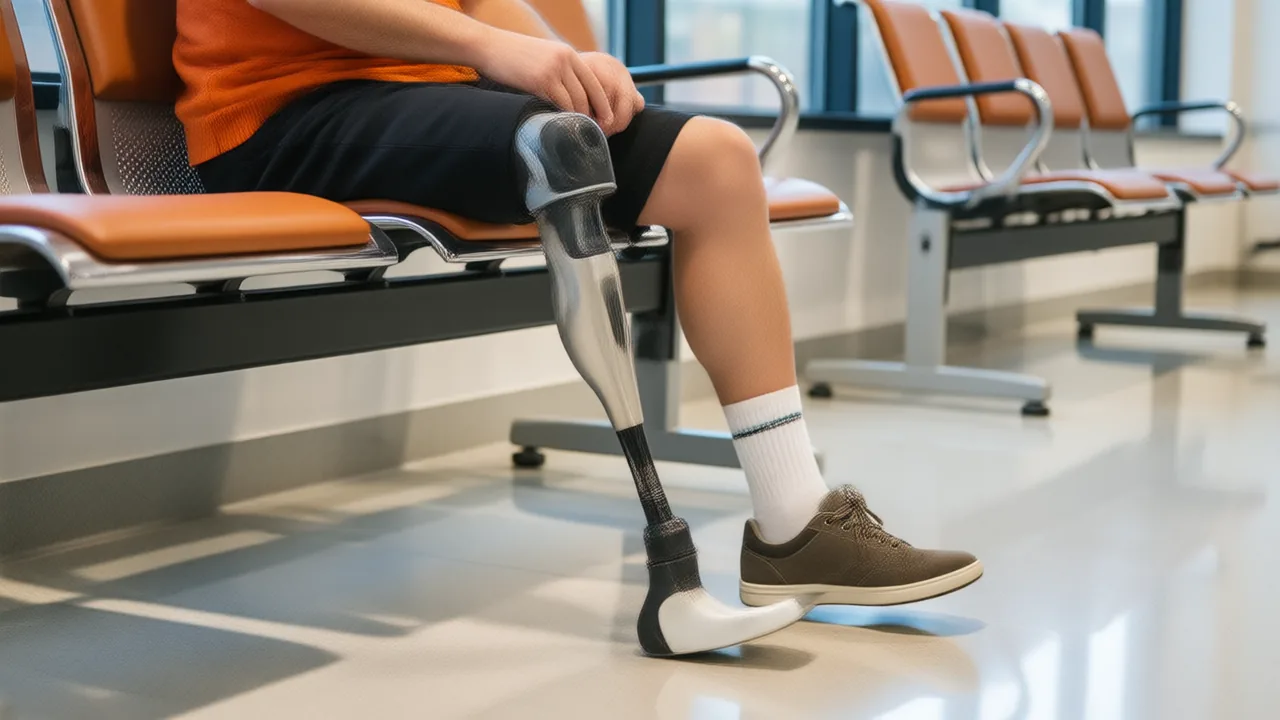
Short answer: The main types of prosthetic legs follow amputation level: partial foot, ankle (Syme), below-knee (transtibial), through-knee, above-knee (transfemoral) and hip. A below-knee leg is a socket, a pylon and a foot. Every level above that adds a prosthetic knee, and a hip-level leg adds a hip joint too. Within each level, legs are built for everyday walking, a specific activity, or appearance.
This guide is for new amputees, people facing a planned amputation, and the family members doing homework in the waiting room. It covers the leg built for each amputation level, the parts they all share, what “mechanical” and “microprocessor” actually mean, and who decides what ends up on your body. Each section points to a deeper guide when you want the details.
One thing up front: nobody picks a prosthesis off a shelf like a pair of sneakers. The type is set by your anatomy, your health, your goals and your insurance, and it is built by a prosthetist around your residual limb. Knowing the categories helps you ask better questions. It does not replace the fitting.
Key facts
- VA/DoD rehabilitation guidance lists prosthesis options from none, cosmetic and daily-use to activity-specific legs (such as for showering or running), mechanical, microprocessor or powered. (Source: VA/DoD guideline summary (2024), checked )
- Walking takes about 12% more energy after non-vascular below-knee amputation and about 102% more after vascular above-knee amputation, compared with people without amputation (2021 meta-analysis). (Source: Prosthetics and Orthotics International (2021), PubMed, checked )
- Medicare’s policy covers fluid, pneumatic and microprocessor prosthetic knees from functional Level 3, and at Level 2 only in limited circumstances. (Source: CMS – Medicare LCD L33787, checked )
- In a Syme (ankle) amputation, all the foot bones are removed and the heel pad is often kept to cover the end of the tibia. (Source: VA/DoD patient guide (2025), checked )
Types of prosthetic legs by amputation level
The biggest single factor in what your leg looks like is where the amputation is. The VA/DoD patient guide to living with limb loss notes that rehab generally gets more complex the higher the amputation, from the toes up toward the hip and pelvis. The prosthesis follows the same pattern: every joint you no longer have is a joint the leg has to supply.
| Amputation level | Also called | What the prosthesis usually includes |
|---|---|---|
| Toes or part of the foot | Partial foot, transmetatarsal | Often a custom insert, a toe filler or a small partial-foot device; the shoe does a lot of the work |
| Ankle | Syme, ankle disarticulation | A socket shaped around the end of the shin and a very low-profile foot |
| Below the knee | Transtibial, BK | Socket, liner, suspension, pylon (the tube) and foot |
| Through the knee | Knee disarticulation | A thigh socket, a prosthetic knee, pylon and foot |
| Above the knee | Transfemoral, AK | A thigh socket, a prosthetic knee, pylon and foot |
| At the hip | Hip disarticulation | A socket that holds the pelvis, plus a hip joint, knee, pylon and foot |
A few of these levels have details that change the build. In a Syme amputation, the same VA/DoD guide explains, all the foot bones are removed and the heel pad often covers the end of the tibia, which can let the limb take some weight on its end. Your prosthetist will tell you whether yours can. A knee disarticulation goes through the knee joint itself, which leaves the whole thigh bone. A transfemoral amputation is between the knee and the hip. A hip disarticulation removes the femur, including the ball of the hip joint, so the socket has to hold on to the pelvis.
If you were born with a limb difference rather than having an amputation, the same logic applies. The prosthetist builds around the limb you have, not around a label on a chart.
Below knee vs above knee prosthesis: why the knee changes everything
Most people with leg loss fall into one of two groups, and the difference between them is bigger than a few inches of leg.
With a below-knee prosthesis, you keep your own knee. It still bends, absorbs impact and pushes you forward, and your thigh muscles still control it. The prosthesis has to replace the shin, ankle and foot. That is a real job, but you are steering it with a joint you have used your whole life. Our guide to the below-knee leg and how it is put together (coming soon) goes through the socket styles, feet and daily routine in detail.
With an above-knee prosthesis, the leg has to supply a knee that bends freely when you swing the leg forward and stays locked-steady when you put weight on it. You control that knee through the socket, mostly with your hip muscles. Learning when the knee will bend and when it will hold is a large part of above-knee rehab. The above-knee prosthesis guide (coming soon) covers knee types, socket shapes and what training looks like.
The difference shows up in how much effort walking takes. A 2021 systematic review and meta-analysis found that people with lower-limb amputation use significantly more energy to walk than people without one. The smallest increase was in non-vascular below-knee amputation, at about 12%. The largest was in above-knee amputation caused by vascular disease, at about 102%, roughly double. Those are averages across studies. Your own number depends on your health, your fit and how much training you get, but it explains why an above-knee user who feels tired after a walk around the block is not doing anything wrong.
Through-knee and hip-level legs sit on either side of the above-knee group. A through-knee leg keeps a long thigh that is good for leverage, but the prosthetic knee has to fit under it, so it can sit a little lower than the other knee. A hip-level leg has the most joints to control and usually the biggest socket.
Everyday, activity-specific or cosmetic: prosthesis types by purpose
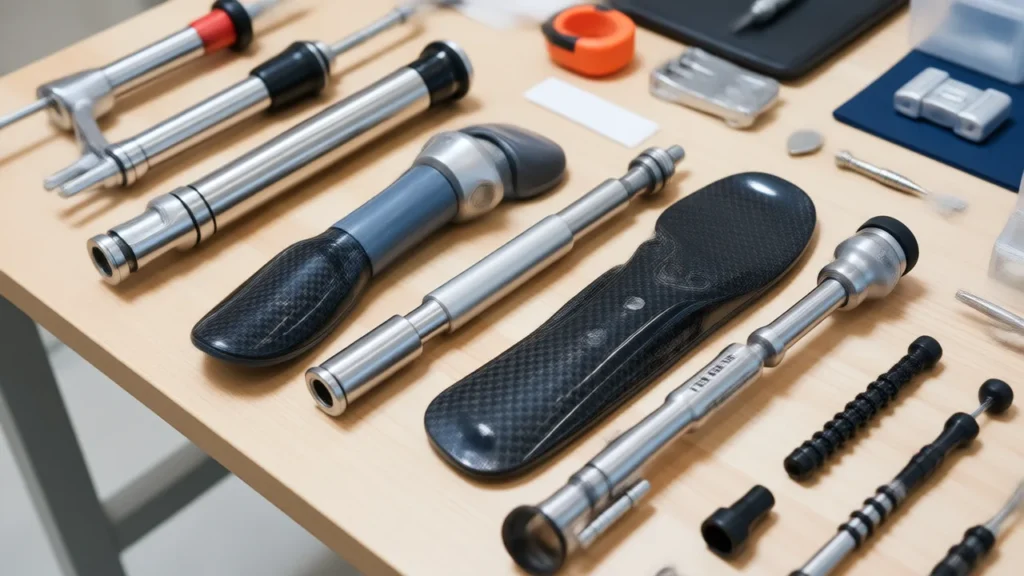
Amputation level tells you the shape of the leg. Purpose tells you what it is built to do. The 2024 VA/DoD rehabilitation guideline patient summary lists the range: no prosthesis, a cosmetic one, a daily-use leg, or an activity-specific leg for something like showering or running, with components that can be mechanical, microprocessor-controlled or powered.
- Daily-use leg. The one you wear from morning to night: walking, standing at work, errands, stairs. It is built for comfort over long hours and for the ground you cover most.
- Activity-specific leg. A running blade, a leg for the shower or water, a leg set up for a sport. It does one job very well and is usually not the leg you want to wear to the grocery store. Ask your insurer before assuming a second leg is covered.
- Cosmetic leg. Built mainly to look like a natural leg, with a shaped cover and skin tone. Some people want that every day; some want it for specific occasions.
- No prosthesis. The VA/DoD guideline treats deciding whether a prosthesis helps you as part of rehab, not a failure of it. Some people get around better with a wheelchair or crutches, some use both depending on the day.
Many people also start in a temporary or preparatory leg while the residual limb is still changing shape, then move to a definitive leg once it settles. Your prosthetist will tell you which stage you are in and why.
How a leg looks from the outside is its own decision. Some people choose a skin-toned cover shaped like a calf, some leave the pylon on show, some go loud with a printed cover. None of that changes the type of leg underneath.
The parts every prosthetic leg shares
Strip away the differences between levels and nearly every leg is the same stack of parts, from your skin outward. Cleveland Clinic describes a prosthetic leg as an artificial replacement for part or all of the leg, with a socket that connects it to the residual limb, usually with a changeable liner or sock in between.
| Part | What it does |
|---|---|
| Liner | A soft sleeve (often silicone or gel) rolled onto the skin to cushion it inside the socket |
| Socks | Worn over the liner or skin to fine-tune fit as the limb changes size during the day |
| Socket | The custom-made shell your limb sits in; it carries your weight and steers the leg |
| Suspension | Whatever keeps the leg on: a pin, suction, a vacuum pump, a sleeve or a strap |
| Knee (above-knee levels) | A mechanical or computer-controlled joint that bends and stabilizes |
| Pylon | The tube that connects socket to foot and sets the leg’s length and alignment |
| Foot and ankle | Anything from a simple cushioned foot to a carbon-fiber foot that flexes and springs back (compared in our guide to prosthetic foot types) |
The socket is the part that makes or breaks comfort, because it is the only part that is truly yours. For a part-by-part tour with the names prosthetists use, see our guide to the components of a prosthetic leg.
Suspension is where the options multiply. Cleveland Clinic lists straps or belts, suction liners, pin-locking liners, electric vacuum pumps and neoprene sleeves. Each has trade-offs in how easy it is to put on, how the limb feels inside, and how much the leg moves when you walk. Our explainer on how a prosthetic leg stays attached compares them side by side.
Liners and socks confuse almost everyone at first, because they sound like the same thing. They are not, and wearing the wrong combination is a common cause of a bad day. Stump socks vs. prosthetic socks vs. liners sorts out which is which. And if you ever need your leg’s outside dimensions, for a cover, a sock or a travel bag, here is how to measure a prosthetic leg without taking it apart.
Mechanical, microprocessor and powered: the technology tiers
The second way prosthetic legs are sorted is by how their joints work. The labels sound like marketing, but each one means something specific.
Mechanical
Mechanical knees and feet use springs, friction, locks, air or oil to control movement. They need no charging, and there is less to go wrong electronically. A basic mechanical knee might lock straight for stability; a more advanced one uses hydraulic or pneumatic resistance so it swings smoothly at different walking speeds.
Microprocessor-controlled
A microprocessor knee or ankle has sensors, a small computer and a battery. It reads what the leg is doing as you walk and adjusts the joint’s resistance to match your speed and the ground under you. The VA/DoD patient summary says a microprocessor knee might be a good option for someone with an above-knee amputation. It still has to be charged, and it still needs a well-fitting socket to do anything useful.
Powered
Powered joints add a motor that can actively push, for example helping lift you up a step, rather than only resisting movement. They are the most specialized option on this list.
How all these parts turn your hip and thigh movement into a step is its own story. Our guide to how a prosthetic leg actually works walks through the physics of a step without the jargon.
Who decides which type of prosthesis you get
The decision is shared, and it helps to know who is at the table.
- Your surgeon decides the amputation level, which sets the basic type of leg.
- Your rehab doctor (often a physiatrist) and physical therapist assess your strength, balance and goals, and write the prescription and documentation.
- Your prosthetist designs, builds, fits and adjusts the leg. Our guide to what a prosthetist does (coming soon) covers the job and what to expect at each visit.
- Your insurer decides what it will pay for, based on that documentation.
- You bring the most important information: what you want to do on the leg.
For people on Medicare, a system called K-levels drives a lot of this. According to the Medicare coverage policy for lower limb prostheses (LCD L33787), Medicare decides which components are medically necessary based on your potential functional ability, rated from Level 0 to Level 4.
| Level | What Medicare’s policy describes |
|---|---|
| Level 1 | Can use a prosthesis for transfers or walking on level surfaces at a fixed pace |
| Level 2 | Can walk and get over low barriers such as curbs, stairs or uneven surfaces |
| Level 3 | Can walk at variable speeds |
| Level 4 | Goes beyond basic walking with high impact, stress or energy, as athletes do |
This matters for the type of leg because the same policy covers fluid, pneumatic and microprocessor knees for functional Level 3 or above, and for Level 2 only in limited circumstances. The rating is about your potential, not just what you can do the week after surgery, so tell your team what you did before and what you want to do next. Rules change, and other insurers use their own criteria, so check your own plan.
Once the type is decided, the leg still has to be made. Casting or scanning, a clear test socket, alignment and fine-tuning all happen before you take it home. How prosthetic legs are made (coming soon) follows that process step by step, so the appointments make sense while you are in them.
When to call your prosthetist or doctor
Whatever type of leg you end up with, the rules for trouble are the same. The leg should fit your limb, not the other way around.
Call your prosthetist if the socket feels loose or tight in a way new socks do not fix, the leg moves up and down on your limb as you walk, you hear new clicks or squeaks, the leg feels a different length, or a knee or foot starts behaving differently. These are fit and alignment problems, and adjusting them is the prosthetist’s job, usually a quick one.
Stop wearing the leg and call your doctor if you see an open sore, a blister, a wound that will not close, redness that spreads or stays, warmth, drainage, or you have a fever, new severe pain or numbness. Do not try to pad your way through any of those. Skin problems inside a socket get worse with every step, and your doctor needs to see them before your prosthetist changes anything.
Before your first fitting: a short checklist
Bring these questions to your prosthetist. They will tell you more about the leg you are getting than any category chart.
- What type of socket and suspension are you planning, and why that one for this particular limb?
- Is this a preparatory leg or a definitive one, and roughly when would that change?
- Which foot, and which knee if I need one, are you considering, and what functional level is my documentation based on?
- What will my daily care routine be for the liner, socks and socket?
- Who do I call, and how fast can I be seen, if something rubs or breaks?
- Is there anything I want to do, like running, swimming or a job that keeps me on my feet, that would need a different leg later?
If the answers leave you confused or brushed off, that is useful information too. Our guide on finding a prosthetist you can work with (coming soon) covers credentials, red flags and how to switch if the fit is not right, in either sense of the word.
Sources
- VA/DoD Lower Limb Amputation CPG patient tool (2025) — Living Well with Limb Loss
- Prosthetics and Orthotics International (2021) — General estimates of the energy cost of walking in people with different levels and causes of lower-limb amputation
- VA/DoD Clinical Practice Guideline (2024) — Rehabilitation of Individuals with Lower Limb Amputation: Patient Summary
- Cleveland Clinic — Prosthetic Leg: What It Is, Who Needs It & How It’s Used
- CMS Medicare Coverage Database — LCD Lower Limb Prostheses (L33787)
From the Loud Limb shop: printed crew socks and prosthetic leg covers in loud prints. Our covers go on the outside of a below-knee prosthesis; measure yours first with the size guide.
Published by Loud Limb. This guide is general information drawn from the sources listed above, not medical advice. Loud Limb sells printed prosthetic leg covers and clothing and is not a clinic: ask your doctor, surgeon or prosthetist about your own care.