
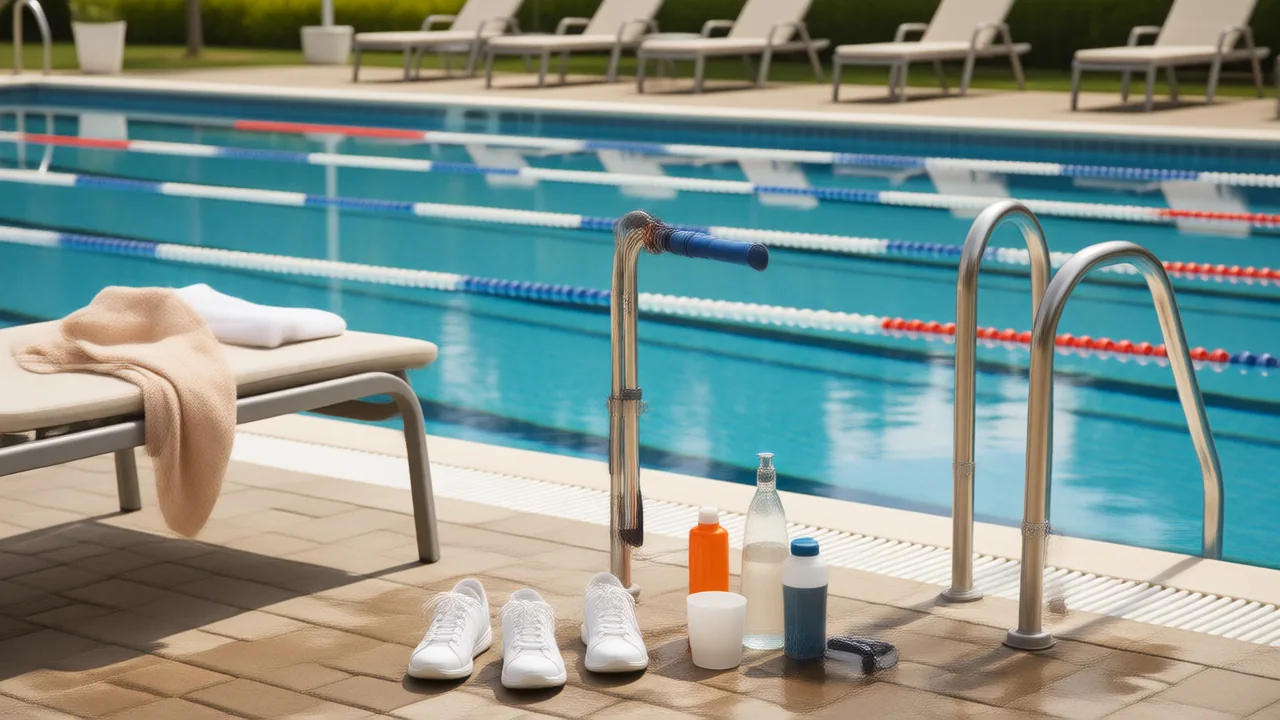
Short answer: Yes, you can swim with limb loss. Swimming with a prosthetic leg usually means one of three setups: the leg off (what most people do), a leg built for water, or a swim fin attachment. Your everyday leg is usually not one of them. Get medical clearance from your doctor first, and tell your prosthetist if swimming with a leg matters to you.
This guide is for people with leg loss who want to get back in the pool, the lake or the ocean, and for the family members holding the towels. It covers swimming with and without a leg, what swim legs and fins are, getting in and out of the water safely, and the part everyone forgets: drying your skin, liner and leg afterward. Swimming is one of many sports open to you; our guide to getting started in adaptive sports covers the rest.
Can you swim with a prosthetic leg? Your three options
The Amputee Coalition’s First Step guide puts it plainly: most people choose to take their prosthesis off before a swim. It also says that if using a prosthesis in the water is a priority for you, you need to tell your prosthetist, and it notes that activity-specific feet exist for swimming, just as they do for running and skiing.
| Option | Good for | Watch out for |
|---|---|---|
| No prosthesis | Lap swimming, water exercise, floating, most pool time | Getting across a wet deck and in and out of the water |
| Water or swim leg | Walking on the deck or beach, wading, standing in the shallow end, walking into open water | It is a separate leg, it needs a prescription, and insurance may not see it as essential |
| Swim fin attachment | More kick power for laps or snorkeling | Usually not something you can walk on |
What is almost never on the list is your everyday leg. Daily sockets, feet and knees are generally not built to be submerged, and anything with electronics needs special care around water. Ask your prosthetist what your own leg can handle before it goes near a pool, and assume the answer is no until you hear otherwise.
How to swim with a prosthetic leg off
For most swimmers, the leg stays on a chair by the pool. The water makes that easier than it sounds. It holds you up, and the First Step guide notes that a warm pool can soothe aches and pains, help your balance and let you exercise without the burden of a prosthesis.
Your first laps will probably feel lopsided. With one leg doing all the kicking, many people roll or drift toward one side until their stroke adjusts. A few things help:
- Start with support. A kickboard, a pool noodle or the wall lets you work on your kick and breathing without worrying about staying level.
- Let your arms do more. Your upper body can make up for a lot of the missing kick. A pull buoy can help you find a balanced position while your arms do the work.
- Find a coach. An adaptive swim program or a swim instructor who has worked with amputees can spot fixes that would take you much longer to find alone. Adaptive Sports USA, which the Amputee Coalition lists among its adaptive sports resources, puts particular emphasis on swimming.
- Stay in your depth at first. Until you know how you float and turn without the leg, swim where you can reach the wall or the lane rope.
Prosthetic legs for swimming: water legs and swim legs
If you want to walk to the water’s edge, stand in the shallow end with your kids, or walk into a lake, a leg built for water may be worth asking about. These go by names like water leg, swim leg or shower leg. In general terms, they use materials that tolerate being submerged, often let water drain out, and sometimes have an ankle that can be set flat for walking on the deck and then pointed for kicking. Designs vary a lot, so the details belong in a conversation with your prosthetist.
A few questions to bring to that appointment:
- Can the leg go in chlorinated water, salt water or both?
- How does it stay on in the water, and what happens if it comes loose?
- Is it safe to walk on wet tile, and can I wear it in the shower too?
- How should I rinse and dry it afterward?
- What documentation would my insurer need, since it is a second leg?
A swim leg is a real prescription, not an accessory. It has to fit your residual limb as carefully as your daily leg does.
Swim fins and other attachments
If speed is the goal, a fin that attaches where a foot would go can add kick on your residual side. Some systems clip onto a swim leg; some attach another way. Our guide to fins for amputee swimmers (coming soon) goes through the options and what to ask about each. The same rule applies to any attachment: your prosthetist needs to be part of the decision, because anything that pulls on your residual limb in the water pulls on your skin too.
Getting into and out of the pool safely
The swimming is often the easy part. The wet deck is where people slip. Plan the route before you take the leg off:
- Know your entry. Many pools have steps with a rail, a ramp or a pool lift. Ask the staff what they have before your first visit, and where you can leave a wheelchair or crutches close to the water.
- Sit, then slide. Sitting on the edge and turning to lower yourself in keeps you low and in control. Getting out, back up to the edge on your forearms, then turn and sit.
- Treat crutches on wet tile with respect. Crutch tips can slip on a wet floor, so take it slowly, or use a wheelchair between the changing room and the water.
- Protect your other foot. A water shoe on your remaining foot helps with grip and with cuts from rough pool floors or rocky beaches. If you have diabetes or reduced feeling in that foot, ask your doctor how to check it after every swim.
- Leave your leg where you can reach it. Set the leg, liner and a towel on a chair near your exit point, out of splash range.
Beaches, lakes and boats add waves, sand and uneven ground. Our guides to cruising with a prosthetic leg (coming soon) and scuba diving with a prosthetic leg (coming soon) cover what changes once you are away from the pool.
Drying off: your skin, your liner and your leg
This is the step that decides how your next day goes. Putting a liner back on damp skin traps moisture against it for hours. The Amputee Coalition’s skin care guidance is to wash the residual limb with a non-soap cleanser and dry it completely with a soft towel, and to clean and dry your socket, liner or socks daily.
- Rinse off the pool. Shower off chlorine or salt water, including your residual limb.
- Dry completely. Pat, do not scrub, and get into skin folds and the end of the limb. Give the skin a few minutes of air before the liner goes back on.
- Care for the liner the way its maker says. Liner rules differ by manufacturer, so follow your own liner’s instructions. As one example, Ottobock says its liners should be turned inside out, washed under lukewarm water with a neutral cleaning lotion, dried inside with a lint-free towel, and never dried on a heater or in the sun. That last one matters on a pool deck in July.
- Rinse and drain a swim leg. Follow your prosthetist’s instructions, and let it dry fully before you pack it.
- Shake out the sand. After the beach, check your socket, liner and shoe for sand before putting anything back on. A few grains feel like gravel by evening.
When to check with your doctor or prosthetist
Before your first swim after surgery, get medical clearance from your doctor, as the First Step guide advises. Your incision needs to be fully healed. In the early weeks, MedlinePlus’s discharge instructions after leg amputation say to wash the residual limb daily with mild soap and water but not to soak it, so ask your surgeon when soaking and swimming become safe for you.
Talk to your prosthetist before your daily leg goes anywhere near water, if you want a swim leg or fin, or if your liner feels different after swimming.
Stay out of the water and call your doctor if you have an open sore, a blister, a wound that has not closed, redness that spreads, warmth, drainage, fever, new severe pain or numbness. Pools and open water are not the place for broken skin. See your doctor too if you get an itchy rash that keeps coming back after swims.
Your first swim: a pool-bag checklist
- Your doctor’s OK to swim, and your prosthetist’s answer on whether your leg can get wet.
- A plan for the deck: crutches, a wheelchair or the pool’s lift.
- A water shoe for your other foot.
- Two towels: one for you, one for your leg and liner.
- Your liner’s cleaning supplies, per its instructions.
- A dry pair of crew socks for the walk home.
- A kickboard or pull buoy for your first laps.
Once the pool feels routine, the same planning carries over to the bike and the wall: see our guides to cycling with a prosthetic leg and climbing with a prosthetic leg (coming soon).
Sources
- Amputee Coalition — First Step: A Guide for Adapting to Limb Loss (2025)
- Amputee Coalition — Adaptive Sports Programs
- Amputee Coalition — Skin Care 101
- Ottobock — Liners
- MedlinePlus (NIH National Library of Medicine) — Leg amputation: discharge
From the Loud Limb shop: prosthetic leg covers in loud prints and printed athletic shorts. Our covers go on the outside of a below-knee prosthesis; measure yours first with the size guide.
Published by Loud Limb, a shop for printed prosthetic leg covers, socks and clothing.
Leave a Reply