
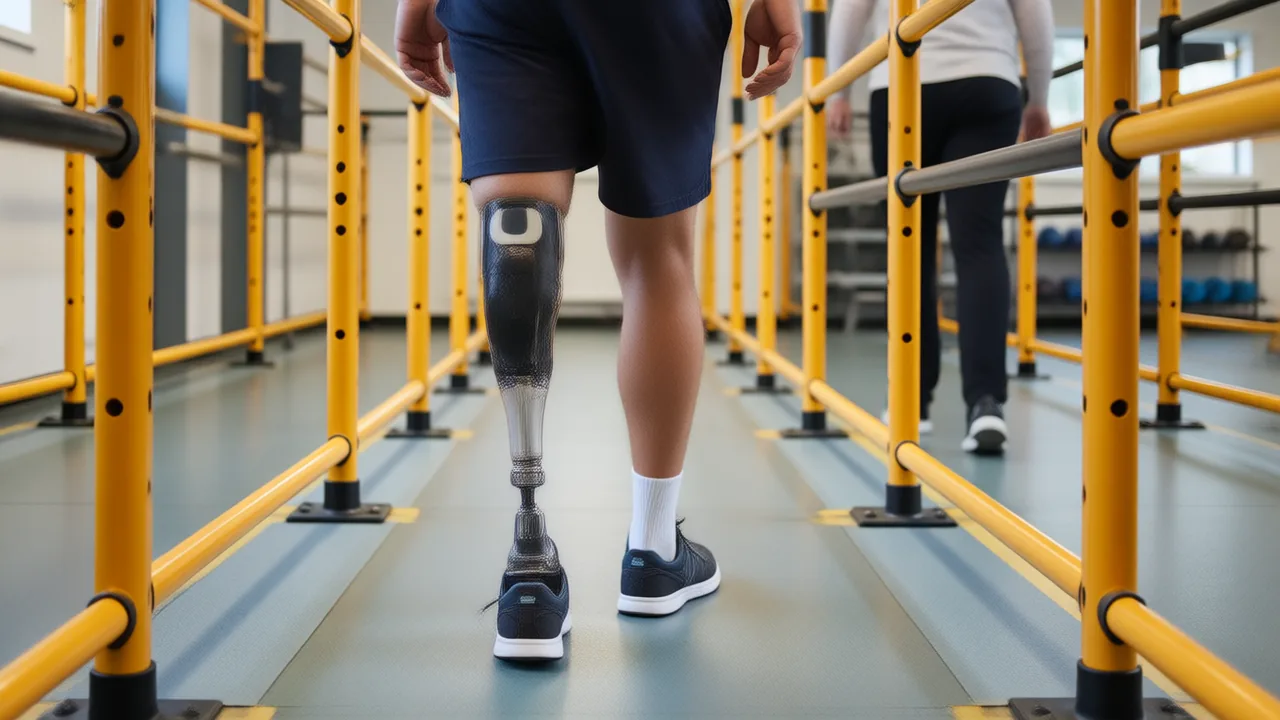
Short answer: Learning to walk again after amputation happens in stages: strength and balance work before the prosthesis, first steps in the parallel bars, then walking with a walker or crutches, then a cane or no aid, then stairs, slopes and uneven ground outdoors. A physical therapist guides each stage. It takes months of practice, and the pace depends on your health, amputation level and socket fit.
This guide is for new amputees about to start gait training, people who have been walking a while and want to walk better, and family members who want to know how to help without hovering. It covers each stage in order, what good walking looks like with a below-knee or above-knee leg, walking aids, stairs and rough ground, falls, energy and pain, and when to call for help.
A fair warning: early walking is hard work, and most people find it slower than they hoped. That is normal. You are learning a new way of moving with a body that is still healing, and every stage builds on the one before it.
The stages of learning to walk again
Every rehab plan is different. The Amputee Coalition’s guide to physical therapy says a therapist’s strategy depends on your prior functional level, strength, endurance and health, and above all on your goals. Still, most people move through a similar sequence:
| Stage | What you practice | Usual support |
|---|---|---|
| Before the prosthesis | Strength, balance on one leg, transfers, hopping or wheeling safely | Walker, crutches or wheelchair |
| First fitting | Putting the leg on, standing, shifting weight onto the prosthesis | Parallel bars |
| Early walking | Even steps, turning, sitting down and standing up | Parallel bars, then a walker |
| Building independence | Longer distances, doorways, curbs, getting up from the floor | Crutches or a cane |
| Community walking | Stairs, ramps, grass, gravel, crowds, carrying things | A cane or no aid, depending on the person |
Not everyone ends up walking without an aid, and that is not a failure. The goal is walking that is safe and gets you where you want to go.
How long it takes
There is no single answer, because it depends on your amputation level, your health before surgery, your healing and how often you can practice. Our guide to how long it takes to walk with a prosthetic leg goes through the published ranges and what speeds progress up or slows it down.
If both legs are affected
Learning to walk with two prostheses follows the same idea with some different tools. The Amputee Coalition explains that some people with two leg amputations start with “stubbies,” shortened prostheses with no knee joints that give a lower center of gravity for better balance, used during and sometimes after early rehab. Our guide for double amputees (coming soon) covers walking, wheelchairs and daily life with both legs affected.
Before the prosthesis: strength, balance and transfers
Walking with a prosthesis starts long before the prosthesis arrives. The weeks between surgery and fitting are when you build the muscles that will do the work.
- Hips and core. Your hip muscles steer the prosthesis, especially with an above-knee leg. Your therapist will give you exercises for the muscles on the side, front and back of the hip, plus your trunk.
- The residual limb. Keeping the knee (for below-knee) and hip able to straighten fully matters a lot. A joint that stiffens in a bent position makes walking much harder later.
- The other leg. It is carrying you for now and will keep doing extra work later. Strength and balance on that leg are your safety net.
- Arms and shoulders. They push you up from chairs and carry your weight on a walker or crutches.
- Transfers. Bed to chair, chair to toilet, getting in and out of a car. Safe transfers are the foundation of everything else.
The same Amputee Coalition guide notes that you will likely see your therapist a couple of times a week, and is honest about the rest: the therapist demonstrates and teaches, but the work to reach your goals is up to you. The home exercise sheet is not optional reading.
How to walk with a prosthetic leg for the first time
The first session with a new leg usually happens in the parallel bars, two rails at hip height that let you hold on with both hands while you get used to standing on the prosthesis. Expect it to feel strange. You are standing on something you cannot feel, and your brain needs time to trust it.
- Put the leg on correctly. Your prosthetist and therapist will teach you how to put on the liner, socks and socket so the fit is right. A leg that is on crooked will feel wrong from the first step.
- Stand tall with weight on both legs. Look ahead, not at your feet. Your therapist may use a mirror so you can see your posture.
- Shift your weight side to side. Slowly move more weight onto the prosthesis until you can stand on it briefly. This is the skill everything else depends on.
- Shift forward and back. Rock gently from heel to toe on the prosthetic side to feel how the foot rolls.
- Take small, even steps. Step forward with one leg, then the other, keeping both steps the same length and rhythm.
- Practice turning, sitting and standing. These catch people out more than straight-line walking does.
Early sessions are short, both because walking is tiring and because your skin needs time to get used to the socket. Your prosthetist and therapist will set a wearing schedule. Stick to it, and check your skin every time the leg comes off.
Gait basics: what good walking looks like
“Gait” just means the way you walk. A therapist watching you walk is looking for a few things, and knowing them helps you practice on your own.
- Equal steps. The step with your prosthesis and the step with your other leg should be about the same length and take about the same time. A short, quick step onto the prosthesis usually means you do not trust it yet.
- Weight on the prosthesis. Leaning away from the prosthetic side, or swinging the trunk over it, is common early on and puts strain on your back and other leg.
- Heel first, then roll. Land on the heel of the prosthetic foot and roll smoothly over the toe, rather than slapping down flat.
- Upright and relaxed. Head up, shoulders level, arms swinging naturally.
Walking with a below-the-knee prosthetic
With a below-knee leg, you still have your own knee, and a big part of good walking is using it: letting it bend slightly as the heel lands and straighten as you roll over the foot. Many people keep the knee stiff at first out of caution. Your therapist will work on that.
Walking with an above-knee prosthetic
With an above-knee leg, you control the prosthetic knee through the socket, mostly with your hip muscles. Pushing back with the hip as the heel lands keeps the knee straight and stable; letting it bend at the right moment lets the leg swing through. It takes longer to learn and more practice to make automatic. Our guide to above-knee amputee gait (coming soon) explains the common gait patterns, what causes them and the exercises that help.
Walking aids: walker, crutches and cane
Most people step down through walking aids as balance and confidence grow. The right aid is the one that keeps you safe today, not the one you hope to use next month.
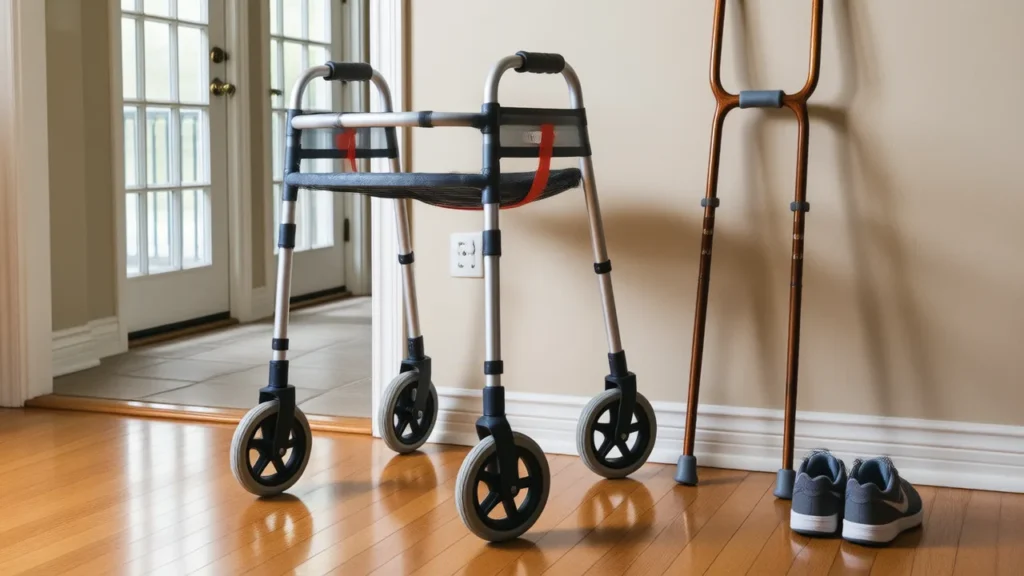
- Walker. The most stable option, used early on and by many people for longer distances or on tired days. Our walker guide (coming soon) covers types, height and how to use one with and without the prosthesis.
- Crutches. Faster and more flexible than a walker, but they need good balance and arm strength. See crutches for amputees (coming soon) for underarm versus forearm crutches and the common mistakes.
- Cane. The lightest support. It is usually held in the hand opposite the prosthesis and moves forward together with the prosthetic leg. The cane guide (coming soon) covers sizing, grips and when a cane is enough.
Have your therapist set the height of any aid you use. An aid at the wrong height pulls your posture out of line and can cause shoulder and back pain.
Stairs, slopes and uneven ground
Flat floors in a therapy gym are the easy part. The real world has curbs, stairs, ramps, grass, gravel and wet leaves, and each one needs its own technique.
Stairs
A common starting method is to go up leading with your other leg and down leading with the prosthesis, one step at a time, always with a handrail. Some people later learn to go step-over-step. Our guide to climbing stairs with a prosthesis (coming soon) walks through both methods, with and without a rail, and how to handle curbs.
Slopes and rough ground
On slopes, shorter steps help, and on steep ones some people turn slightly sideways. On grass, gravel or trails the foot does not land where you expect, so slow down, look a few steps ahead and keep your weight centered. The guide to walking on uneven ground with a prosthetic leg (coming soon) covers techniques for each surface and how your foot type affects it.
Practice these with your therapist before trying them alone, and start on dry ground in daylight.
Falls, energy and pain: the hard parts
Falls
Falls are common, and planning for them is part of learning to walk. In a study of 435 community-living people with leg amputations, 52.4% had fallen in the past year and 49.2% reported fear of falling. Falling was linked to above-knee amputation, back pain and joint pain, and having had the amputation for four or more years was protective, which suggests experience helps.
Ways to lower the risk: good lighting, especially at night; no loose rugs or cords; a walking aid within reach; shoes with the heel height your leg is set for; and extra care when you are tired, rushing or on wet ground. Ask your therapist to teach you how to get up from the floor safely. It is a skill worth practicing before you need it.
Energy
Walking with a prosthesis takes more effort. A systematic review and meta-analysis published in 2021 found people with leg amputations use significantly more energy to walk, from about 12% more with a non-vascular below-knee amputation to about 102% more with an above-knee amputation from vascular disease. Being tired is not a sign you are doing it wrong. Build distance gradually, plan rest stops and let fitness catch up.
Pain in other places
Your back, hips and other leg take on extra work. The Amputee Coalition reports a survey in which nearly 50% of people with limb loss had pain in the non-amputated limb and 62% had low back pain, and it recommends back extension strengthening and balance exercises to reduce stress on the low back and hips. Good gait habits now are an investment in fewer aches later.
When to call your prosthetist, therapist or doctor
Call your prosthetist if the leg feels too long or too short, the knee buckles or feels unpredictable, the foot catches, the socket feels loose or tight, or you hear new noises. Many gait problems are really fit or alignment problems, and they are quick to fix.
Tell your physical therapist if you have plateaued, feel unsafe with a particular task, have fallen, or have new pain in your back, hips or other leg.
Stop wearing the leg and call your doctor if you notice an open sore, a blister, redness that spreads or feels warm, drainage, a fever, new severe pain or numbness. After any fall onto the residual limb, get it checked before you keep walking on it.
Your practice checklist
Use this between therapy sessions:
- Do your home exercises, including the ones that seem boring.
- Walk a little every day, at the level your therapist has cleared you for.
- Practice one hard thing per session: a turn, a curb, a ramp, getting up from a chair without using your arms.
- Check your skin every time the leg comes off.
- Write down what felt hard, and bring the notes to your next session.
- Set up your home so falls are less likely, and keep a walking aid within reach.
Progress is rarely a straight line, and a flat week is not a failed one. Keep showing up for the boring parts; they are the ones that build the rest.
Sources
- Amputee Coalition — Getting the Most Out of Physical Therapy
- Amputee Coalition — Foreshortened Prostheses (Stubbies)
- Archives of Physical Medicine and Rehabilitation (Miller et al., 2001) — The prevalence and risk factors of falling and fear of falling among lower extremity amputees
- Prosthetics and Orthotics International (2021) — General estimates of the energy cost of walking in people with different levels and causes of lower-limb amputation
- Amputee Coalition — Avoiding Secondary Pain
From the Loud Limb shop: printed athletic shorts and printed crew socks.
Published by Loud Limb. This guide is general information drawn from the sources listed above, not medical advice. Loud Limb sells printed prosthetic leg covers and clothing and is not a clinic: ask your doctor, surgeon or prosthetist about your own care.