

Short answer: There is no single above knee artificial leg price. An above-knee leg usually costs more than a below-knee leg because it adds a prosthetic knee and a larger, more complex thigh socket, and the knee you get, from a simple mechanical knee to a microprocessor knee, is the biggest swing in the total. What you personally pay depends mostly on your coverage and your documented functional level.
You will find dollar ranges quoted all over the internet. We looked for a current, verifiable US price range we could cite, did not find one we would stand behind, and made-up numbers do not help anyone budget. So this guide does the more useful thing: it shows what goes into the price, how insurance decides which parts it pays for, and exactly what to ask to get your own number in writing.
For costs across every kind of prosthesis, including arms and feet, start with our overview of what prosthetics cost and who pays.
Why above knee prosthetic leg cost runs higher
A below-knee leg replaces a shin, ankle and foot. An above-knee leg has to do all of that and supply a working knee. That changes the bill in four ways:
- The knee unit. A whole extra joint, ranging from a simple locking hinge to a knee with sensors, a battery and a small computer.
- The socket. A thigh socket is bigger, has to carry weight near the hip and pelvis, and usually takes more test sockets and adjustment to get right.
- Alignment. Getting a knee and foot to work together takes more of your prosthetist’s time than aligning a foot alone.
- Training. Learning to trust a prosthetic knee means more physical therapy, which is a separate bill from the leg itself.
If you are comparing the two levels, our guide to below-knee prosthetic leg cost covers the other side, and the above-knee prosthesis guide (coming soon) explains how the leg is built and what training involves.
The knee unit: the biggest line on the bill
Prosthetic knees span a wide range of technology, and the price follows the technology.
| Knee type | What it does | Where it sits on cost |
|---|---|---|
| Manual locking | Stays straight while you walk; you unlock it to sit | Simplest |
| Single-axis or polycentric mechanical | Bends on a hinge or linkage; stability from alignment and design | Low to moderate |
| Hydraulic or pneumatic | Fluid or air adjusts swing to your walking speed | Moderate to high |
| Microprocessor | Sensors adjust resistance step by step | Highest of the common options |
The expensive knee is not automatically the right one, and the cheap one is not automatically the wrong one. A 2019 clinical practice guideline on prosthetic knee selection found that knees with hydraulic or pneumatic swing resistance suit active walkers, improving comfort, speed and symmetry, and that microprocessor knees are indicated to reduce stumbles, falls and the mental effort of walking compared with non-microprocessor knees. The same guideline reported that step counts, gait symmetry and total rehab costs were comparable between the two groups. In plain terms: a pricier knee does not necessarily mean a pricier recovery.
For the numbers side of that decision, see our guide to microprocessor knee cost (coming soon).
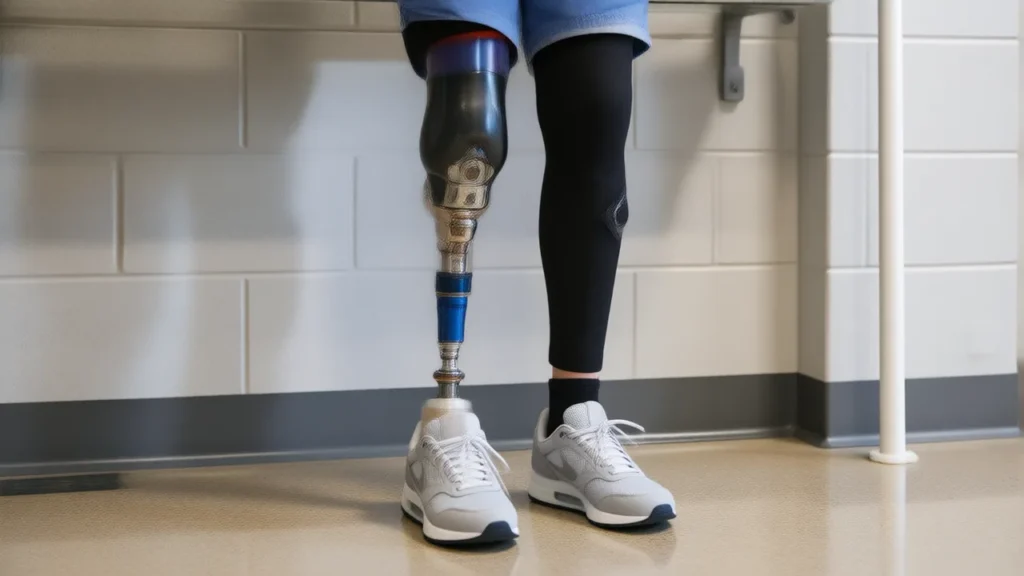
The socket, suspension and foot
The rest of the leg adds up too.
- Socket. Custom-made for your thigh, usually after one or more clear test sockets. Your limb changes shape, especially in the first year, so sockets get remade.
- Liner and suspension. Suction, a pin lock, a vacuum system or a belt. Liners wear out and are replaced on their own schedule.
- Pylon and adapters. The tube and connectors that set length and alignment.
- Foot. From a simple cushioned foot to a carbon-fiber or hydraulic ankle. Our guide to prosthetic foot price (coming soon) breaks down that part.
In the US, a prosthesis is billed as a list of component codes rather than one price, so two legs that look similar can bill very differently depending on what is inside the socket and the knee.
How K-levels decide which knee insurance pays for
For people on Medicare, and for many private plans that follow similar rules, the knee you can get covered depends on your functional level. According to the Medicare coverage policy for lower limb prostheses (LCD L33787), Medicare decides which components are medically necessary based on your potential functional ability, rated Level 0 to Level 4:
- Level 1: can use a prosthesis for transfers or walking on level surfaces at a fixed pace.
- Level 2: can walk and get over low barriers such as curbs, stairs or uneven surfaces.
- Level 3: can walk at variable speeds.
- Level 4: goes beyond basic walking with high impact, stress or energy, as athletes do.
The same policy covers fluid, pneumatic and microprocessor knees for functional Level 3 or above, and for Level 2 only in limited circumstances. Because the rating is about your potential, tell your doctor and prosthetist what you did before your amputation and what you want to do next. That documentation shapes what gets approved.
What Medicare and private insurance cover
Medicare.gov says Part B covers prosthetic devices when a doctor or other provider orders them. Once you have paid the yearly Part B amount that comes out of your own pocket first, you pay 20% of the Medicare-approved amount. Medicare pays only for devices from suppliers that participate in Medicare, so confirm that before anything is made. If you have a secondary plan, ask whether it pays any part of that 20%.
Private insurance is less predictable. The Amputee Coalition’s open enrollment guide notes that many states did not explicitly include prosthetic devices in their Affordable Care Act essential health benefits, though nearly every state appears to have at least some level of coverage for prosthetic care. Check your plan for a yearly or lifetime cap on prosthetics, prior authorization rules, and whether your prosthetist is in network.
The costs people forget: replacements, second legs and repairs
- Your first year is usually two legs. Many people start in a preparatory leg while the limb shrinks, then move to a definitive one.
- Sockets are remade. Weight changes and limb volume changes mean new sockets over the years, even when the knee and foot carry over.
- Electronics need service. A microprocessor knee needs charging, periodic servicing and occasional repair. Ask what the warranty covers and whether a loaner is provided.
- Activity legs are usually on you. The Amputee Coalition’s funding guide notes that running prosthetics are generally not covered by insurance because they are considered not medically necessary. Our guide to running blade cost (coming soon) covers grants that can help.
Help when coverage falls short
The same Amputee Coalition funding guide lists several places to start:
- The Amputee Coalition’s Resource Center helps with funding questions at 888-267-5669, option 1.
- Limbs for Life provides assistance for lower-limb amputees at 888-235-5462.
- State vocational rehabilitation agencies can help when a prosthesis is needed for work, and usually ask you to show how the device helps you get or keep a job.
Veterans should talk to their VA care team about prosthetic services before paying anything out of pocket. And if a claim is denied, ask for the denial in writing, with the reason. If the reason is documentation, ask your doctor and prosthetist exactly what is missing before you give up on the part.
Getting your own above-knee leg price: questions to ask
- Ask your prosthetist for an itemized estimate listing each component and its billing code.
- Ask which knee you are recommending, why, and what functional level the documentation supports.
- Ask your insurer for the allowed amount on each code and your share after coinsurance.
- Ask whether prior authorization is needed, and who submits it.
- Ask what happens, and what it costs, when the socket needs replacing or the knee needs service.
- If the number is out of reach, ask about a different knee or foot now with a documented plan to upgrade later.
Bring the answers back to your doctor and prosthetist together. The right above-knee leg is the one you can get, afford and actually walk on.
Sources
- Journal of Prosthetics and Orthotics (2019) — Prosthetic Knee Selection for Individuals with Unilateral Transfemoral Amputation: A Clinical Practice Guideline
- CMS Medicare Coverage Database — LCD Lower Limb Prostheses (L33787)
- Medicare.gov — Prosthetic Coverage
- Amputee Coalition — Open Enrollment for Health Insurance Coverage
- Amputee Coalition — Financial Assistance for Prosthetic Services
From the Loud Limb shop: gift ideas for amputees and funny amputee shirts & hoodies.
Published by Loud Limb, a shop for printed prosthetic leg covers, socks and clothing.