

Short answer: There is no single price. The cost of prosthetics depends on your amputation level, the knee and foot, the custom socket, the clinic visits that come with it, and how often parts need replacing. What you pay depends on your coverage: under Medicare Part B, for example, you pay 20% of the approved amount once you have paid the yearly Part B amount due before Medicare starts paying.
This guide is for new amputees, families and anyone staring at an estimate and wondering where the number came from. It explains what goes into the price of a prosthetic leg, why it is so high, how Medicare, Medicaid, private insurance and the VA fit in, and where to find help when coverage falls short.
A note on numbers. Price figures for prosthetic legs float around the internet, but they rarely say what they include, where they come from or when they were true. We could not find a current national price range from a source we would stand behind, so this page does not quote one. What it does instead is show you how to get the one number that matters: the real estimate for your leg, and your real share of it.
How much does a prosthetic leg cost? Why there is no single number
A prosthetic leg is not one product with one price tag. It is a bundle of custom work and separate components, and the final bill is the sum of all of them:
- The socket, molded to your residual limb, often with one or more test sockets before the final one.
- The interface: liners, socks and whatever suspension holds the leg on.
- The components: the pylon, the foot, and for higher amputation levels a knee, and sometimes a hip joint.
- The clinical work: evaluation, casting or scanning, fittings, alignment, training and follow-up adjustments.
Two people with the same amputation level can end up with very different bills because they need different sockets, feet and knees. That is why comparing your estimate to a number you found online is rarely useful. Comparing it line by line with what your insurer says it covers is.
What drives prosthetic leg cost
These are the factors that move the number most, and the question worth asking about each.
| Cost driver | Why it matters | Ask your prosthetist |
|---|---|---|
| Amputation level | Every joint you no longer have is a joint the leg has to supply, so higher levels need more components | Which components does my level require? |
| Knee type | Mechanical, fluid, pneumatic and microprocessor knees differ a great deal in complexity | Why this knee for me, and what would the alternative be? |
| Foot type | Feet range from simple designs to energy-storing and powered ones; our guide to the types of prosthetic feet lists which ones Medicare covers at each level | What does this foot let me do that a simpler one would not? |
| Socket and suspension | The socket is custom work, and suspension systems vary in parts and upkeep | How many test sockets do you expect, and are they included? |
| Your activity level | Insurers tie coverage for many components to your expected function | What functional level are you documenting for me? |
| Replacements and supplies | Liners, socks, sockets and whole legs wear out or stop fitting | What will I likely need to replace in the first year? |
| Follow-up care | Adjustments and refits are part of living with a prosthesis | Which follow-up visits are included in this estimate? |
The activity-level row deserves its own explanation. Medicare’s coverage policy for lower limb prostheses decides which components are medically necessary based on your potential functional ability, rated from Level 0 to Level 4 (often called K-levels). Level 3 means you can walk with a variable cadence, and Level 4 describes people whose activity exceeds basic walking, such as athletes. Under that policy, fluid, pneumatic and microprocessor knees are covered for people at Level 3 or above, and at Level 2 only in limited circumstances. Many private insurers use similar logic, so your documented level can shape what you are offered.
Below-knee vs above-knee: how level changes the price
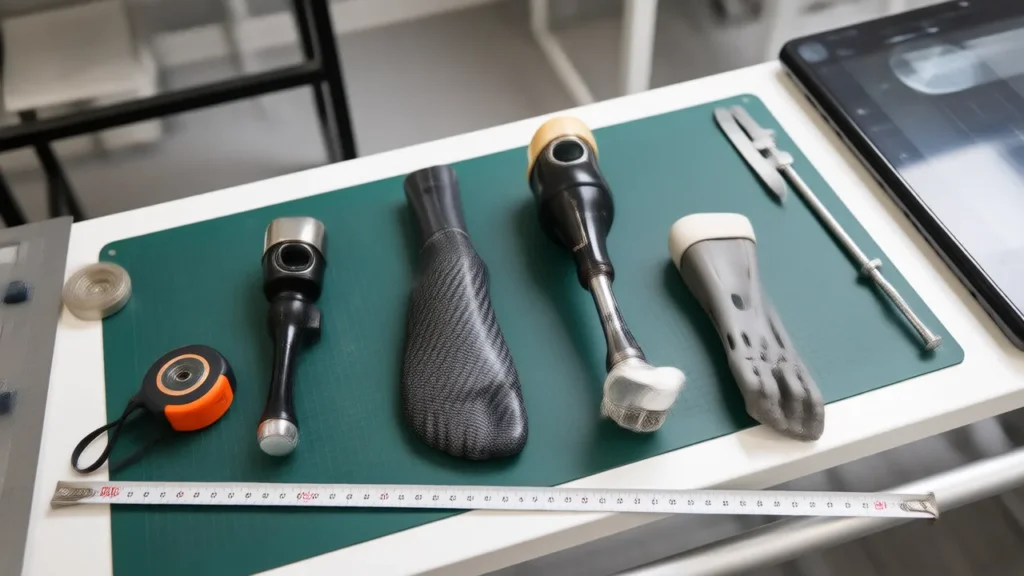
The biggest single jump in cost usually comes with the knee. A below-knee leg replaces the shin, ankle and foot while you keep your own knee. An above-knee leg has to add a prosthetic knee, which is a major component in its own right, and a microprocessor-controlled knee adds electronics, sensors and charging on top of that.
That does not mean below-knee legs are cheap. The socket is still custom, the foot can be sophisticated, and suspension systems vary. Through-knee and hip-level legs bring their own socket designs and joints, so ask your prosthetist to walk you through exactly which parts your level needs.
For the level-specific detail, including what goes into each estimate and what to ask, see our guides to below-knee prosthetic leg cost and the price of an above-knee artificial leg.
Why do prosthetic legs cost so much?
People are often shocked the first time they see an estimate. A few reasons explain most of it:
- It is custom medical work. The socket is made for one body. It usually takes several appointments, sometimes several test sockets, and a certified clinician’s time at every step.
- The components are specialized. Knees and feet are engineered to carry your full body weight, step after step, for years.
- Care continues after delivery. Alignment changes, socket adjustments, new liners and training visits are part of the deal, and some of that cost is built into the price.
- Legs get replaced. The Amputee Coalition’s prosthetic FAQs for new amputees say a prosthesis can last anywhere from several months to several years, depending on age, activity level and growth. Kids outgrow legs. New amputees often need a new socket as the residual limb changes shape. So the true cost of prosthetics is a lifetime of legs, not one.
The first year often costs the most. The same Amputee Coalition FAQ explains that some people get a temporary prosthesis right after amputation or within two to three weeks of surgery, and that fitting usually begins two to six months after surgery, once the incision heals and swelling goes down. As the residual limb settles, a temporary or preparatory leg is typically followed by a definitive one, so budget for more than one socket in that first stretch.
One thing cost should never do is keep you in a socket that hurts. If the fit changes, you are adding socks more and more, or you see redness that does not fade, blisters or open skin, call your prosthetist. Wounds, spreading redness, warmth or fever need your doctor the same day. A skin problem left alone can cost you far more time out of your leg than an adjustment visit costs in money.
The cost of prosthetics beyond the leg itself
The leg itself is only part of the bill. When you plan, include the things that do not show up on the prosthetist’s estimate:
- Supplies: prosthetic socks in several plies, replacement liners, skin cleansers and anything your clinician recommends for your skin.
- A shrinker or compression garment, if your team uses one, especially in the early months.
- Shoes: a prosthetic foot may need a particular heel height, and a worn shoe can change how the leg walks.
- Getting to appointments: fittings and follow-ups add up to a lot of trips, time off work and parking.
- Physical therapy: learning to use the leg is part of the cost, and coverage for therapy visits has its own limits.
- Home changes: a shower chair, grab bars or a raised toilet seat for the times the leg is off.
None of these is huge on its own. Together, they are why a budget built only around the device usually comes up short.
What insurance covers: Medicare, Medicaid and private plans
Medicare
According to Medicare.gov’s prosthetic coverage page, Part B covers prosthetic devices when a doctor or other health care provider orders them. Once you have paid the yearly Part B amount you owe before Medicare starts paying, you pay 20% of the Medicare-approved amount, and Medicare only pays for a device from a supplier that participates in Medicare. That last point is worth checking before your first appointment, not after.
Our guide to whether Medicare covers prosthetics (coming soon) walks through Parts A, B and Advantage plans, and our explainer on how often Medicare will pay for a new prosthetic leg covers replacements and repairs.
Medicaid
Medicaid is run by each state, so what it covers for prosthetics, and how you get approval, depends on where you live. Our Medicaid prosthetics guide (coming soon) explains how to find your state’s rules and what to ask.
Private insurance and marketplace plans
Private coverage varies more than people expect. The Amputee Coalition’s page on open enrollment for health insurance notes that many states did not explicitly include prosthetic devices in their Affordable Care Act essential health benefits, though nearly every state appears to have at least some level of coverage for prosthetic care. It also notes that marketplace open enrollment typically runs from November 1 to January 15. If you are choosing a plan, read the prosthetics section of each plan’s documents before you pick. Look for annual or lifetime limits on devices, prior authorization rules, and whether your prosthetist is in network.
Our guide to prosthetic insurance coverage (coming soon) lists the exact questions to ask your insurer and how to read the answers.
When insurance says no
Denials happen, and they are not always the final word. Common reasons include missing documentation, a functional level that does not match the components requested, a supplier outside the network, or a device the insurer does not consider medically necessary.
The Amputee Coalition’s financial assistance page points people with funding questions to its Resource Center at 888-267-5669, option 1. Before you give up on a denial, ask your insurer for the reason in writing, ask your prosthetist and doctor what documentation would address it, and check your appeal deadline. Our step-by-step guide to a prosthetic insurance denial appeal covers the letters, the evidence and the timelines.
The evidence that tends to matter most is specific and personal. Useful documentation usually includes your doctor’s notes on your health and expected function, your prosthetist’s evaluation, and a plain description of what you do day to day and what you want to be able to do: the stairs at home, the walk to work, the uneven ground at your job, the grandkids you chase. Vague requests are easy to deny. Detailed ones are harder.
Help paying for a prosthesis
If insurance does not cover enough, or you do not have it, there are other routes. None of them is a sure thing, and each has its own rules, so contact them directly for your situation.
- Veterans: the VA runs its own prosthetic care system, separate from Medicare and private insurance. Our guide to VA prosthetics for veterans (coming soon) explains who qualifies and how to get started.
- State vocational rehabilitation: the same Amputee Coalition page says these agencies usually require you to show how the device helps you get or keep a job.
- Nonprofits: the page also lists Limbs for Life, which provides assistance for lower-limb amputees.
- Children: it notes that Shriners provides orthopedic care to children under 18 when the condition can reasonably be helped. Shriners Children’s says care is given regardless of a family’s ability to pay or insurance status, but families may be billed for co-payments, deductibles and co-insurance.
- Sports legs: it says running prosthetics are generally not covered by insurance because they are considered “not medically necessary,” so athletes usually look to grants.
How to get a real number for your own leg
This is the part that turns a scary unknown into a plan. Do it before the first fitting if you can.
- Ask your prosthetist for an itemized estimate. Every component and service listed separately, with what is and is not included, such as test sockets and follow-up visits.
- Call your insurer with that estimate in hand. Ask how much you pay before coverage kicks in each year, your coinsurance, any annual or lifetime limit on prosthetics, whether prior authorization is needed, and whether the clinic is in network or participates in Medicare.
- Ask what functional level is being documented and whether the components match it.
- Ask about the next two years, not just today: liners, socks, socket replacements and repairs.
- Get the answers in writing, with the name of the person you spoke to and the date.
With those five answers, you will know more about the cost of your prosthetic leg than any price chart online can tell you.
Sources
- Medicare.gov (CMS) — Prosthetic Coverage
- CMS Medicare Coverage Database — LCD Lower Limb Prostheses (L33787)
- Amputee Coalition — Prosthetic FAQs for the New Amputee
- Amputee Coalition — Open Enrollment for Health Insurance Coverage
- Amputee Coalition — Financial Assistance for Prosthetic Services
From the Loud Limb shop: gift ideas for amputees and funny amputee shirts & hoodies.
Published by Loud Limb, a shop for printed prosthetic leg covers, socks and clothing.