

Short answer: Residual limb care is a simple daily routine: wash the limb with a mild cleanser, dry it completely, check every side for redness or broken skin, moisturize at night rather than before putting on your liner, and clean your liner and socket every day. Control swelling with a shrinker or wrap as your team directs. Any wound, spreading redness or fever means calling your doctor.
This guide is for new amputees learning the routine for the first time, long-time prosthesis users whose skin has started complaining, and the family members who help. It covers the daily wash and check, what to look for, sweat and heat, swelling and shaping, looking after the gear that touches your skin, the first weeks after surgery, and when to call someone.
None of this is complicated. The hard part is doing it every single day, including the days you are tired and the limb looks fine. Those are the days the routine is doing its job.
Why residual limb care matters more than regular skin care
The skin on a residual limb works harder than almost any other skin on your body. It carries your weight, it is sealed inside a liner and socket for most of the day, and it has to cope with friction and heat it was never built for. The Amputee Coalition’s skin care guide explains that prosthetic sockets trap sweat and block air circulation, which creates conditions for bacteria to grow.
That is why skin problems are so common. A six-year review at one amputee clinic found 528 skin problems in 337 residual limbs of prosthesis users. Ulcers, irritation, cysts, calluses and a thickened, warty skin change called verrucous hyperplasia made up 79.5% of them.
The Amputee Coalition’s infection-prevention guide puts it plainly: the residual limb needs lifelong hygiene attention because it is enclosed in a socket or liner and prone to skin breakdown. The good news is that most problems give you warning signs first, and a daily routine is how you catch them.
A daily residual limb care routine
Here is a routine built from what the Amputee Coalition and prosthetic manufacturers recommend. Your prosthetist or doctor may adjust it for your skin, your liner and your stage of recovery; their instructions win.
Evening, when the leg comes off
- Wash. Use a gentle cleanser. The Amputee Coalition recommends a non-soap cleanser, and Össur’s care guidance recommends a mild pH-neutral soap or special cleansing lotion. Skip harsh, perfumed or antibacterial products unless your doctor recommends one.
- Rinse well and dry completely. Pat with a soft towel, including creases and the end of the limb. Leftover soap and damp skin both cause trouble inside a liner.
- Check. Look at every side of the limb (more on how below).
- Moisturize if your skin needs it. Össur suggests applying a moisturizing cream each evening, preferably at bedtime, so it soaks in overnight instead of sitting under your liner.
- Clean your gear. The Amputee Coalition says to clean and dry the socket, liner and/or sock daily. Follow each item’s own instructions.
Morning, before the leg goes on
- Make sure the skin is clean and completely dry. Washing at night, the Amputee Coalition notes, gives skin time to dry fully before you put the prosthesis on in the morning.
- Skip lotion and powder unless your prosthetist says otherwise. That is the point of moisturizing at bedtime: many liners are designed to go onto clean, bare skin.
- Put the liner on properly. Roll it on, do not pull it, with no wrinkles or trapped air at the end.
- Start with the right socks for how your limb feels that day.
One more rule from the Amputee Coalition that surprises people: do not shave the residual limb. Short hairs can become ingrown and infected inside a liner. If hair on the limb is bothering you, ask your doctor or prosthetist what they recommend for your skin.
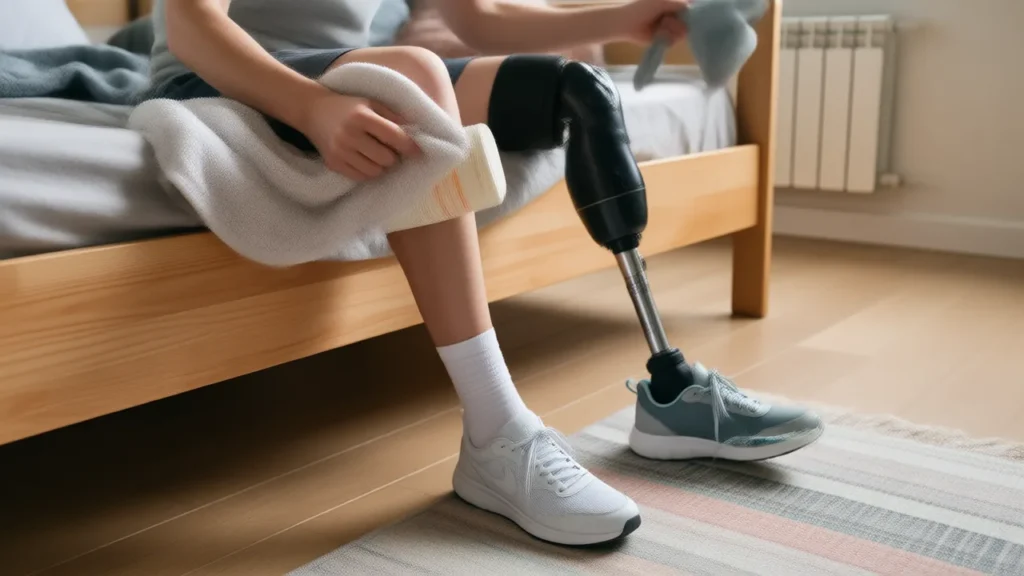
How to check your residual limb every day
A skin check takes a minute and is the most useful minute in the routine. Össur recommends using a mirror to look at the limb from every angle, and says that once you are used to it, one daily inspection after washing is enough. A handheld mirror or your phone camera works for the back and the end of the limb. If you cannot see or feel part of the limb well, ask someone to look for you.
What to look for:
- Redness. Mild redness where the socket carries weight that fades soon after the leg comes off is common. Redness in a new place, or redness that stays, is worth noting and reporting.
- Blisters and rubbed spots. Usually a sign of friction, pistoning or a fit problem. Do not pop them. Our guide to blisters on a residual limb (coming soon) covers causes, covering them and when they need a doctor.
- Rashes. An itchy, red or bumpy rash where the liner sits can be irritation, an allergy, sweat rash or infection. See prosthetic liner rash for how to tell them apart and what to do.
- Bumps, cysts, calluses and thickened skin. These build up over weeks and are easy to miss. The guide to amputee skin problems (coming soon) explains each one and which clinician treats it.
- Changes in color or temperature. Dark, purple, pale or unusually warm or cold areas need attention, especially if you have diabetes or circulation problems.
Keep a note on your phone of anything you find and where. A photo taken on the same spot a few days apart is easier for your clinician to judge than a memory.
Sweat, heat and odor
Sweat is the most common everyday complaint about life inside a liner, and it is not a hygiene failure. The liner and socket keep heat in and moisture has nowhere to go, which is exactly the warm, wet setup the Amputee Coalition warns lets bacteria grow. Sweat also makes the liner slip, which causes friction, which causes blisters.
Practical steps that help many people:
- Take the leg off when you reasonably can, dry the limb and the inside of the liner, and put it back on.
- Carry a small towel and a spare liner if your prosthetist has given you one.
- Wash and dry the liner every day so sweat and bacteria do not build up.
- Tell your prosthetist if sweat is making the leg loose or causing rashes. There may be a liner or suspension option that helps.
Our guide to sweating in a prosthetic liner (coming soon) goes deeper on why it happens and what to try. Some people use an antiperspirant on the limb; check with your doctor and prosthetist first, because some products can irritate skin or react with liner materials. The antiperspirant for a residual limb (coming soon) guide covers how to test one safely.
Swelling and shaping: shrinkers and wrapping
After surgery, and for a long time after in some people, the residual limb swells. Controlling that swelling helps the limb heal, reduces discomfort and shapes it for a prosthesis. The VA/DoD guide to residual limb management says swelling is controlled and the limb shaped with elastic bandage wrapping or a shrinker, and that shrinker compression should be used whenever you are out of the prosthesis during prosthetic training.
Your options, each with its own guide:
- Shrinker. An elastic sock made for residual limbs that gives steady compression and is easy to put on. See the stump shrinker guide for sizing, how long to wear it and how to tell if it is too tight.
- Elastic bandage wrapping. Used when a shrinker is not yet suitable, or when your team prefers it. Technique matters: wrapped wrong, a bandage can squeeze too hard in one spot. See how to wrap a residual limb for the method and the mistakes to avoid.
Swelling that comes back, gets worse, or shows up on one side only needs a closer look. Residual limb swelling (coming soon) explains the normal patterns and the warning signs. Your surgeon or rehab team decides when to start compression, what kind and for how long, so ask before you change anything.
Stump care in the first weeks after surgery
Early care is different, because the incision is still healing. Follow your surgical team’s written instructions exactly; they know your wound. A few principles from the Amputee Coalition’s wound care guide apply broadly:
- While the wound is fresh, compression is kept on the limb with an elastic bandage, a shrinker or an immediate post-operative prosthesis.
- Washing is with mild soap and water, then rinsing and patting dry, once your team says the wound can get wet.
- Signs of wound infection include tenderness or pain, fever, redness, swelling and discharge. Any of these is a reason to call, not to wait.
This is also the stage when you learn the routine above, so it becomes automatic by the time a prosthesis arrives. Ask your nurse or therapist to watch you do a skin check and a wrap once, so you know you are doing it right.
Caring for liners, socks and the socket
Everything that touches your skin needs cleaning as often as the skin does. The catch is that care rules differ by manufacturer, sometimes completely. Some liner makers allow machine washing and some forbid it; some recommend weekly disinfecting and some do not. The only safe rule is: follow the instructions for your specific liner, and ask your prosthetist if you have lost them.
A few things are true across most products: clean the liner after wearing it, dry it fully away from direct heat, rotate between two liners if you have them, and replace liners and socks when they tear, thin out or stop gripping. Clean the inside of the socket regularly with whatever your prosthetist recommends. For the difference between the liner, the socks and the stump socks you might wear, see socks vs. liners explained.
When to call your doctor or prosthetist
Stop wearing the prosthesis and call your doctor if you notice:
- An open sore, a wound or a blister that has broken
- Redness that spreads, red streaks, or skin that feels warm
- Pus, drainage or a bad smell from the skin
- A fever
- New or severe pain, or numbness
- Skin that turns dark, purple or very pale
If you have diabetes or circulation problems, call sooner rather than later, because small skin problems can get serious quickly. After surgery, your surgeon’s office is usually the first call; later, your primary care doctor, rehab doctor or a dermatologist may be the right person.
Call your prosthetist for problems that come from the leg: redness in a new spot, rubbing, pistoning, needing many more socks than usual, or a liner that has torn or stopped gripping. They can adjust the socket or change the liner so the skin problem does not come back.
Your residual limb care kit
Keep these in one place so the routine is easy to do even on a bad day:
- A gentle cleanser your skin tolerates
- Two soft towels: one for the limb, one for the liner
- A handheld mirror, or your phone for photos
- A fragrance-free moisturizer for bedtime, if your skin needs it
- Your shrinker or bandages, if you are using them
- Spare socks in the plies you use, and a spare liner if you have one
- Your liner’s care instructions and your prosthetist’s phone number
Set a phone reminder for the evening check for the first few weeks. After that, it just becomes part of taking the leg off.
Sources
- Amputee Coalition — Skin Care 101
- Össur — Taking Care of Your Residual Limb & Prosthetic
- American Journal of Physical Medicine & Rehabilitation (2006) — Skin problems in an amputee clinic
- VA/DoD Lower Limb Amputation CPG clinical support tool (2025) — Residual Limb Management in Lower Limb Amputation
- Amputee Coalition — Wound Care: Preventing Infection
Published by Loud Limb. This guide is general information drawn from the sources listed above, not medical advice. Loud Limb sells printed prosthetic leg covers and clothing and is not a clinic: ask your doctor, surgeon or prosthetist about your own care.