

Short answer: A stump shrinker is a stretchy, closed-end compression sock for your residual limb. It keeps swelling down and helps shape the limb so a prosthetic socket can fit it. Your surgical team decides when you start. After that, the usual instruction is to wear it all the time, off only to bathe and check your skin, and later whenever your prosthesis comes off.
This guide is for new amputees and the people helping them through the first months after surgery: what a shrinker does, when it starts, a realistic wearing schedule, how to get one on without a wrestling match, sizing, washing, and the skin signs that mean you should call someone. It’s one piece of a bigger routine, and our guide to caring for your residual limb covers the rest.
A shrinker is prescribed, not picked off a shelf. Your surgeon’s, therapist’s and prosthetist’s instructions for your limb beat any general guide, this one included.
What a stump shrinker does (and what it doesn’t)
After an amputation the residual limb swells, and for a while it is bigger, softer and a different shape than it will be once it heals. A socket built around that swollen limb would be loose within weeks. The VA/DoD clinical support tool on residual limb management names the two standard ways to control swelling and shape the limb: elastic bandage wrapping or a shrinker.
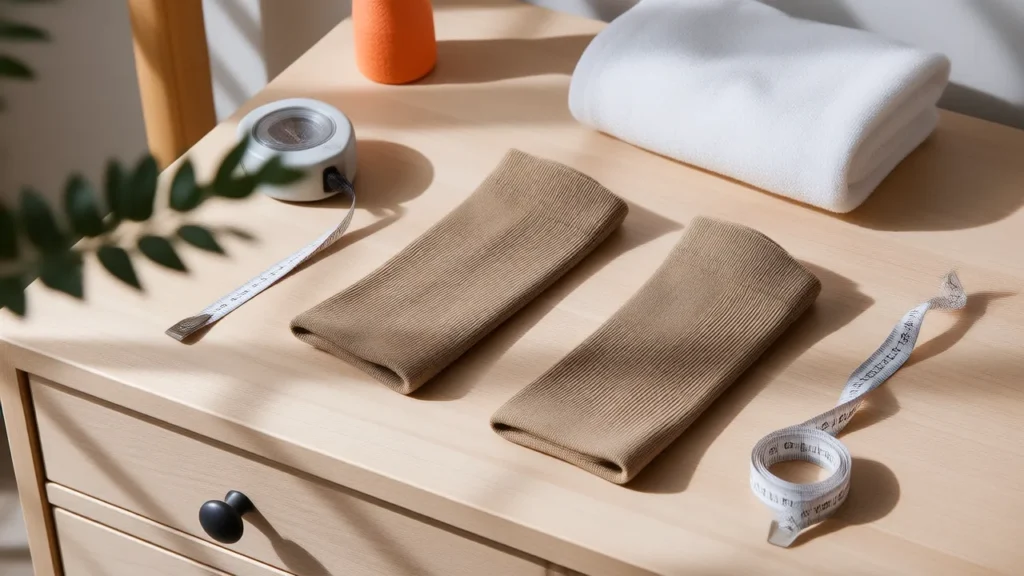
A shrinker is a knitted tube, closed at one end, that you pull on like a very determined sock. Juzo, one maker, describes its prosthetic shrinkers as giving graduated compression to help maintain the shape of the limb. Graduated means the squeeze is firmest at the end of the limb and eases toward the top, which is meant to move fluid up and out instead of trapping it at the tip.
- It is not a liner. A liner cushions your skin inside the socket. A shrinker covers the hours the prosthesis is off. If the names blur together, see our explainer on stump socks, prosthetic socks and liners.
- It is not a wound dressing. It goes on when your surgeon says the limb is ready, not before.
Once it’s the right size, a shrinker gives the same pressure every time and is quicker to put on than a wrap. Wrapping can be adjusted around an unusual shape or a tender spot, but even pressure takes practice. Your team may start you in a wrap and switch later, or go straight to a shrinker. If you’re still wrapping, here’s how to wrap a residual limb the right way.
When to start wearing a shrinker for your stump
Timing is your surgeon’s call, because it depends on how the incision is healing. Right after surgery the limb may be in a soft elastic dressing, a rigid dressing or an immediate post-op prosthesis. The Amputee Coalition’s guide to preventing wound infection says that while the wound is fresh, you keep compression on with an elastic bandage, a shrinker or an immediate post-op prosthesis, and keep the limb elevated.
For below-knee amputations, the Amputee Coalition’s below-knee recovery guide says you may be fitted with a shrinker sock within the first week, and puts the first prosthetic fitting at about 8 to 12 weeks. That gap is the shrinker’s main working period: the more settled the limb’s shape by fitting day, the better the first socket can match it.
Other levels follow their own timelines. After a foot amputation, MedlinePlus discharge instructions say to wear the elastic bandage or shrinker sock on the residual limb all the time. If your discharge papers don’t say when you switch to a shrinker, ask before you leave:
- When do I start the shrinker, and who fits it?
- Can it go on over stitches or staples, or do I wait until they’re out?
- What do I do if it slips or feels too tight in the middle of the night?
How long to wear a stump shrinker, day and night
In the first weeks
The standard instruction is simple and a little relentless: wear it all the time. Take it off to bathe and to check and wash your skin, then put it back on. Compression only works while it’s there. “All the time” includes overnight unless your team says otherwise. If it keeps you awake because it hurts, not just because it feels strange, that’s a fit question for your therapist, not a reason to sleep without it.
Once you have a prosthesis
The shrinker doesn’t retire when the leg arrives. The VA/DoD tool tells clinicians to reinforce shrinker use whenever you are out of the prosthesis during prosthetic training. So the routine flips: leg on during the day, shrinker on at night and during long breaks.
For how many months?
There’s no universal end date. Your limb keeps changing size for a while, and your prosthetist tracks that through sock ply and socket fit; the same VA/DoD tool lists wear schedule and sock ply management among the things your team should teach you. When your volume settles, your prosthetist will say whether to keep wearing it at night, cut back or stop. Don’t quit on your own because the limb looks smaller. Stopping early can let swelling creep back and leave the socket fitting worse.
How to put on a stump shrinker without a fight
A new shrinker is supposed to be tight, so the first attempts are awkward. Ask your therapist or prosthetist to show you in person, and if their steps differ from these, follow theirs.
- Sit down, with clean, dry skin. Look the limb over first, using a mirror for the back and the end. Damp skin makes the fabric grab and twist.
- Check you have the right one. Shrinkers are shaped for different levels; Juzo, for example, makes above-knee and below-knee styles. Note where any seam sits.
- Gather it down toward the closed end, the way you’d bunch a sock before putting it on.
- Seat the end first, snug against the end of your limb, with no air pocket at the tip.
- Work it up evenly in small sections, spreading it around the limb rather than hauling on one side.
- Smooth every wrinkle. A fold concentrates pressure along a line and can mark or rub the skin.
- Check the top band lies flat. A band that rolls over on itself becomes a tight ring, the opposite of graduated compression.
If grip, reach or balance makes this hard, ask your occupational or physical therapist about a donning aid or another technique. Needing help at first is nothing to be embarrassed about, and a shrinker that goes on badly does its job badly.
Getting the size and compression right
Too loose and a shrinker does nothing. Too tight and it can dig in, pinch, or squeeze hardest at the band, where you least want it. Your prosthetist or the fitter they work with measures your limb and matches it to the maker’s chart, and compression strength is prescribed too. Juzo lists standard compression options of 20–30 and 30–40 mmHg. Which one you need is a clinical decision, not a guess from an online store.
Because the whole point is to shrink the limb, your shrinker will get looser. Ask for the next size down or a replacement when:
- It slides down or bunches during the day or overnight.
- It pulls on easily when it used to take real effort.
- The closed end no longer sits snug against the end of your limb.
- The fabric has lost its stretch.
Don’t improvise, such as folding the band over or layering a second shrinker on top, unless your team tells you to. Both can put pressure in the wrong places.
Washing and caring for your shrinker
- Follow the care label. Makers differ on water temperature, detergent and drying, so the label or insert that came with yours is the rule.
- Keep a spare. With one shrinker, every wash leaves you without compression while it dries. Ask your prosthetist whether a second is part of your prescription.
- Retire it when it’s worn out. A stretched-out shrinker still looks like a shrinker. It has just stopped working.
- Wash your skin too. The Amputee Coalition’s wound care guide says to wash the residual limb with mild soap and water, rinse and pat dry. Put the shrinker back on dry skin.
When to call your prosthetist, therapist or surgeon
Look at your skin every time the shrinker comes off. Call your prosthetist or physical therapist if it keeps slipping, leaves deep marks that don’t fade, pinches at the band, or you can’t get it on by yourself. Those are fit and technique problems, usually quick to fix.
Take it off and call your surgeon or doctor right away if you see any of the following. The Amputee Coalition lists tenderness or pain, fever, redness, swelling and discharge as signs of wound infection.
- An open area, a blister, or an incision that is reopening
- Redness that spreads or streaks, or skin that feels warm
- New drainage, a bad smell, or a fever
- Numbness, tingling, throbbing or new severe pain after it goes on
- Skin that turns pale, blue or dusky
A blister under compression means something is rubbing; our guide to blisters on the residual limb (coming soon) covers what to do and what to leave alone. A new lump deserves a look from your clinician, and cysts on a residual limb explains the common kinds. If part of your limb has a skin graft, ask your surgeon before any shrinker goes on, and read up on skin grafts and wearing a prosthesis.
Your shrinker checklist
- Know who prescribed it and who to call about fit.
- Know your current schedule: all the time, or whenever the leg is off.
- Ask for a spare so one can dry while you wear the other.
- Check your skin every time it comes off.
- Put it on smooth, with the band lying flat.
- Ask about the next size as soon as it starts to slip.
- Keep wearing it until your prosthetist says you can stop.
Sources
- VA/DoD Lower Limb Amputation CPG clinical support tool (2025) — Residual Limb Management in Lower Limb Amputation
- Amputee Coalition — Beginning Your New Journey: Below-Knee Amputation (2025)
- Amputee Coalition — Wound Care: Preventing Infection
- MedlinePlus (NIH National Library of Medicine) — Foot amputation: discharge
- Juzo (manufacturer product information) — Dynamic Prosthetic Shrinker
Published by Loud Limb. This guide is general information drawn from the sources listed above, not medical advice. Loud Limb sells printed prosthetic leg covers and clothing and is not a clinic: ask your doctor, surgeon or prosthetist about your own care.