
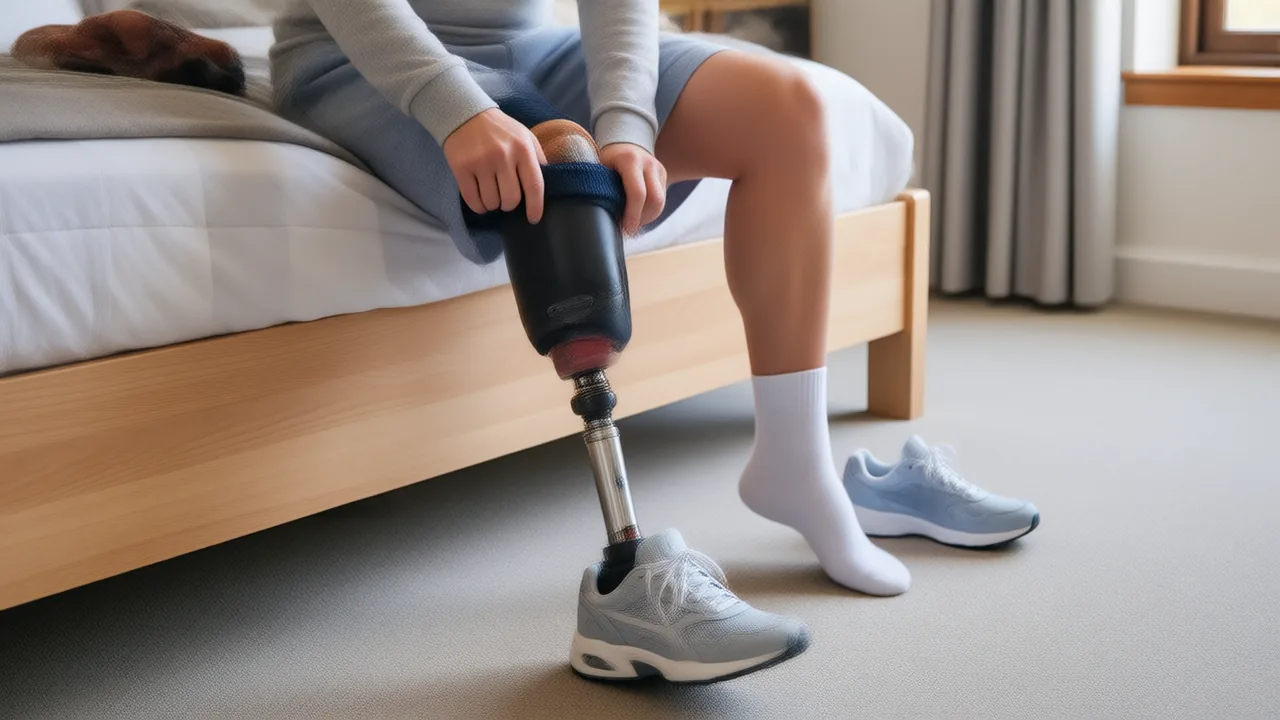
Short answer: Adaptive clothing for amputees is clothing built or modified to go on easily over a prosthesis and not snag, rub or wear through: side zips or magnetic closures instead of fiddly buttons, wider or zip-off pant legs, flat hems and seams, tough stretchy fabric, and shoes that suit a prosthetic foot. Plenty of people wear ordinary clothes with a few smart tweaks instead.
This guide is for leg amputees, and the people who shop for them, working out what to wear now that one leg is made of carbon, metal and foam. It covers what makes clothing adaptive, which fabrics survive a prosthesis, pants and shorts, dresses and tights, getting dressed, shoes, style, and the skin problems clothing can cause. Each section links to a more detailed guide.
The good news: you probably do not need a whole new wardrobe. Most people keep most of their clothes and change a few habits and a few key pieces. The rest is about deciding whether you want the leg hidden, visible, or loud.
What makes clothing adaptive for a leg amputee
The Amputee Coalition’s adaptive clothing resources describe adaptive clothing as including magnetic closures instead of buttons or zippers and flat hems that are less likely to snag. It counts adaptive clothing among the high- and low-tech aids for daily living, and makes a point worth repeating: it should benefit the wearer physically and psychologically. Clothes that are easy to put on but make you feel like you are wearing a hospital gown are not doing their whole job.
For a leg amputee, the features that matter most are:
- Openings in the right places. Side zips, snaps or magnetic closures along the leg let pants go on over the prosthesis, or let you reach the socket without taking the pants off.
- Room where the prosthesis is widest. The socket, the knee (for above-knee legs) and the top of the foot all need space for fabric to slide past.
- Nothing to catch. Flat hems, smooth linings and no loose threads or hooks inside the leg, where a knee joint or foot can grab them.
- Easy fastenings. Pull-on waists, magnets and larger zipper pulls help when you are dressing seated or balancing on one leg.
- Durability. A socket edge or knee joint rubs the same spot every step. Tougher fabric, or a reinforcement patch inside, lasts longer.
You can buy clothing made this way, or get a tailor to add zips, patches or wider legs to clothes you already love. Both count.
Fabrics that work with a prosthesis
Fabric choice affects three things: how easily clothing slides over the leg, how long it lasts, and how your skin feels at the end of a long day.
| What you want | What tends to help |
|---|---|
| Pants that slide over the prosthesis | Smooth or lined fabrics, a bit of stretch, and no rough inner seams |
| Clothes that last | Denser weaves, reinforced knees, and a patch where the socket or knee joint rubs |
| Comfort on the sound leg and residual limb | Soft, breathable fabric that wicks sweat, and flat seams |
| Less snagging on the prosthetic foot | Wider hems, no loose threads, and pulling pants on before the shoe |
Your skin has opinions too. Cleveland Clinic explains that chafing happens where skin rubs repeatedly against skin, fabric or other materials, and that activities that make you sweat a lot raise the risk. Heat is another factor: heat rash forms when sweat gets trapped under the skin and often develops where skin does not get enough airflow, such as areas covered by clothing. With a liner and socket already holding heat on one leg, breathable fabric for the rest of you makes a difference on hot days.
If you are a Veteran whose prosthesis wears out your clothes
The VA recognizes that prostheses damage clothing. According to the VA clothing allowance page, Veterans with a service-connected disability whose prosthetic or orthopedic device damages clothing may get an annual clothing allowance. VA collects applications all year and holds them until the August 1 closing date. You apply with VA Form 10-8678 through the prosthetic representative at your local VA medical center, and more than one allowance may apply if you have more than one device or it affects more than one type of clothing. Check the VA page or your prosthetic representative for your own case, since details can change.
Pants and shorts with a prosthetic leg
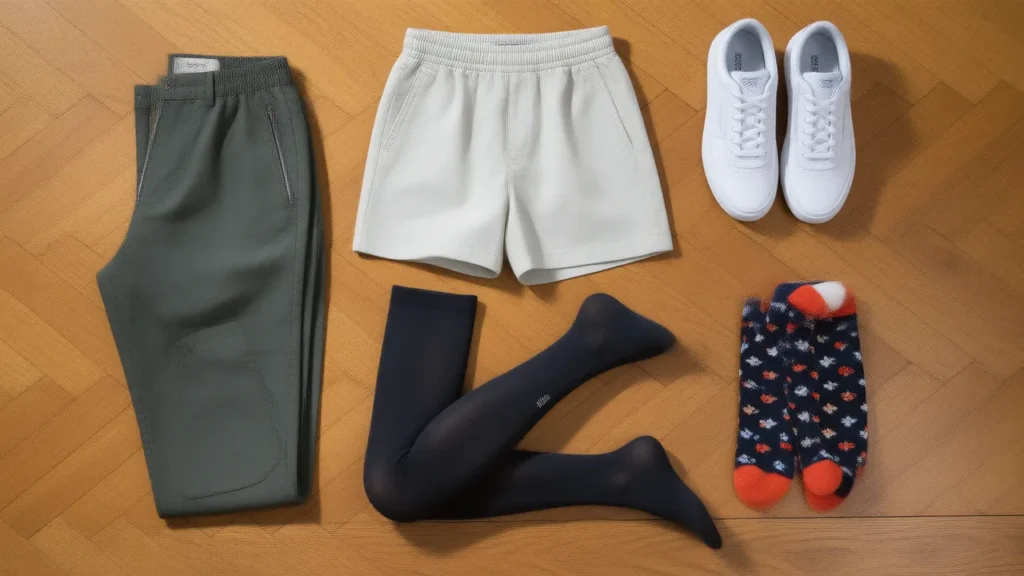
Pants are where most people first notice the prosthesis. The socket and foot are both wider than a natural ankle, so slim-fit or cuffed pants can be a struggle to get on, and an above-knee leg’s knee joint can pinch fabric when it bends.
What helps:
- Straight, relaxed or bootcut legs slide over the foot and socket more easily than skinny styles.
- Side-zip or zip-off legs let you get pants on over the prosthesis and reach the socket or valve without undressing.
- An inner patch where the socket edge or knee joint rubs slows down wear.
- The right length for the shoe you wear most, since the prosthetic side may need hemming to match.
Our guide to pants for prosthetic legs goes deeper on cuts, fabrics and alterations that work, including for above-knee legs.
Shorts are simpler in one way and bigger in another: they are easy to put on, and they show the leg. Some people love that; some need time. Hem length matters, because a hem that sits right at the top of the socket can rub, and a leg opening that is too tight can catch on the socket edge. Wearing shorts with a prosthetic leg covers lengths, fabrics and the confidence side of it.
If you don’t wear a prosthesis: the empty pant leg and the shoe
Not everyone with a leg amputation wears a prosthesis. The Atlas of Limb Prosthetics (American Academy of Orthopaedic Surgeons, 2nd edition, reproduced by the O&P Virtual Library) notes that even people who wear one do some things, such as bathing and putting on underwear, without it, and that some people decide not to go ahead with a prosthesis at all. Two clothing points apply (checked October 21, 2026):
- The empty pant leg. A tailor can alter pants you already own on the amputated side. The Association of Sewing and Design Professionals, listed in the Amputee Coalition’s adaptive clothing resources, runs a Sewing Pro Directory that can be searched by location and by specialty, including alterations.
- The shoe on your sound foot. For walking with crutches, the Atlas advises a low-heeled shoe with laces or a strap fastening high on the top of the foot, so the shoe does not slip off when you swing the leg.
Your physical or occupational therapist can show you dressing methods that suit your own situation.
Dresses, skirts and tights
Dresses and skirts are among the easiest things to put on over a prosthesis, since nothing has to slide down the leg. The questions are length, how much of the leg you want to show, and what to do about hosiery.
- Length. A hem that falls at or just below the knee shows the pylon and foot; a midi or maxi covers most of it. Neither is right or wrong.
- Movement. A skirt with some flare or a slit makes stairs and big steps easier than a tight pencil cut.
- Sitting. An above-knee leg sits differently from a natural one, so check how a dress falls when you sit before you buy.
Dresses with a prosthetic leg covers cuts and styling in more detail.
Tights are the tricky part. Some people wear ordinary tights over both the sound leg and the prosthesis; some cut off one leg of the tights; some wear a single stocking on the sound leg only. Prosthetic feet and knee joints can snag or ladder thin tights, so thicker opaque tights usually last longer. See tights with a prosthetic leg for methods and the snag-avoiding tricks.
Getting dressed with a prosthetic leg
A little order makes dressing much easier, especially early on.
- Sit down. Dressing on one leg is a fall waiting to happen. Use a sturdy chair or the edge of the bed.
- Decide leg on or leg off. Some people put pants on before the prosthesis and pull the leg through; others put the leg on first and dress over it. Try both and use whichever is easier with your socket and suspension.
- Pants over the prosthetic foot before the shoe. Feed the pant leg over the foot first, then put the shoe on.
- Keep reachers and aids handy if bending is hard. An occupational therapist can suggest tools and techniques for your situation.
Our step-by-step guide to dressing with a prosthetic leg covers both methods, above-knee legs, and dressing when you are tired or in a hurry.
Shoes for prosthetic feet
Shoes matter more with a prosthesis than almost any other clothing choice, because the leg is aligned for a certain heel height. Switch to a much higher or flatter shoe and the whole leg can feel wrong, even if the socket fits perfectly. When you buy new everyday shoes, keep the heel height close to what your prosthetist set the leg up for, or ask before you change it.
Other things to look for: a wide opening, a removable insole, a firm heel counter, and fastenings like laces with elastic or a zip that make the shoe easy to get onto a foot you cannot flex. Our guide to shoes for prosthetic feet (coming soon) explains what to look for, getting shoes on and off, and how to protect the foot shell.
Buying a pair when you need one shoe gets expensive. The Amputee Coalition’s shoe exchange list notes that the National Odd Shoe Exchange accepts matched pairs, mismatched pairs, singles and bulk footwear, that OddShoeFinder.com lets amputees buy, sell or give away single shoes or mismatched pairs, and that some retailers sell single or mismatched shoes, sometimes at a discount. Single shoes for amputees (coming soon) covers those options and more.
Heels are possible for some people, with the right foot. Some prosthetic feet can be adjusted for different heel heights; others are set for one. Talk to your prosthetist before your first pair, and read high heels with a prosthetic leg for what to ask.
Socks, covers and how loud you want to be
Clothing is not only about getting dressed. It is also about how you want the world to see you, and that is your call every morning.
Some people want the leg to disappear under long pants. Some wear shorts and let the pylon show. Some want it seen from across the parking lot. If you are in that last group, two small things go a long way: printed crew socks for the sound foot, and, if you wear a below-knee leg, a printed stretch cover. Covers like ours are worn on the outside of a below-knee prosthesis, over everything else, never inside the socket or under a suspension sleeve and never over a knee joint, so they are not for above-knee legs. They are sized by measuring your leg. If you would rather say it in words, there are funny amputee shirts too.
For more ideas, from paint and fabric wraps to custom shells, see prosthetic leg cover ideas, and for every way to style the leg, from socket art to tattoos, cool prosthetic leg designs. If you are shopping for someone else, gifts for amputees has ideas that are useful without being awkward.
When clothing becomes a skin problem
Clothes can cause trouble where they meet the top of the socket, the edge of a liner or a suspension sleeve, or the sound leg that is doing extra work. Watch for the signs Cleveland Clinic lists for chafing: redness, irritation, itching, raised bumps and a stinging or burning feeling.
- Change what is rubbing: a different hem length, softer fabric, flatter seams or looser leg openings.
- Keep skin dry: breathable fabrics and a chance to air out on hot days.
- Tell your prosthetist if the rubbing is at the socket or sleeve edge, since the trim line may need adjusting.
Stop wearing the prosthesis and call your doctor if the skin breaks open, blisters, bleeds, oozes, or develops redness that spreads or feels warm, or if you have a fever. If you have diabetes or poor circulation, check your sound foot every day as well, because tight socks and new shoes can cause sores you might not feel.
Your adaptive clothing checklist
Before you buy, or before you hand something to a tailor, run through this:
- Can it go on over the prosthetic foot and socket, or open at the side?
- Is there anything inside the leg that could catch on a foot or knee joint?
- Will the fabric survive a socket edge rubbing it all day, or can it take a patch?
- Is it breathable enough for a hot day with a liner on?
- Do the shoes match the heel height your leg is set for?
- Can you put it on sitting down?
- Do you like how you look in it?
That last question is not optional. The best adaptive clothing is the kind you actually want to wear.
Sources
- Amputee Coalition — Adaptive Clothing Resources
- Cleveland Clinic — Chafing: Causes, Treatment & Prevention
- Cleveland Clinic — Heat Rash (Prickly Heat): Symptoms & Treatment
- U.S. Department of Veterans Affairs — VA Clothing Allowance
- Amputee Coalition — Shoe Exchanges
- Atlas of Limb Prosthetics (AAOS), Chapter 30: Rehabilitation Without Prostheses — O&P Virtual Library
- Association of Sewing and Design Professionals — Sewing Pro Directory
From the Loud Limb shop: printed athletic shorts and amputee tees & hoodies.
Published by Loud Limb, a shop for printed prosthetic leg covers, socks and clothing.